
AR-15 Calibers: The Best Proven Guide for New Owners
So you bought your first AR-15 — or you’re about to. One of the first questions every new owner asks is what caliber is an AR-15, and the answer surprises people: it isn’t just one. The AR-15 platform runs a whole family of AR-15 calibers, and swapping between most of them takes nothing more than a new barrel or upper.
This guide covers every caliber worth knowing, which one you should actually start with, and — most importantly — which ammo to buy once you’ve decided.
The Short Answer
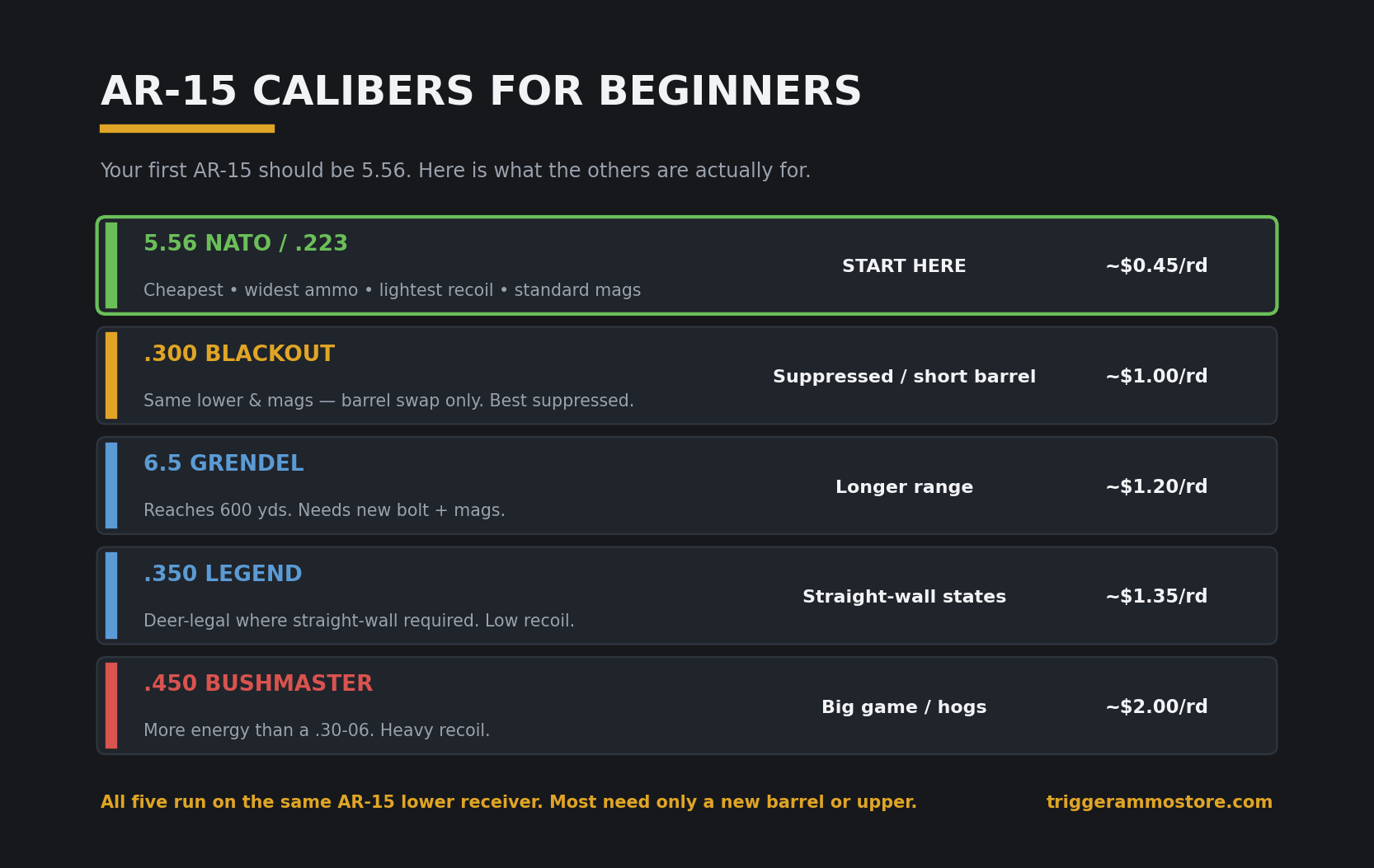
If this is your first AR-15, buy 5.56 NATO. It’s the cheapest to shoot, has the widest ammo selection, the mildest recoil, and every accessory on earth is built for it. Master it, then branch out.
Everything else on this list is a specialist tool that solves a specific problem.
Which Is the Best AR-15 Caliber for a Beginner?
5.56 NATO / .223 Remington — Start Here
The default, and rightly so. It’s the most common of all AR-15 calibers, the cheapest to feed (roughly $0.45 per round in bulk), and the lightest-recoiling. There is more ammo, more rifles, and more parts for 5.56 than for every other AR caliber combined.
5.56 vs .223 — the one thing you MUST know
These look identical and fit the same magazines, but they are not freely interchangeable:
- ✅ .223 Remington is safe in a 5.56 chamber.
- ❌ 5.56 NATO should NOT be fired in a .223-only chamber.
5.56 runs at higher pressure and needs a longer chamber throat. Firing it in a tight .223 chamber can spike pressure to dangerous levels. Check your barrel markings — they’ll say “5.56 NATO,” “.223 Rem,” or “.223 Wylde” (a hybrid that safely shoots both). See our full 5.56 vs .223 guide.
.300 Blackout — Suppressed and Short Barrels
The most popular second caliber for AR-15 owners, and for good reason: it uses the same lower receiver and the same magazines as 5.56. You only change the barrel.
It’s built for short barrels (full power from just 9″) and it’s the best suppressed AR caliber there is. Costs roughly double 5.56 to shoot.
⚠️ Critical safety warning. Because .300 Blackout shares magazines with 5.56, a .300 BLK round can chamber and fire in a 5.56 barrel — destroying the rifle. Label your magazines. Never mix them.
6.5 Grendel — Longer Range
When you want more reach than 5.56 from an AR-15, this is the answer — effective to around 600 yards with far more energy downrange. Requires a new bolt and magazines as well as a barrel.
.350 Legend — Straight-Wall States
If you hunt deer in Ohio, Michigan, Indiana, or Iowa, straight-wall cartridge rules may apply. The .350 Legend is the softest-shooting legal option — a big bullet with very mild recoil, effective to about 200 yards.
.450 Bushmaster — Maximum Power
The hammer. Over 2,500 ft-lbs of muzzle energy — more than a .30-06 — from a standard AR-15 lower. Superb on big hogs and bears inside 200 yards. Heavy recoil, expensive ammo, dedicated bolt and mags.
AR-15 Caliber Conversion: Changing Calibers Is Easy
This is the platform’s superpower and the thing new owners most often don’t realize.
An AR-15 caliber conversion usually means buying a complete upper receiver and swapping it onto the lower you already own — a 5-second, tool-free job. Your lower, trigger, and stock stay the same.
- .300 Blackout — barrel only. Same bolt, same mags. Easiest conversion.
- 6.5 Grendel, .350 Legend, .450 Bushmaster — need a dedicated bolt and magazines too.
That means one lower can become several rifles. It’s the cheapest way to try a new caliber.
AR-15 Barrel Length and Twist Rate
Two specs that confuse every new owner:
Barrel length. 5.56 wants a longer barrel (16–20″) to reach full velocity — it bleeds speed badly when short. .300 Blackout is the opposite: it hits near-full power from a 9″ barrel, which is exactly why it dominates short and suppressed builds.
Twist rate. Written as 1:7, 1:8, or 1:9 — how far the bullet travels per full rotation. A faster twist (1:7 or 1:8) stabilizes heavier bullets. Most modern AR-15s ship 1:7 or 1:8, which handles the full range of 5.56 bullet weights. If your barrel is 1:9, stick to lighter 55-grain loads.
How Much Does AR-15 Ammo Cost?
| Caliber | Approx. cost per round |
|---|---|
| 5.56 NATO / .223 | ~$0.35–0.55 |
| .300 Blackout | ~$0.75–1.50 |
| 6.5 Grendel | ~$1.20 |
| .350 Legend | ~$1.35 |
| .450 Bushmaster | ~$2.00+ |
This table is the real argument for starting with 5.56. You’ll shoot two to four times as much for the same money — and trigger time, not caliber, is what makes you a better shooter.
Which Ammo Should You Actually Buy?
The best ammo for your AR-15 depends entirely on the job. This matters more than the caliber.
| Purpose | Buy |
|---|---|
| Range / practice | 55 gr FMJ — cheap, buy in bulk |
| Home defense | Expanding/fragmenting defensive loads — never FMJ |
| Hunting | Bonded or expanding hunting bullets — never FMJ |
| Competition | 69–77 gr match (needs 1:7 or 1:8 twist) |
The number-one beginner mistake: using cheap bulk FMJ for defense or hunting. It’s built for volume practice, not terminal performance.
What Will You Use It For?
- AR-15 for home defense → 5.56 with quality defensive loads, or .300 Blackout if you’re running a short suppressed build.
- AR-15 for deer hunting → .350 Legend (straight-wall states), 6.5 Grendel, or .450 Bushmaster. Check your state’s rules — some don’t allow 5.56 for deer.
- Range and plinking → 5.56, every time. Cheapest trigger time available.
- Long range → 6.5 Grendel.
The Verdict for Your First AR-15
Buy a 5.56 NATO (or .223 Wylde) with a 16″ barrel and a 1:7 or 1:8 twist. It’s the cheapest, most versatile, best-supported configuration in existence, and it does everything a new owner needs.
Shoot it a lot. Once you know what you actually want — quieter, farther, harder-hitting — add an upper in the caliber that solves that problem. Your lower will be waiting.
Shop AR-15 Ammo
Whichever caliber you run, we’ve got you covered. Browse 5.56 NATO ammo, .223 Remington ammo, .300 Blackout ammo, 6.5 Grendel ammo, and .350 Legend ammo — from bulk range loads to defensive and hunting ammunition.
Please buy and use ammunition responsibly and in accordance with all federal, state and local laws. Always confirm your barrel’s chamber markings before selecting ammunition, and never mix .300 Blackout with 5.56. Hunting caliber regulations vary by state. You must meet all legal requirements to purchase, and ammunition cannot be shipped to every jurisdiction.
Frequently Asked Questions
What caliber is an AR-15? Most commonly 5.56 NATO or .223 Remington, but the platform also runs .300 Blackout, 6.5 Grendel, .350 Legend, .450 Bushmaster and more. Check your barrel markings to confirm yours.
What is the best AR-15 caliber for a beginner? 5.56 NATO. It’s the cheapest, has the widest ammo and parts selection, and the mildest recoil.
Can I shoot .223 in a 5.56 AR-15? Yes — that direction is safe. But never fire 5.56 in a .223-only chamber; the pressure can be dangerous.
How do I change my AR-15’s caliber? Buy a complete upper receiver in the new caliber and swap it onto your existing lower — no tools needed. Some calibers also require a new bolt and magazines.
How much does AR-15 ammo cost? Roughly $0.35–0.55 per round for bulk 5.56/.223. Specialty calibers like .300 Blackout and .450 Bushmaster cost two to five times more.
What ammo should I use for home defense? Purpose-built expanding or fragmenting defensive loads — never bulk FMJ, which penetrates more and doesn’t expand.
What barrel twist rate do I need? 1:7 or 1:8 handles the full range of 5.56 bullet weights. 1:9 is fine for lighter 55-grain loads only.
For official ammunition safety standards and cartridge specifications, visit
SAAMI (Sporting Arms and Ammunition Manufacturers’ Institute)
.
For hunting regulations, wildlife conservation, and federal hunting information, see the
U.S. Fish & Wildlife Service
.
For firearm safety resources, shooting sports education, and industry information, visit the
National Shooting Sports Foundation (NSSF)
.
For public land hunting information and outdoor recreation resources, visit the
Bureau of Land Management
.
