
9mm vs .45 ACP: The Best Proven Guide for 2026
The 9mm vs .45 ACP debate has raged in gun shops for over a century. One side says the .45 has “stopping power.” The other says the 9mm is the modern answer. Most of the argument is opinion.
Here’s the thing: the FBI already settled it — in 2015. After decades of experimenting with 10mm and .40 S&W, the Bureau went back to the 9mm. This guide explains why, using the actual ballistic data, and then tells you the part that matters far more than caliber: which ammo to actually buy.
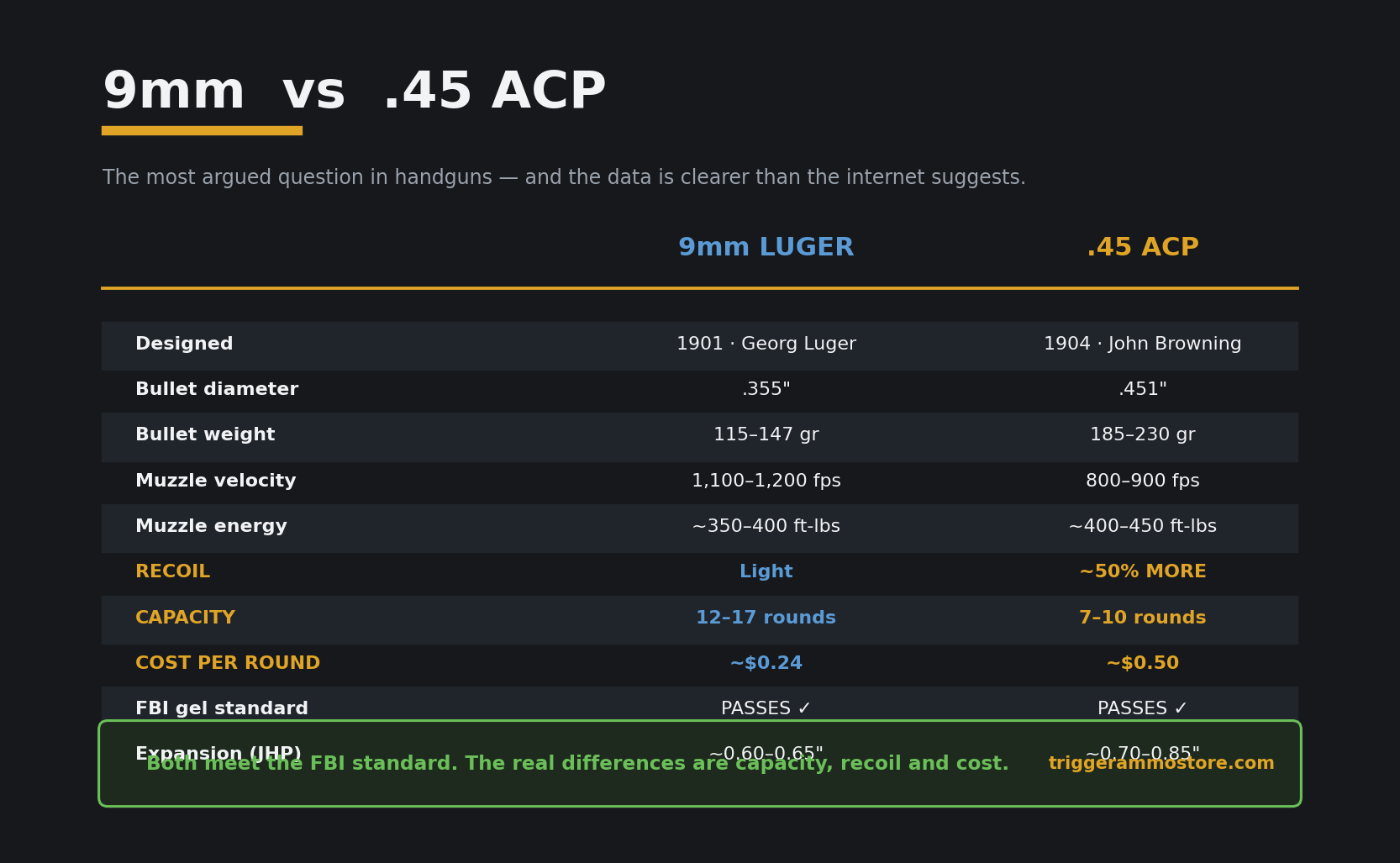
Where They Came From
The .45 ACP (1904). Designed by John Browning and adopted alongside the legendary Colt M1911, the .45 ACP was America’s service cartridge through both World Wars. Big, slow, heavy — a large-diameter bullet built to hit hard at close range. It carries genuine historical weight, and a devoted following to match.
The 9mm Luger (1901). Designed by Georg Luger as the 9x19mm Parabellum, it went the opposite way: a lighter, faster bullet that let a pistol hold far more rounds. It became the world’s most widely used handgun cartridge.
Two different philosophies: big and slow versus small and fast. For a century, nobody could prove which was better.
The Big One: “Stopping Power” Is a Myth
Let’s kill this first, because it drives most of the 9mm vs .45 ACP argument.
There is no meaningful ballistic advantage of .45 ACP over 9mm. That isn’t an opinion — it’s the conclusion of forensic pathology. Dr. Vincent Di Maio, author of the standard forensic text Gunshot Wounds, states there is no appreciable difference in the effectiveness of the 9mm and .45 ACP cartridges.
“Stopping power” isn’t a measurable property of a cartridge. What actually stops a threat is where the bullet lands and how deep it goes. Handgun rounds — all of them — are relatively weak compared to rifles. None of them reliably drop a person from energy alone.
Shot placement beats caliber. Every time. That’s not a cop-out; it’s the whole finding.
The FBI Standard: What Actually Matters
Forget muzzle energy. The professional benchmark is the FBI ballistic gel protocol, established after the 1986 Miami shootout.
Ammunition is fired into calibrated 10% ballistic gelatin through six barriers — bare gel, heavy clothing, sheet steel, wallboard, plywood, and auto glass. The requirement:
✅ 12 to 18 inches of penetration.
- Under 12″ → may not reach vital organs.
- Over 18″ → over-penetrates, risking whatever is behind the target.
-
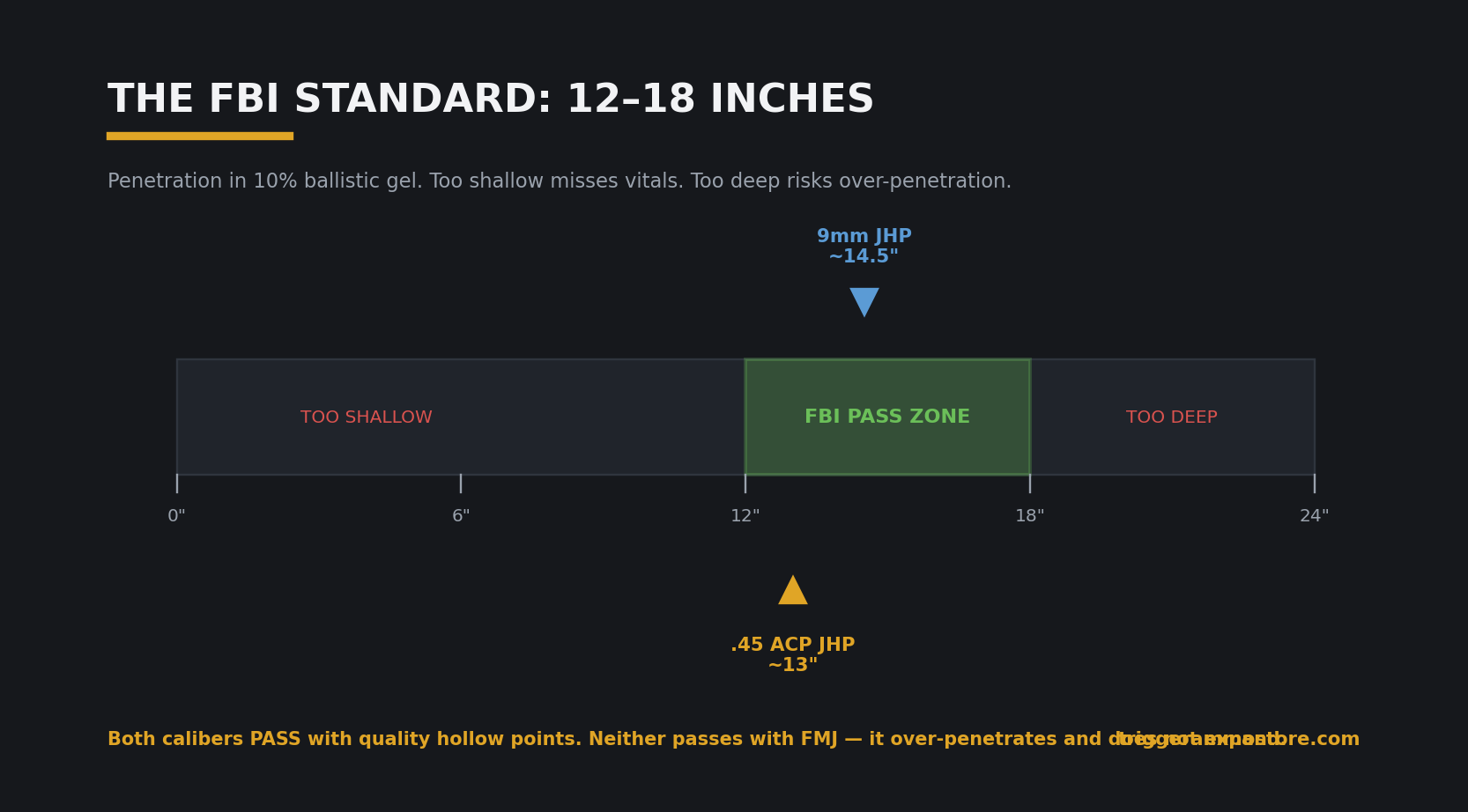
FBI ballistic gel standard 12 to 18 inches penetration for 9mm and .45 ACP
The result: with quality jacketed hollow points, both 9mm and .45 ACP pass. Both reliably land in that 12–18″ window. Both expand. Both work.
Expansion is the one place the .45 keeps a real edge: a premium .45 JHP opens to roughly 0.70–0.85″, versus about 0.60–0.65″ for 9mm. That’s a genuinely bigger wound channel, and it’s fair to acknowledge.
But here’s the question that decides it: is that extra fraction of an inch worth what it costs you?
Where They Actually Differ
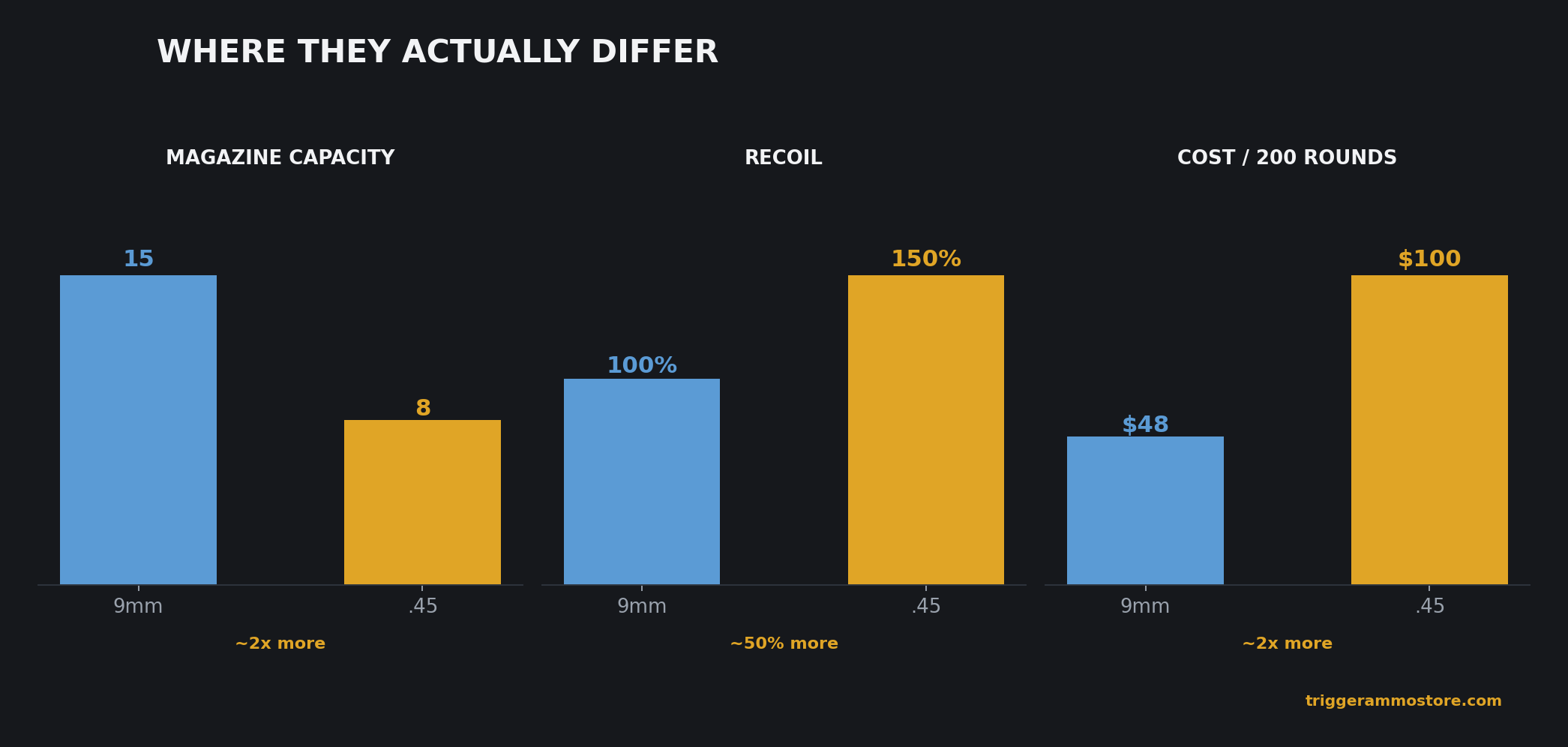
1. Capacity — roughly double
Most 9mm carry pistols hold 12–17 rounds. Most .45 ACP pistols hold 7–10.
In a defensive encounter, more rounds means more margin for error. This is the single biggest reason law enforcement went 9mm nationwide.
2. Recoil — the .45 kicks about 50% harder
The .45 ACP generates roughly 50% more free recoil than a 9mm from a comparable pistol.
And recoil isn’t a comfort issue — it’s an accuracy issue. Less recoil means:
- Faster, more accurate follow-up shots
- Less flinch under stress
- Less fatigue over a long practice session
- An easier learning curve for new shooters
Compact .45 pistols are especially snappy. A big steel 1911 tames it well; a small polymer .45 does not.
3. Cost — the 9mm is about half the price
- 9mm: roughly $0.24 per round in bulk
- .45 ACP: roughly $0.50 per round
A 200-round range session costs about $48 in 9mm and $100 in .45.
This matters more than people admit. Cheaper ammo means more practice. More practice means better shot placement. And shot placement — as we established — is the thing that actually works.
Where the .45 ACP genuinely wins
Being fair:
- ~30% more momentum → better penetration through intermediate barriers
- Larger expanded diameter (~0.85″ vs ~0.65″)
- Naturally subsonic → an excellent suppressed cartridge
- Big-frame recoil impulse — a slow push rather than a sharp snap, which many experienced shooters genuinely prefer
- The 1911. It’s a wonderful pistol, and that’s a legitimate reason to choose a caliber.
The Thing That Matters More Than Caliber: Your Ammo
Here’s the part most 9mm vs .45 ACP articles skip — and it’s the part that will actually keep you alive.
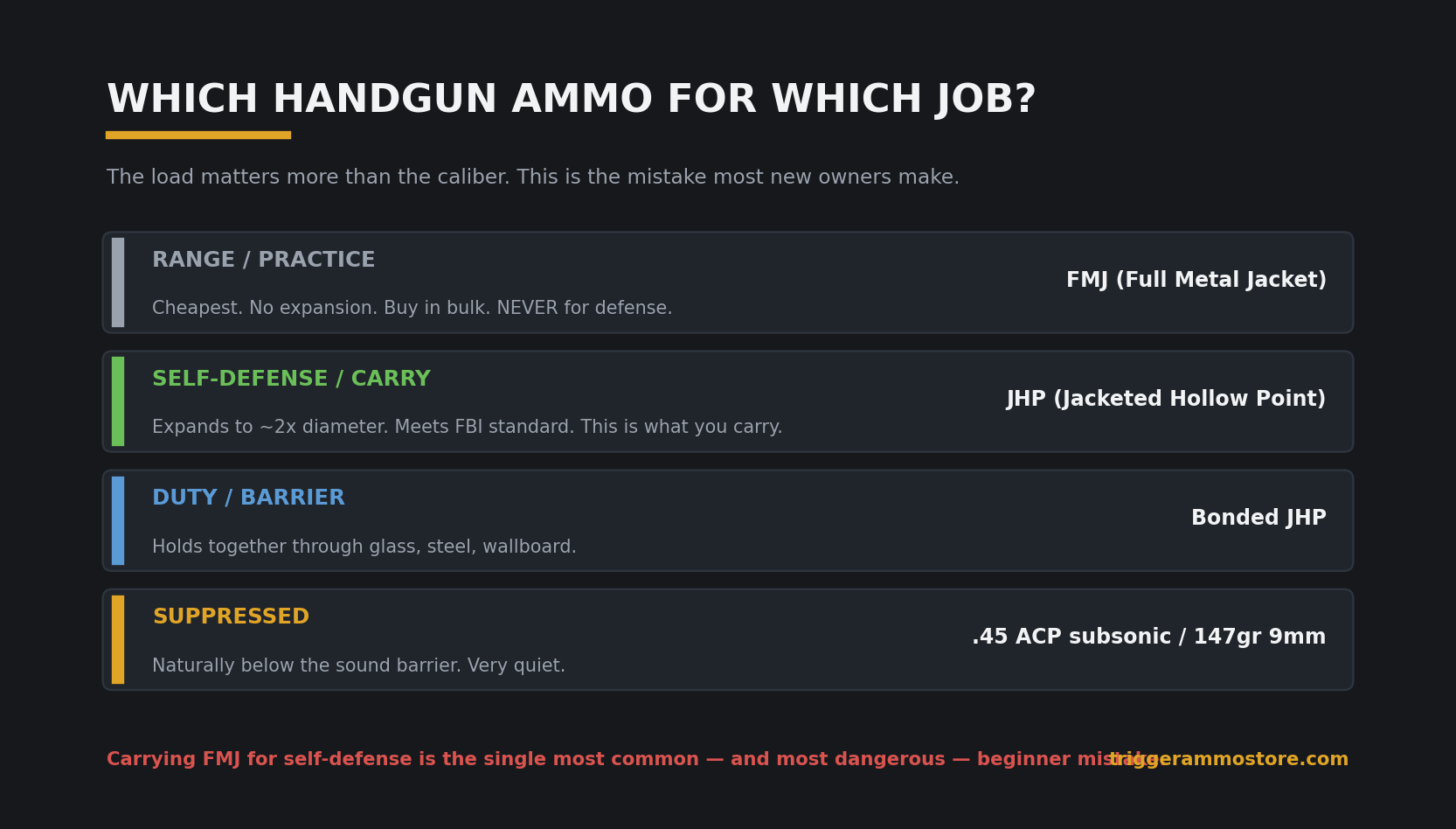
Hollow point vs FMJ — know the difference
FMJ (Full Metal Jacket) — a solid, jacketed bullet. It does not expand. It’s cheap, it feeds reliably, and it’s built for one job: practice.
JHP (Jacketed Hollow Point) — engineered to expand to roughly twice its diameter on impact. That’s what creates an effective wound channel and what prevents dangerous over-penetration through walls.
⚠️ The most dangerous beginner mistake
Carrying FMJ for self-defense.
Bulk range ammo is cheap because it’s built for volume, not terminal performance. FMJ:
- Doesn’t expand → a smaller wound channel
- Over-penetrates → sails through a threat and the wall behind them
A quality JHP in 9mm beats a cheap FMJ in .45 ACP, every single time. The load matters more than the caliber. Read that twice.
What to buy
| Purpose | Buy |
|---|---|
| Range / practice | FMJ — in bulk, in whichever caliber you shoot |
| Self-defense / carry | Premium JHP (Federal HST, Speer Gold Dot, Hornady Critical Duty) |
| Duty / barriers | Bonded JHP |
| Suppressed | .45 ACP (naturally subsonic) or 147gr 9mm subsonic |
Practice with FMJ. Carry JHP. Confirm your carry load feeds reliably in your pistol — run at least 100–200 rounds of it before you trust it.
So Which Should You Choose?
Choose 9mm if you:
- Want more rounds in the magazine (12–17 vs 7–10)
- Want lighter recoil and faster follow-up shots
- Are newer to handguns, or recoil-sensitive
- Want to shoot more for the same money — half the cost per round
- Want the widest selection of pistols and defensive loads on earth
- Want what the FBI, and most US law enforcement, actually carry
Choose .45 ACP if you:
- Prefer the big, slow push over a sharp snap
- Want maximum expanded diameter and barrier momentum
- Shoot suppressed (it’s naturally subsonic)
- Love the 1911 — an entirely valid reason
- Shoot it well and accept the capacity and cost trade-offs
The Honest Verdict
For most shooters, the 9mm is the better choice — and the FBI’s 2015 reversal is the strongest evidence you’ll find. After chasing bigger calibers for decades, the Bureau concluded that 9mm with modern hollow points offers the best combination of terminal performance, shootability, and capacity. If it’s good enough for the FBI’s Hostage Rescue Team, it’s good enough for your nightstand.
That said: the .45 ACP is not obsolete, and anyone who tells you it is doesn’t understand the data either. Both cartridges pass the FBI standard. Both will do the job with quality ammunition.
The right answer is the caliber you shoot well and practice with often. If that’s a 1911 in .45 that you love and shoot constantly, that beats a 9mm sitting unused in a safe.
Pick the one you’ll train with. Then buy good ammo for it.
Shop 9mm and .45 ACP Ammo
Whichever you carry, feed it right. Browse our full range of 9mm ammo and .45 ACP ammo — bulk FMJ for high-volume practice, and premium jacketed hollow points built to meet defensive standards.
Please buy and use ammunition responsibly and in accordance with all federal, state and local laws. Always test a new defensive load for reliable feeding in your specific firearm before carrying it. This article is general information, not legal or tactical advice. You must meet all legal requirements to purchase, and ammunition cannot be shipped to every jurisdiction — check your local regulations before ordering.
Frequently Asked Questions
Is 9mm or .45 ACP better for self-defense? Both pass the FBI ballistic gel standard with quality hollow points. The 9mm offers roughly double the capacity, about half the recoil, and half the cost — which is why the FBI and most US law enforcement carry it. The .45 ACP expands larger. For most shooters, the 9mm is the better practical choice.
Does .45 ACP have more stopping power than 9mm? No. Forensic pathology finds no appreciable difference in effectiveness between the two. “Stopping power” isn’t a measurable cartridge property — shot placement and penetration depth are what matter.
Why did the FBI switch back to 9mm? In 2015, after years with 10mm and .40 S&W, the FBI concluded that modern 9mm hollow points delivered equivalent terminal performance with better shootability and higher capacity.
What’s the difference between hollow point and FMJ? FMJ doesn’t expand — it’s cheap practice ammo that over-penetrates. JHP expands to roughly twice its diameter, creating an effective wound channel while reducing over-penetration. Practice with FMJ; carry JHP.
How much does 9mm ammo cost vs .45 ACP? Roughly $0.24 per round for bulk 9mm versus about $0.50 for .45 ACP — the 9mm is about half the price, so you can practice twice as much.
How many rounds does each hold? Most 9mm carry pistols hold 12–17 rounds; most .45 ACP pistols hold 7–10.
Is .45 ACP good for suppressors? Yes — it’s naturally subsonic, making it one of the best suppressed handgun cartridges. In 9mm, use 147-grain subsonic loads.
Which has less recoil? The 9mm, by a wide margin — the .45 ACP generates roughly 50% more free recoil.
For firearm safety resources, shooting sports education, and industry information, visit the
National Shooting Sports Foundation (NSSF)
.
For public land hunting information and outdoor recreation resources, visit the
Bureau of Land Management
.
