.308 Winchester Explained: The Best Proven Guide to America’s All-Rounder
The .308 Winchester has been in production since 1952, and it’s still one of the best-selling rifle cartridges in the world. Newer rounds beat it on paper — flatter, faster, less recoil. And yet the .308 endures. This guide explains why: what it actually does, where it excels, where it doesn’t, and which load to buy for your particular job.
What Is the .308 Winchester?
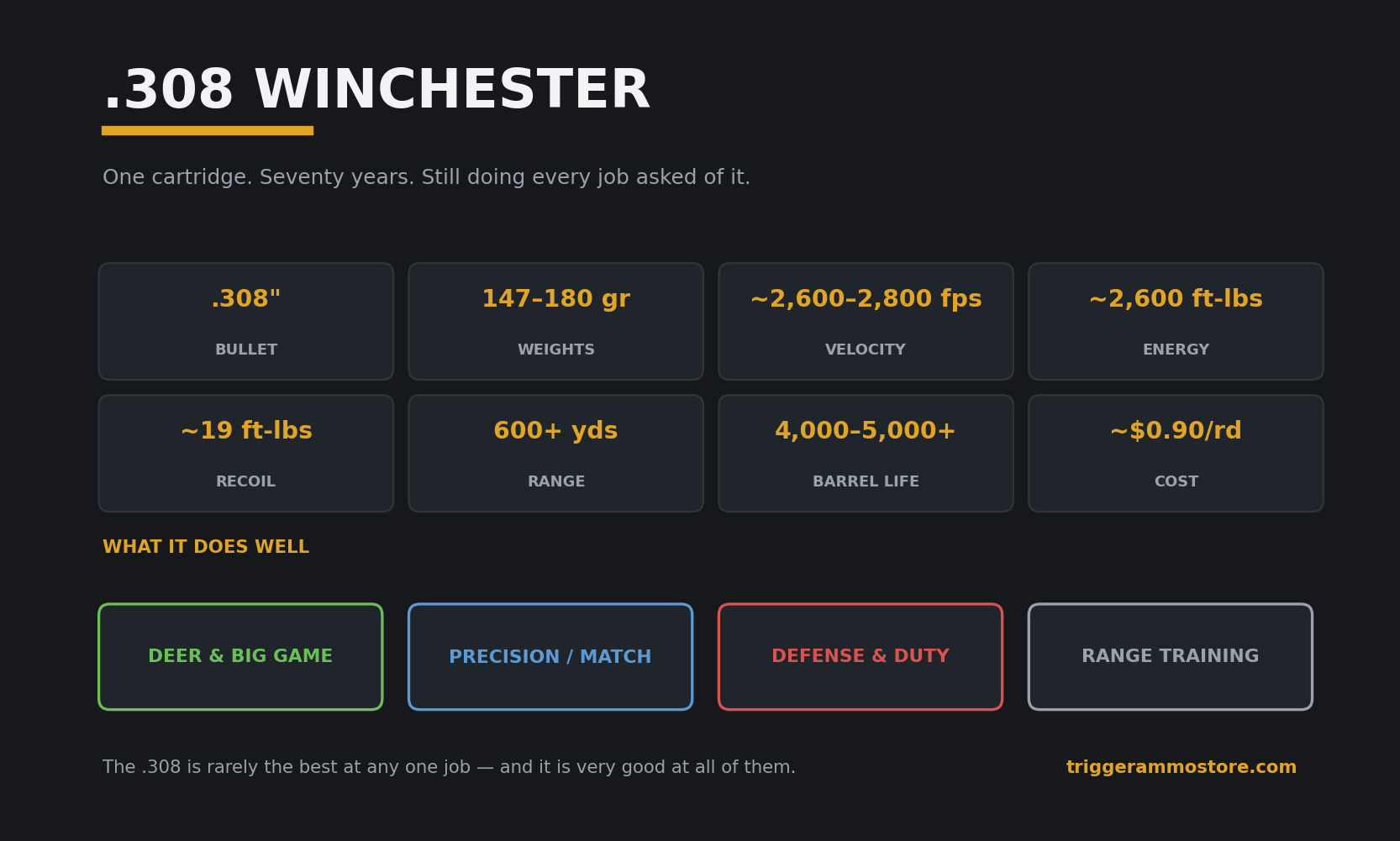
The .308 Winchester is a short-action centerfire rifle cartridge firing a .308-inch bullet, typically 147–180 grains. It was born from a post-WWII military requirement: deliver .30-06 performance in a shorter case that would cycle reliably in semi-automatic actions.
The military version became the 7.62x51mm NATO, standardized in 1954. Winchester, seeing what was coming, beat the Army to market and released it commercially as the .308 Winchester in 1952.
That short case is the entire trick. It fits a short action — meaning lighter, shorter, faster-cycling, cheaper rifles — while still delivering serious .30-caliber power.
.308 Winchester Ballistics
| Spec | Typical value |
|---|---|
| Bullet diameter | .308″ |
| Common weights | 147–180 gr |
| Muzzle velocity | ~2,600–2,800 fps |
| Muzzle energy | ~2,600 ft-lbs |
| Recoil | ~19 ft-lbs (moderate) |
| Effective range | 600+ yards |
| Barrel life | 4,000–5,000+ rounds |
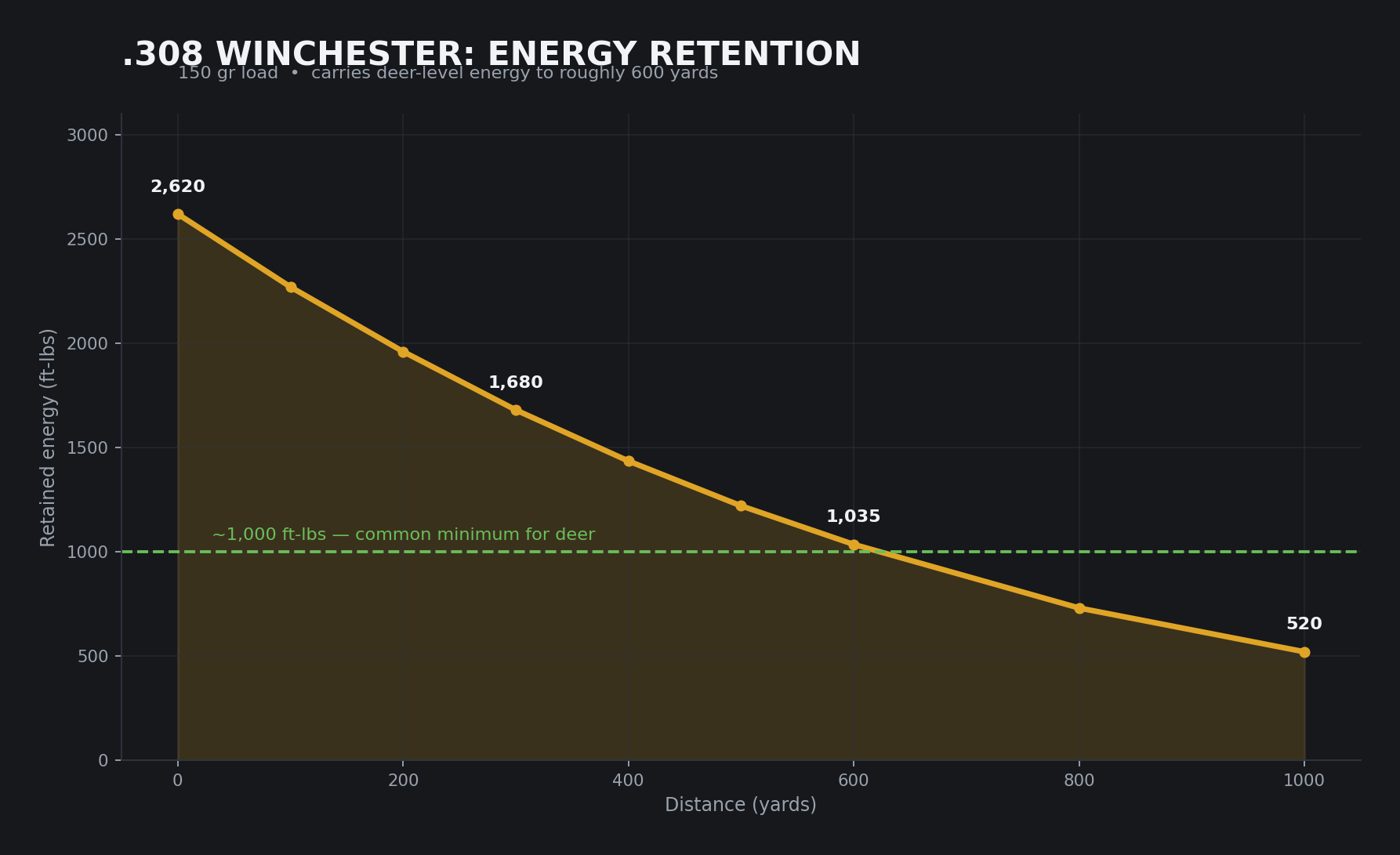
What the numbers mean. The .308 leaves the muzzle with around 2,600 ft-lbs and still carries roughly 1,000 ft-lbs — the common minimum for deer — out to about 600 yards. It isn’t the flattest-shooting cartridge, but it hits hard where most people actually shoot.
Barrel life is the quiet advantage. The .308’s modest pressure is gentle on throats. Expect 4,000–5,000+ rounds of accurate life — roughly double a 6.5 Creedmoor and several times a magnum. For a high-volume shooter, that’s real money.
Bullet Weights: What to Actually Buy
This is where most people get it wrong, and it matters more than the rifle.
- 147–150 gr — faster, flatter, less recoil. FMJ for range training (never for hunting). Expanding 150s are a solid deer load.
- 165–168 gr — the do-everything sweet spot. Best balance of trajectory and energy. If you’re unsure, start here.
- 175–180 gr — more energy, deeper penetration, better wind resistance. Best for larger game and long-range match work.
Matching the load to the job
| Job | Buy |
|---|---|
| Range / training | 147–150 gr FMJ (cheap, bulk) |
| Deer / medium game | 150–165 gr soft point or polymer tip |
| Elk / large game | 165–180 gr bonded or partition |
| Precision / match | 168–175 gr HPBT match |
| Defense / duty | 150–168 gr expanding — never FMJ |
The single most common mistake: buying bulk FMJ and hunting with it. FMJ is built for volume practice, not terminal performance — it won’t expand reliably and can wound rather than harvest cleanly. Train with FMJ. Hunt with expanding bullets.
.308 Winchester vs 7.62×51 NATO
They look identical and get used interchangeably in conversation. They are not the same specification.
- .308 Winchester — SAAMI commercial spec, generally higher pressure (~62,000 psi).
- 7.62×51 NATO — military spec, typically milder, with a longer chamber throat and thicker case walls.
The practical rule: most modern .308 rifles safely handle both, and surplus 7.62 NATO in a .308 chamber is generally fine. The riskier direction is commercial .308 in an older or looser 7.62 NATO chamber, where higher pressure can create headspace problems.
Always check your barrel markings and manufacturer guidance. If your rifle is marked “7.62 NATO” only, don’t assume commercial .308 is safe without confirming.
What Is the .308 Winchester Good For?
Hunting. One of the most proven deer cartridges in America, and capable on elk, bear, and moose with the right bullet. Moderate recoil, ammo on every shelf, and enough power for essentially any North American game at sensible ranges.
Precision and match shooting. Long the standard for military and police marksmen, and still a mainstay of match competition. Newer cartridges beat it ballistically, but the .308 remains extremely accurate and dirt cheap to practice with.
Range and training. Cheap FMJ plus long barrel life makes it one of the more affordable serious rifle cartridges to shoot in volume.
Defense and duty. Widely used by law enforcement in designated-marksman roles with expanding, barrier-tested loads.
Where the .308 Falls Short
An honest cartridge guide has to say this. Compared to a 6.5 Creedmoor, the .308:
- Drops more and drifts more at long range (lower BC bullets)
- Kicks harder (~19 vs ~13 ft-lbs)
Past 500 yards, a 6.5 Creedmoor is the better long-range tool. Inside 500, and on bigger animals, the .308 hits harder and costs less. (We compare them fully in our .308 vs 6.5 Creedmoor guide.)
So Why Does It Endure?
Because “second best at everything” is an enormously useful thing to be.
The .308 is rarely the optimal answer — but it’s a very good answer to almost every question. Add the widest ammo and rifle selection on earth, low cost, and outstanding barrel life, and you get a cartridge that has quietly outlived a dozen “.308 killers.” Specifications from SAAMI and load data from Hornady confirm what shooters have known for seventy years: it just works.
Looking for a rifle? See our full guide to .308 Winchester rifles — bolt-action, AR-10, and battle-rifle platforms compared.
Shop .308 Winchester Ammo
Browse our full range of .308 Winchester ammo — bulk FMJ for training, expanding soft points and bonded bullets for hunting, and match-grade HPBT for precision.
Please buy and use ammunition responsibly and in accordance with all federal, state and local laws. Always confirm your rifle’s chamber markings (.308 Winchester vs 7.62×51 NATO) before selecting ammunition. You must meet all legal requirements to purchase, and ammunition cannot be shipped to every jurisdiction.
FAQ
What is .308 Winchester good for? Nearly everything — deer and big-game hunting, precision and match shooting, range training, and duty use. It’s the definitive all-rounder.
What’s the effective range of a .308? 600+ yards, and it retains roughly 1,000 ft-lbs (the common deer-energy threshold) out to about 600 yards. Skilled shooters ring steel well past 1,000.
What grain .308 should I buy? 147–150 gr FMJ for range work; 150–165 gr expanding for deer; 165–180 gr bonded for elk; 168–175 gr match HPBT for precision.
Is .308 the same as 7.62×51 NATO? No. Similar dimensions, but different pressure and chamber specs. Most modern .308 rifles handle both — always check your barrel markings first.
How long does a .308 barrel last? Typically 4,000–5,000+ rounds of accurate life — considerably better than the 6.5 Creedmoor or any magnum.
Is .308 or 6.5 Creedmoor better? Past 500 yards, the 6.5 Creedmoor — flatter, less recoil, less wind drift. Inside 500 yards and on larger game, the .308 hits harder and costs less.