
9mm vs .40 S&W: The Best Proven Guide
The 9mm vs .40 S&W debate has an unusual feature: it’s already been settled, publicly, by the people with the most data — and most of the internet still argues about it anyway.
The .40 S&W was invented specifically to replace the 9mm. For two decades it dominated American law enforcement. Then, in 2015, the FBI dropped it and went back to the 9mm — and hundreds of police departments followed.
Here’s what the data actually says, and what it means for you.
9mm vs .40 S&W: Where the .40 Came From
The .40 S&W exists because of one event: the 1986 FBI Miami shootout, where agents’ 9mm and .38 Special rounds failed to stop two heavily armed bank robbers. Two agents died.
The FBI’s response was the 10mm Auto — powerful, but so punishing that many agents couldn’t control it. So in 1990, Smith & Wesson and Winchester created a compromise: a downloaded 10mm in a 9mm-sized frame. The .40 S&W was born.
It took over. The FBI adopted it in 1997, and most of American law enforcement followed.
(A quirk of history worth knowing: the 1994 Assault Weapons Ban capped magazines at 10 rounds — which erased the 9mm’s capacity advantage overnight and handed the .40 S&W an enormous boost. When the ban expired in 2004, that advantage came back.)
9mm vs .40 S&W: The Ballistics
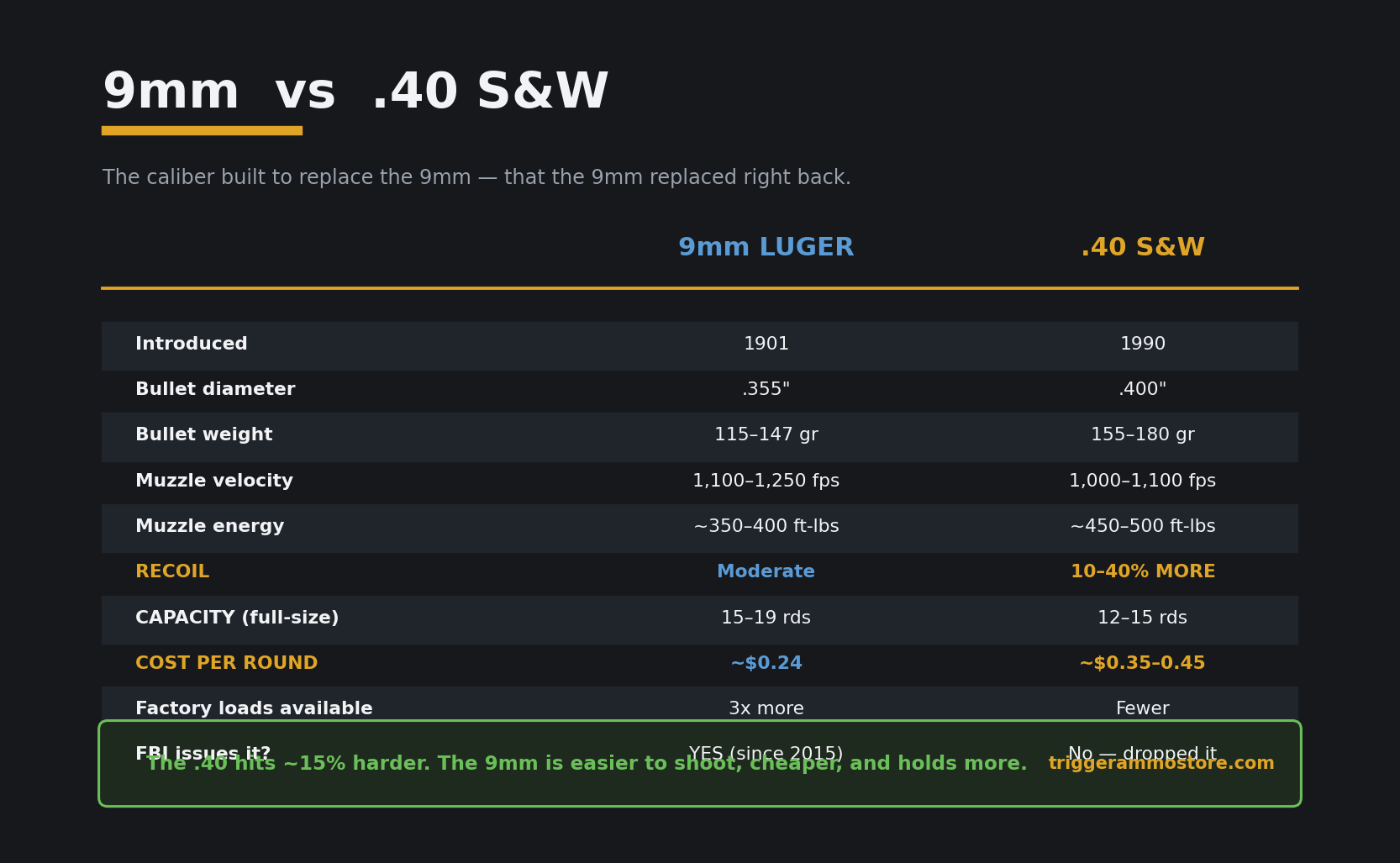
Here is the whole matchup in one table.
| 9mm Luger | .40 S&W | |
|---|---|---|
| Bullet diameter | .355″ | .400″ |
| Bullet weight | 115–147 gr | 155–180 gr |
| Velocity | 1,100–1,250 fps | 1,000–1,100 fps |
| Muzzle energy | ~350–400 ft-lbs | ~450–500 ft-lbs |
| Recoil | Moderate | 10–40% more |
In the 9mm vs .40 S&W power comparison, the .40 does hit harder — but by less than you’d think. In gel testing, quality .40 S&W loads create a crush cavity roughly 10–20% larger than 9mm. That’s a real edge, but a modest one. And notably, some 9mm loads actually outperform .40 S&W through the FBI’s intermediate barriers.
Modern hollow-point engineering is why. Twenty years ago the gap was meaningful. Today, a premium 9mm JHP expands to nearly the same diameter and penetrates to nearly the same depth.
Why the FBI Switched Back
This is the decisive fact in the 9mm vs .40 S&W argument, and it deserves more attention than it gets.
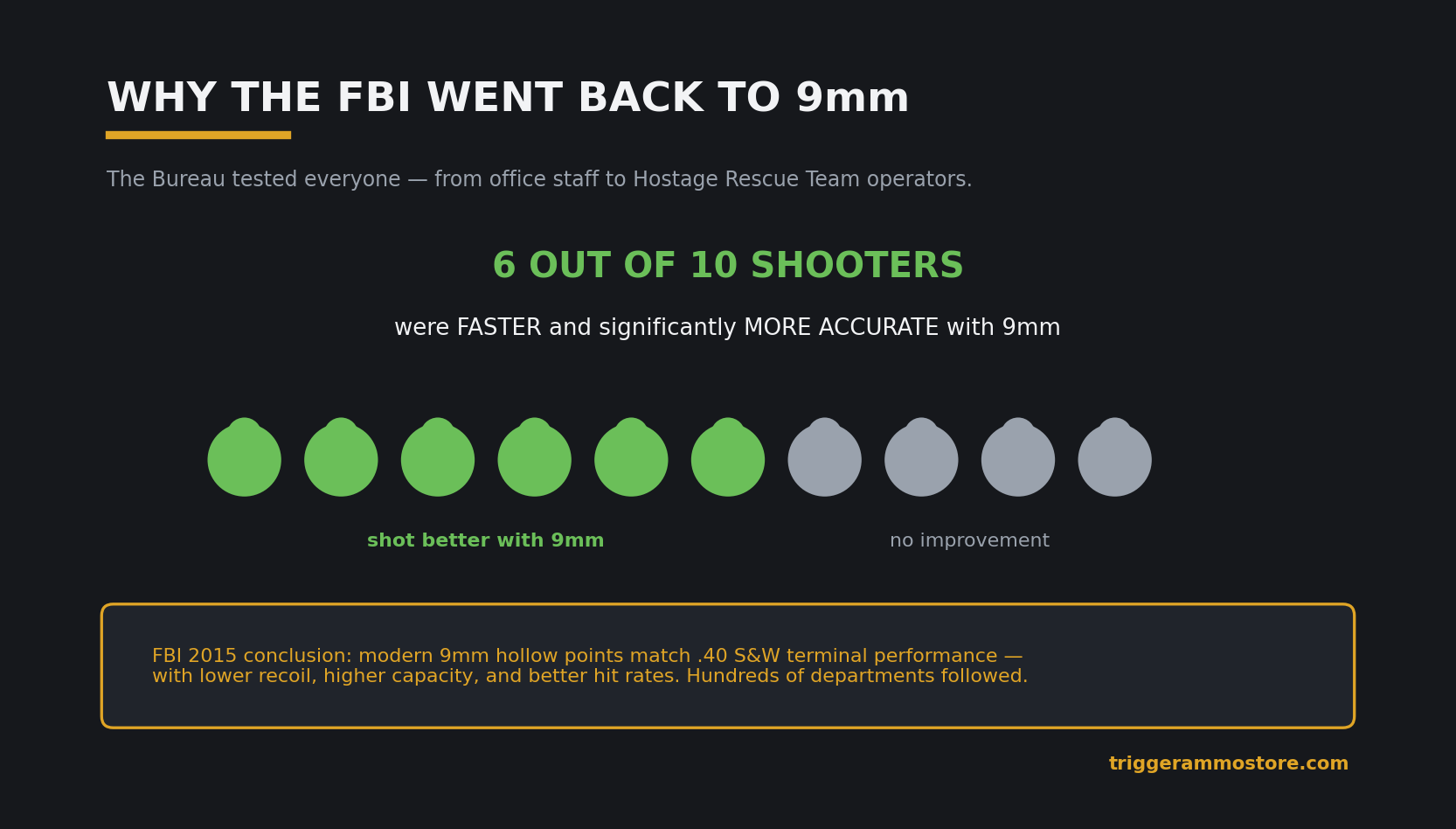
The FBI didn’t switch on a hunch. They ran a controlled test across the entire Bureau — from office staff who’d never held a gun, up to Hostage Rescue Team operators — and published a 200-page report making the case.
The finding: 6 out of 10 shooters were faster and significantly more accurate with 9mm than with .40 S&W.
That single finding effectively ended the 9mm vs .40 S&W debate inside the Bureau. Their 2015 conclusion: modern 9mm hollow points match .40 S&W terminal performance, while delivering lower recoil, higher capacity, and better hit rates under stress.
The Bureau’s own ballistics lead noted the internal resistance was emotional, not scientific — going from a .40 bullet to a .35 bullet felt like a downgrade, even when the data said otherwise.
Hundreds of police departments have since followed.
9mm vs .40 S&W Recoil: The Real Difference
The .40 S&W recoils 10–40% harder than 9mm depending on the load — and it’s not just more recoil, it’s snappier. A sharper, more abrupt impulse that’s harder to ride out.
Why that matters: recoil directly controls how fast you can get an accurate second shot. Under stress, with adrenaline, a snappy gun costs you hits. The FBI’s test measured exactly this — and 9mm won.
In the end, the 9mm vs .40 S&W question answers itself here. Shot placement beats energy. A hit with a 9mm beats a miss with a .40 every time.
Capacity: Smaller Than You’d Guess
Here’s a nuance most articles get wrong.
In full-size pistols the gap is small: a Glock 17 holds 17 rounds of 9mm; a Glock 22 holds 15 rounds of .40. That’s a two-round difference.
But in compact and subcompact carry guns — where most people actually carry — the difference widens, and the .40’s harder recoil is amplified by the smaller, lighter frame. That’s a double penalty exactly where it hurts most.
9mm vs .40 S&W Cost: The 9mm Wins Easily
- 9mm: ~$0.24 per round
- .40 S&W: ~$0.35–0.45 per round
That’s roughly 50% more expensive — and there are about three times as many factory 9mm loads available.
Cheaper ammo means more practice. And practice, not caliber, is what makes you effective. This is the quiet reason departments switched: training budgets.
9mm vs .40 S&W: Is the .40 Dead?
No — and anyone who says so is being sloppy.
If you own a .40 S&W and shoot it well, you are not undergunned. Millions of Americans carry one successfully. It’s a fully capable defensive cartridge with quality hollow points, and it hits harder than a 9mm.
What has happened is that new pistol development has shifted almost entirely to 9mm. Fewer new .40 models are released each year. The .40 S&W has become, as one writer put it, the middle child — stuck between the 9mm’s shootability and the .45’s authority.
The .40’s best argument in 2026: value
Because agencies dumped them, the used market is flooded with police trade-in .40 pistols — Glock 22s, Glock 23s, S&W M&Ps — often under $350 for a duty-grade gun. That’s a genuine bargain, and a legitimate reason to buy a .40 today.
9mm vs .40 S&W: Which Should You Choose?
Choose 9mm if you:
- Are buying your first handgun
- Want lower recoil and faster follow-up shots
- Want cheaper ammo so you can practice more
- Want the widest selection of pistols and defensive loads
- Want what the FBI and most US law enforcement carry
Choose .40 S&W if you:
- Already own one and shoot it well
- Want a heavier bullet and more energy
- Want a police trade-in bargain
- Genuinely handle the recoil without losing accuracy
The 9mm vs .40 S&W Verdict
For most shooters, the 9mm wins the 9mm vs .40 S&W matchup — and it’s not close. Modern ammunition erased the terminal-performance gap, and the 9mm wins on capacity, cost, recoil, gun selection, and law-enforcement consensus.
But if you already carry a .40 S&W with quality hollow points, keep it. You’re not undergunned, and switching calibers for the sake of a chart is worse than mastering the gun you have.
The difference between a 9mm and a .40 S&W defensive load is small. The difference between a shooter who trains and one who doesn’t is enormous.
Shop 9mm and .40 S&W Ammo
Whichever you carry, feed it well. Browse our 9mm ammo and .40 S&W ammo — bulk FMJ for high-volume practice, plus premium jacketed hollow points for carry and duty.
Please buy and use ammunition responsibly and in accordance with all federal, state and local laws. 9mm and .40 S&W are not interchangeable — confirm your pistol’s chamber marking. Always test a defensive load for reliable feeding before carrying it. This article is general information, not legal or tactical advice.
Frequently Asked Questions
Why did the FBI switch back to 9mm? Their testing found 6 of 10 shooters were faster and significantly more accurate with 9mm, while modern 9mm hollow points matched .40 S&W terminal performance. Lower recoil, higher capacity, better hit rates — and cheaper training.
Is .40 S&W more powerful than 9mm? Yes, moderately — roughly 450–500 ft-lbs versus 350–400, with a crush cavity about 10–20% larger. But the gap is far smaller than it was before modern hollow points.
Is the .40 S&W obsolete? No. It’s a fully capable defensive cartridge and millions carry it. But new pistol development has largely shifted to 9mm.
Should I switch from .40 to 9mm? Only if you want to. If you shoot your .40 well with quality JHP, you’re not undergunned. If you struggle with the recoil, the 9mm will make you a better shooter.
Which has more recoil in the 9mm vs .40 S&W comparison? The .40 — 10–40% more, and snappier. It’s especially noticeable in compact carry guns.
In the 9mm vs .40 S&W cost comparison, is .40 ammo more expensive? Yes — roughly 50% more per round than 9mm, with far fewer factory loads available.
For firearm safety resources, shooting sports education, and industry information, visit the
National Shooting Sports Foundation (NSSF)
.
