
.380 vs 9mm: The Best Proven Guide for Concealed Carry
The .380 vs 9mm question comes up every time someone buys their first carry gun. The .380 ACP is smaller, gentler, and easier to conceal. The 9mm Luger hits harder, holds more, and — surprisingly — costs less.
But the honest answer to .380 vs 9mm has changed in the last decade, and most articles haven’t caught up. Here’s the real comparison.
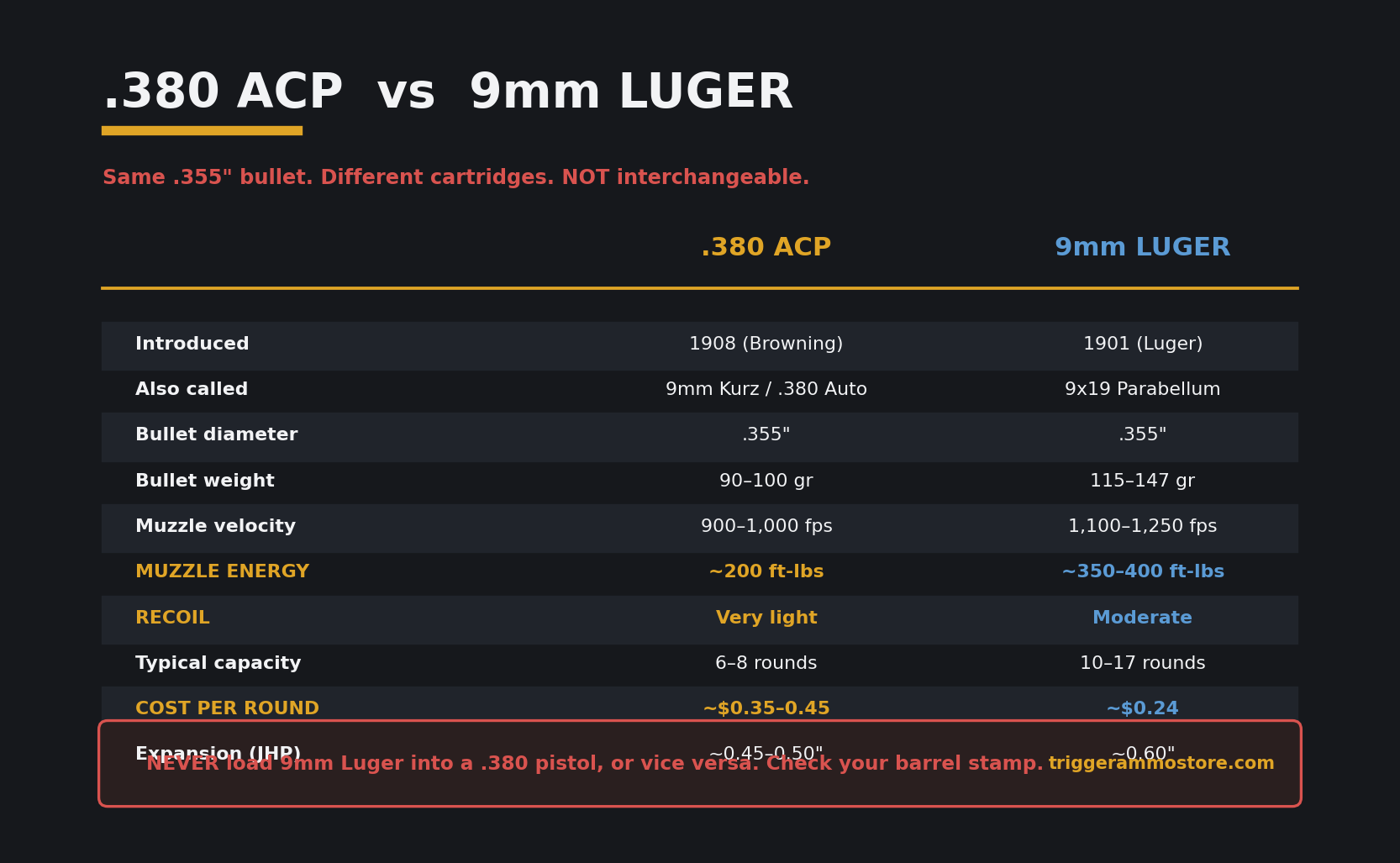
.380 vs 9mm Safety: They Are NOT Interchangeable
Before anything else, burn this in:
The .380 ACP and 9mm Luger fire the same .355-inch bullet — but they are completely different cartridges.
- .380 ACP (also called .380 Auto, 9mm Kurz, or 9mm Short) uses a shorter, lower-pressure case
- 9mm Luger (9×19 Parabellum) is longer and far more powerful
❌ Never load 9mm Luger into a .380 pistol. ❌ Never load .380 into a 9mm. ❌ Neither is the same as 9mm Makarov (9×18).
Check your barrel stamp. If it says “.380,” “.380 ACP,” or “9mm Kurz,” buy .380. Getting this wrong is dangerous.
Is .380 the Same as 9mm?
No — and this is the single most common confusion in the .380 vs 9mm debate. The bullet diameter is identical, which is why people assume interchangeability. The case is what differs: the .380 is shorter and loaded to far lower pressure.
Think of it as a 9mm Short — because that’s literally one of its names.
.380 vs 9mm: The Ballistics
Here is the whole matchup in one table.
| .380 ACP | 9mm Luger | |
|---|---|---|
| Bullet weight | 90–100 gr | 115–147 gr |
| Velocity | 900–1,000 fps | 1,100–1,250 fps |
| Muzzle energy | ~200 ft-lbs | ~350–400 ft-lbs |
| Capacity | 6–8 rounds | 10–17 rounds |
| Recoil | Very light | Moderate |
| Expansion (JHP) | ~0.45–0.50″ | ~0.60″ |
In the .380 vs 9mm energy comparison, the 9mm carries roughly double. That isn’t marketing — it’s physics.
Does the .380 Have Enough Stopping Power?
Here’s where the .380 vs 9mm comparison gets honest, and where most guides go soft.
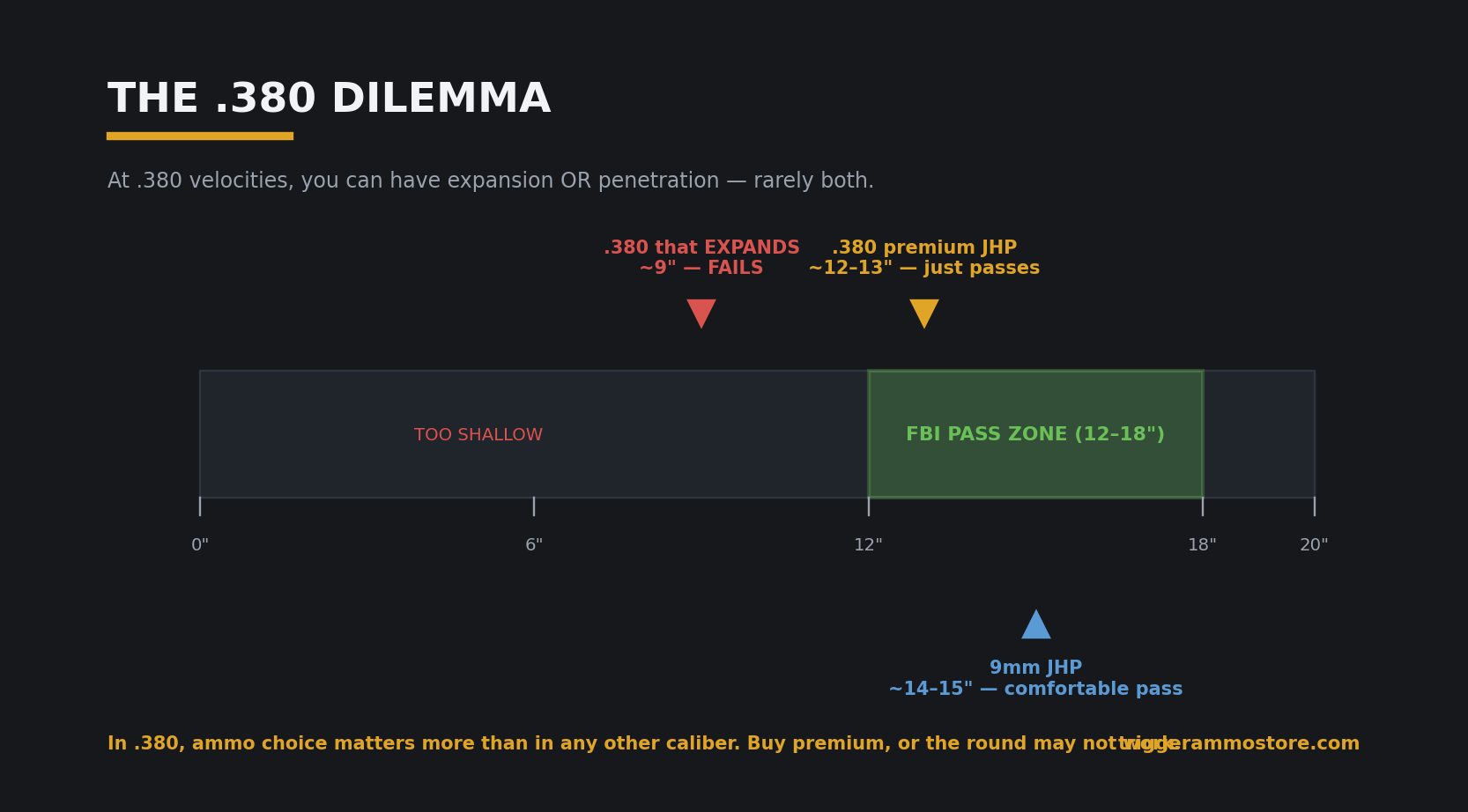
The FBI standard is 12–18 inches of penetration in ballistic gel with reliable expansion.
The .380 faces a genuine dilemma. At its lower velocity:
- If the hollow point expands properly, it often fails to reach 12 inches — FBI testing has shown expanded .380 rounds stopping around 9 inches.
- If it penetrates deep enough, it frequently didn’t expand — especially through heavy clothing, which can plug the hollow point cavity.
Premium .380 defensive loads can pass — quality rounds have tested around 12–13 inches with adequate expansion. But they’re scraping the line. A 9mm JHP clears it comfortably at 14–15 inches.
The practical conclusion: in .380, ammunition choice matters more than in any other caliber. Buy cheap .380 hollow points and you may get a round that does neither job properly.
.380 vs 9mm Recoil: The .380’s Real Advantage
This is the .380’s genuine win, and it’s not a small one. .380 recoil is dramatically lighter than 9mm.
That matters enormously for:
- Shooters with arthritis or limited hand strength
- Anyone who struggles to rack a 9mm slide (a .380’s lighter recoil spring is much easier)
- New or recoil-sensitive shooters
- Anyone who flinches with a 9mm
And this is the whole point: a .380 you shoot accurately beats a 9mm you flinch with. Shot placement is what stops a threat — not muzzle energy.
The Surprise: .380 Ammo Costs MORE
This catches everyone out. Despite being smaller and less powerful:
- 9mm: ~$0.24 per round
- .380 ACP: ~$0.35–0.45 per round
The .380 is roughly 50% more expensive. Why? Volume. 9mm is manufactured in staggering quantities, and that scale crushes the price. The .380 is a niche cartridge by comparison.
So in the .380 vs 9mm cost comparison, the 9mm wins — which means you can afford to practice more with it.
.380 vs 9mm: The Size Argument Has Changed
Here’s the part most articles are ten years out of date on.
The .380’s traditional case was: it fits in smaller guns. That used to be decisively true.
Then came the micro-compact 9mm — the SIG P365, Springfield Hellcat, and their imitators. These pistols are barely larger than a .380 pocket gun, yet hold 10–15 rounds of 9mm.
The size gap has narrowed to almost nothing. For many buyers, the .380’s main structural advantage has simply evaporated.
Who Should Actually Carry a .380?
The .380 vs 9mm choice comes down to your hands, not the ballistics chart. The .380 remains the right choice if you:
- Physically struggle with 9mm recoil — arthritis, injury, limited grip strength
- Can’t reliably rack a 9mm slide
- Need deep concealment (ankle, pocket, backup gun) where even a micro-9 is too big
- Shoot the .380 well and the 9mm badly — this alone justifies it
Choose the 9mm if you:
- Can handle the recoil (most people can, with practice)
- Want more energy, more capacity, cheaper ammo
- Want the widest possible selection of guns and defensive loads
The Verdict
For most people, the 9mm wins the .380 vs 9mm matchup. More energy, more rounds, cheaper ammo, and a modern micro-compact gives up almost nothing in size.
But the .380 is not a toy, and dismissing it is lazy advice. For a shooter who genuinely cannot manage a 9mm — through arthritis, hand strength, or recoil sensitivity — a .380 they shoot accurately is vastly better than a 9mm sitting unused in a drawer.
Buy the gun you’ll actually carry and actually practice with. Then buy premium defensive ammunition for it — especially in .380, where the load does the heavy lifting.
Shop .380 and 9mm Ammo
Whichever you carry, feed it properly. Browse our .380 ACP ammo — including premium JHP loads engineered to expand reliably from short pocket-pistol barrels — and our 9mm ammo for bulk FMJ training and defensive hollow points.
Please buy and use ammunition responsibly and in accordance with all federal, state and local laws. .380 ACP and 9mm Luger are NOT interchangeable — always confirm your pistol’s chamber marking before buying. Always test a defensive load for reliable feeding before carrying it. This article is general information, not legal or tactical advice.
Frequently Asked Questions
Is .380 the same as 9mm? No. They share a .355″ bullet diameter, but the .380 ACP uses a shorter, lower-pressure case. They are not interchangeable — never load one in a pistol chambered for the other.
Can you shoot .380 in a 9mm pistol? No. Neither direction is safe. Always match ammunition to your barrel’s marked chambering.
Is .380 enough for self-defense? With premium defensive ammunition, yes — at close range. But it’s marginal: many .380 loads struggle to both expand and reach the FBI’s 12-inch penetration minimum. Ammo choice matters more in .380 than in any other caliber.
Which has less recoil in the .380 vs 9mm comparison? The .380, by a wide margin. That’s its main advantage, and a genuine one for recoil-sensitive shooters.
Why is .380 ammo more expensive than 9mm? Manufacturing volume. 9mm is produced in vastly greater quantities, which drives its price down. The .380 is comparatively niche.
What’s the effective range of a .380? Realistically inside 25 yards — it’s a close-range defensive cartridge, not a distance round.
Should I get a .380 or a micro-compact 9mm? For most people, the micro-9mm — it’s barely larger and holds far more rounds with more energy. Choose the .380 if recoil or slide manipulation is genuinely a problem for you.
For firearm safety resources, shooting sports education, and industry information, visit the
National Shooting Sports Foundation (NSSF)
.

2 Comments