
.357 Magnum vs .38 Special: The Best Proven Guide
The .357 Magnum vs .38 Special question is the most important thing a new revolver owner can understand — and it comes with a safety rule you must not get wrong.
These two cartridges fire the exact same .357-inch bullet. The magnum’s case is just one-tenth of an inch longer. That tiny difference was engineered deliberately, and it’s the whole story.
.357 Magnum vs .38 Special: The One-Way Safety Rule
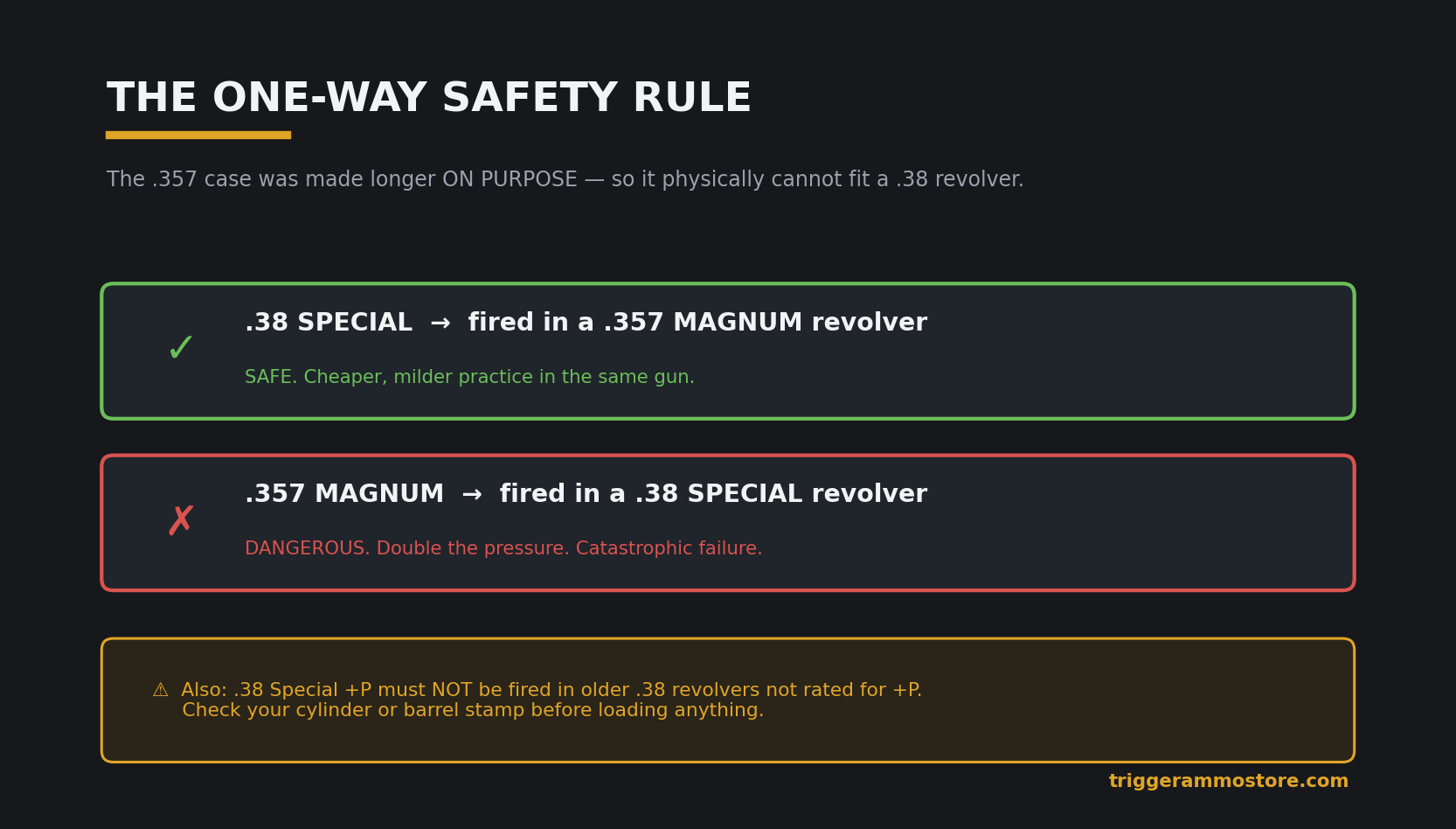
- ✅ .38 Special is SAFE in a .357 Magnum revolver.
- ❌ .357 Magnum must NEVER be fired in a .38 Special revolver.
This is the one part of the .357 Magnum vs .38 Special comparison you cannot afford to get wrong.
Why? The .357 Magnum runs at 35,000 psi — roughly double the .38 Special’s 17,500 psi. A .38-only revolver simply isn’t built for that. Firing a magnum in one risks catastrophic failure.
Here’s the clever part. When the .357 Magnum was created in 1934, its designers made the case 0.1 inches longer specifically so it physically cannot chamber in a .38 Special cylinder. The safety is engineered into the cartridge itself. You literally can’t make that mistake by accident.
One more warning: .38 Special +P ammunition is loaded hotter than standard .38. It’s safe in .357 revolvers and in modern +P-rated .38s — but it must not be fired in older .38 Special revolvers that aren’t rated for it. Check your barrel or cylinder stamp.
.357 Magnum vs .38 Special: Where They Came From
The .38 Special (1898) became the standard American police cartridge for most of a century. Mild, accurate, cheap — still probably the most popular revolver round in the world.
The .357 Magnum (1934) was born from a specific problem: Prohibition-era criminals were wearing early body armour and using cars as cover, and the .38 Special couldn’t get through either. Gun writers Elmer Keith and Phillip Sharpe simply loaded the .38 case far hotter. The result penetrated what police needed it to penetrate — and nearly every US department adopted it until reliable semi-autos arrived in the 1990s.
.357 Magnum vs .38 Special: The Ballistics
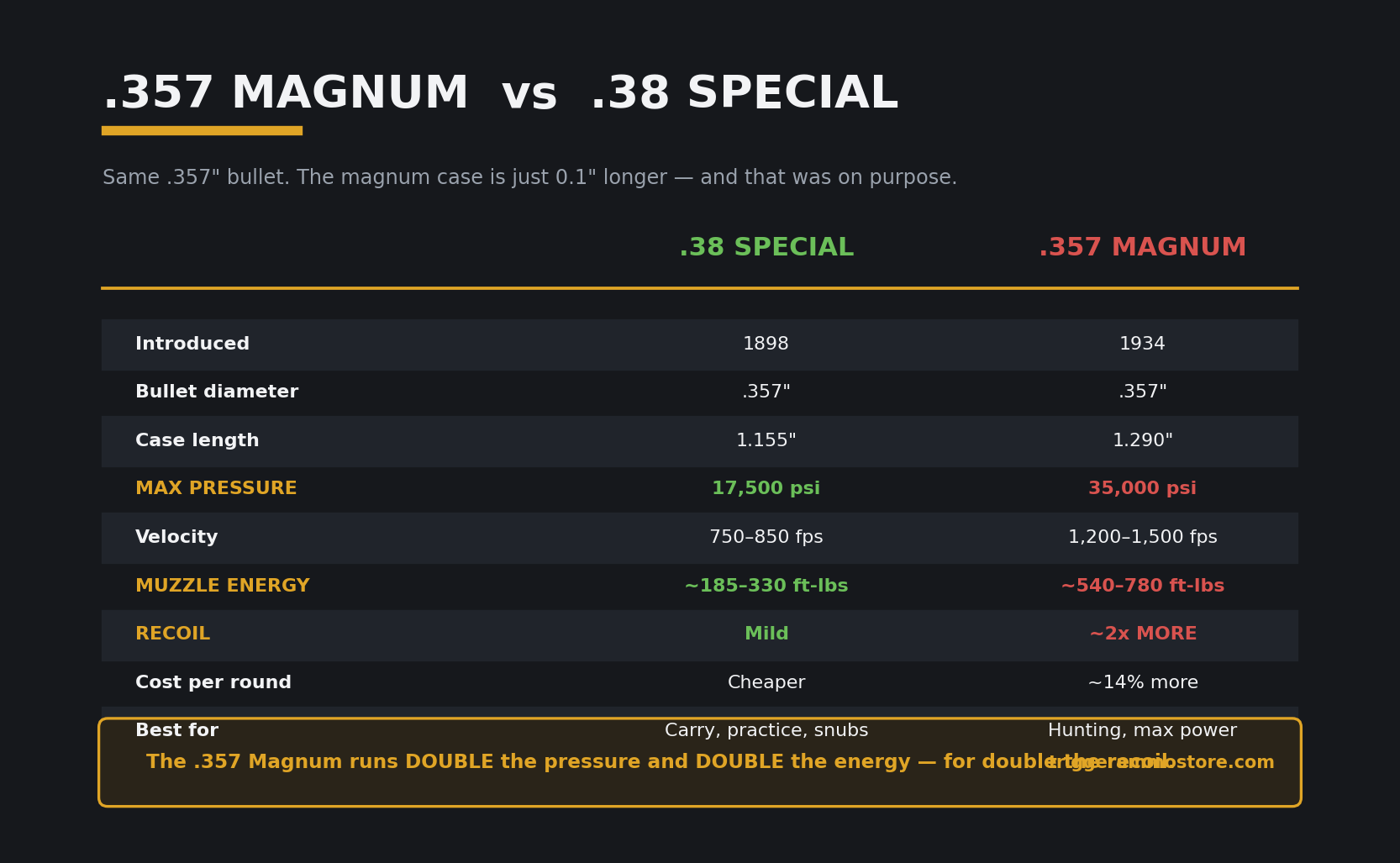
In the .357 Magnum vs .38 Special comparison, the gap is genuinely large — one writer likened it to comparing a .30-30 with a .30-06.
| .38 Special | .357 Magnum | |
|---|---|---|
| Velocity | 750–850 fps | 1,200–1,500 fps |
| Muzzle energy | ~185–330 ft-lbs | ~540–780 ft-lbs |
| Max pressure | 17,500 psi | 35,000 psi |
| Recoil | Mild | ~2x more |
The .357 Magnum delivers roughly double the energy — and roughly double the recoil. There’s no free lunch. It also produces a genuinely ferocious muzzle blast and fireball, which matters more than people expect indoors and at night.
.38 Special +P sits between them: from a snub-nose it produces around 240–265 ft-lbs — a real step up from standard .38, without the magnum’s punishment.
Recoil: Why It Decides Most Purchases
This is where the .357 Magnum vs .38 Special decision gets practical.
In a full-size steel revolver, .357 Magnum is manageable and genuinely fun. In a lightweight snub-nose, full-power magnum loads are punishing — sharp, loud, and hard to control. Many owners of .357 snubs fire one cylinder of magnum, wince, and carry .38 Special +P from then on.
That isn’t weakness. Recoil causes flinch, and flinch causes misses. A .38 you shoot accurately beats a .357 you flinch with.
(A practical note on snubs: some short revolvers have a short ejection rod that won’t reliably kick out the longer .357 cases. Worth knowing before you buy.)
.357 Magnum vs .38 Special: The Best Move Is to Buy the .357
Here’s the strategy most experienced revolver shooters use, and it’s the real answer to .357 Magnum vs .38 Special:
Buy a .357 Magnum revolver. Shoot .38 Special for practice. Load .357 Magnum (or .38 +P) for defense.
You get:
- Cheap, mild practice — .38 ammo is cheaper and far gentler
- Full magnum power on tap when you want it
- One gun, both cartridges
A .38-only revolver can never fire magnums. A .357 can do everything.
The trade-off: .38-only revolvers can be made smaller and roughly 20% lighter — because they don’t need to contain magnum pressure. If absolute minimum size and weight is your priority, a dedicated .38 snub still wins.
🔧 The maintenance tip nobody tells you
When you fire the shorter .38 Special in a .357 Magnum cylinder, carbon and lead build up in the extra 0.1″ of empty chamber — leaving a fouling ring.
If you don’t scrub it out, .357 Magnum cases may not seat properly later. Clean your chambers thoroughly after shooting .38 in a magnum revolver. This catches a lot of people out.
.357 Magnum vs .38 Special: What Each Is Actually For
.38 Special is best for:
- Concealed carry, especially lightweight snub-nose revolvers
- New and recoil-sensitive shooters
- High-volume, affordable range practice
- Home defense with less over-penetration risk and less blinding muzzle flash
.357 Magnum is best for:
- Hunting — deer and hogs at close range with heavy 158–180gr loads
- Woods carry / animal defense (capable, though bigger bores are better for large bears)
- Maximum defensive power from a full-size revolver
- Lever-action carbines, where the longer barrel unlocks serious velocity
Which for Self-Defense?
Both work. That’s the honest answer.
.38 Special +P has an outstanding real-world defensive record, and in a small carry revolver it’s often the smarter choice — softer, faster follow-ups, less flash.
.357 Magnum hits substantially harder and penetrates barriers better, but demands a heavier gun and real practice to shoot well.
Choose the one you’ll actually train with. In the .357 Magnum vs .38 Special debate, that single sentence beats every ballistics chart.
Shop .357 Magnum and .38 Special Ammo
Feed your revolver right. Browse our .38 Special ammo — affordable range loads and premium +P defensive rounds — and our .357 Magnum ammo for hunting, woods carry, and full-power defense.
Please buy and use ammunition responsibly and in accordance with all federal, state and local laws. NEVER fire .357 Magnum in a revolver chambered only for .38 Special, and never fire .38 Special +P in a revolver not rated for +P. Always confirm your revolver’s marked chambering before loading. This article is general information, not legal or tactical advice.
Frequently Asked Questions
Can you shoot .38 Special in a .357 Magnum revolver? Yes — it’s completely safe, and it’s one of the best features of owning a .357. The .38 is cheaper and much milder, making it ideal for practice.
Can you shoot .357 Magnum in a .38 Special revolver? No — never. The .357 runs at double the pressure. Fortunately the magnum’s case is longer by design, so it physically won’t chamber in a .38 revolver.
Is .38 Special enough for self-defense? Yes, particularly in +P. It has a long and proven defensive record and is far easier to shoot well from a small revolver.
In the .357 Magnum vs .38 Special matchup, how much more powerful is the magnum? Roughly double the muzzle energy — about 540–780 ft-lbs versus 185–330 for standard .38 Special — with roughly double the recoil.
Should I buy a .357 or a .38 revolver? A .357 Magnum, in most cases — it fires both cartridges. Choose a .38-only revolver if minimum size and weight matter most; they’re about 20% lighter.
Can .38 Special +P be fired in any .38 revolver? No. Only in revolvers rated for +P, and in .357 Magnums. Check your gun’s stamp.
Is .357 Magnum good for hunting? Yes — it’s a capable close-range deer and hog cartridge with heavy loads, and it really comes alive in a lever-action carbine.
For firearm safety resources, shooting sports education, and industry information, visit the
National Shooting Sports Foundation (NSSF)
.
