
10mm vs .45 ACP: The Best Proven Guide
The 10mm vs .45 ACP debate splits big-bore shooters cleanly down the middle. The 10mm is faster, flatter and hits harder. The .45 ACP is older, cheaper, gentler, and expands wider.
But most articles miss the real point: these two cartridges aren’t competing for the same job. Here’s the honest comparison — including the ammunition mistake that renders a 10mm nearly useless in bear country.
10mm vs .45 ACP: Where They Came From
The .45 ACP (1905) — John Browning’s cartridge for the M1911. Big, slow, and carried by American soldiers through two World Wars. It has over a century of proven service and a devoted following.
The 10mm Auto (1983) — designed by Jeff Cooper to give a semi-auto pistol magnum-class ballistics. The FBI adopted it in 1989 after the Miami shootout, then found it too punishing for many agents and downloaded it — creating the .40 S&W, the “10mm Short.”
The 10mm faded to a cult following. Then it came roaring back — driven by handgun hunting, backcountry bear defense, and a flood of new factory loads.
10mm vs .45 ACP: The Ballistics
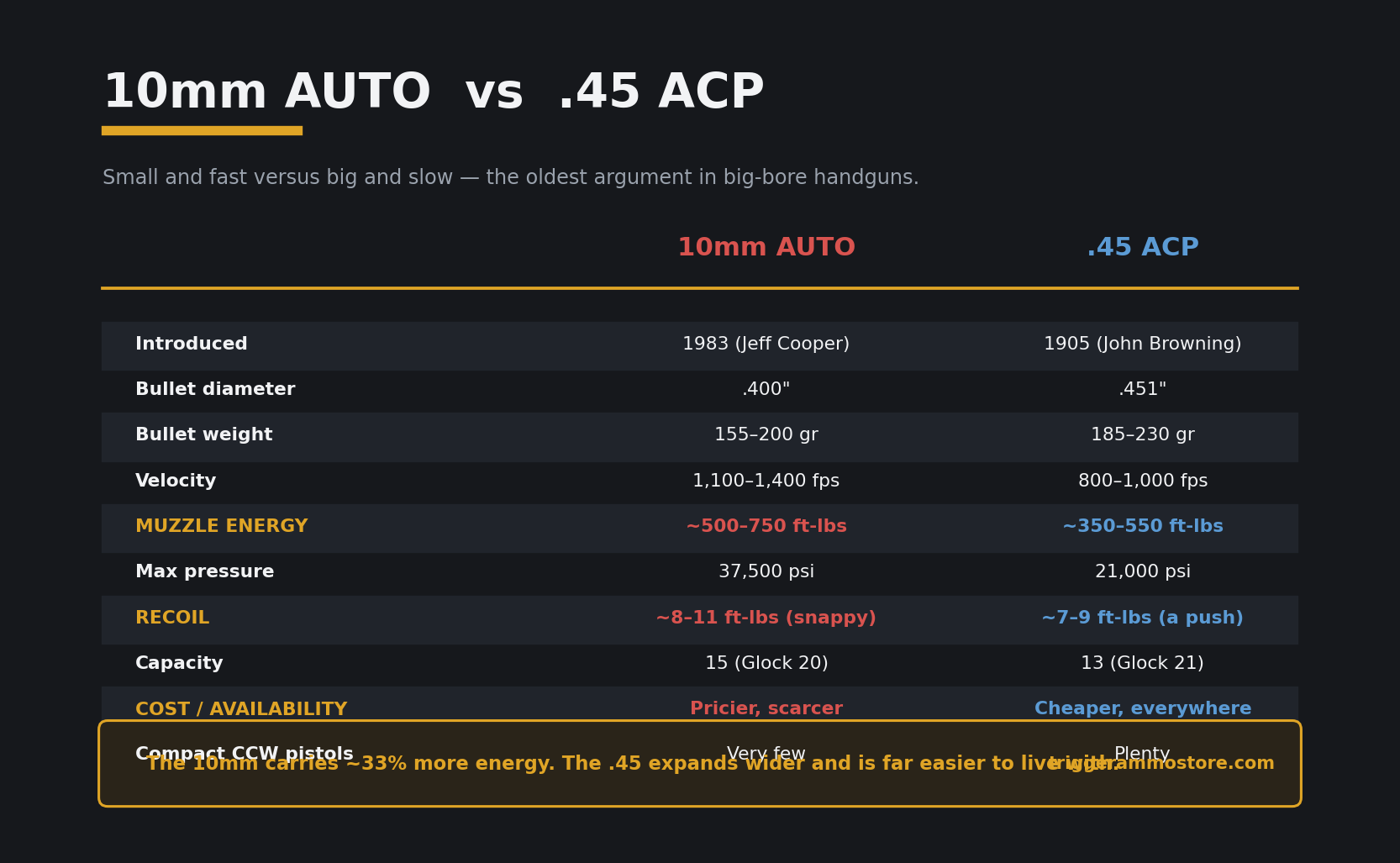
| 10mm Auto | .45 ACP | |
|---|---|---|
| Bullet diameter | .400″ | .451″ |
| Velocity | 1,100–1,400 fps | 800–1,000 fps |
| Muzzle energy | ~500–750 ft-lbs | ~350–550 ft-lbs |
| Max pressure | 37,500 psi | 21,000 psi |
The average 10mm load carries roughly 33% more energy and shoots noticeably flatter — only 3–5 inches of drop at 100 yards, which is why it works for hunting.
But the .45 hits back in one important way: its bigger, slower bullet expands wider. Premium .45 JHP loads can open to nearly an inch. In the 10mm vs .45 ACP terminal-performance argument, that’s a genuine advantage at defensive distances.
10mm vs .45 ACP Recoil: Smaller Gap Than You’ve Heard
Here’s where the internet exaggerates.
- .45 ACP: roughly 7–9 ft-lbs of free recoil
- 10mm: roughly 8–11 ft-lbs
That’s a real difference — but it’s not the wrist-breaker forums describe. What does differ is the character of the recoil:
- The .45 ACP delivers a slow, rolling push.
- The 10mm, running nearly double the pressure, delivers a sharper, faster snap.
Most shooters feel that snap immediately, and it’s harder to ride out for fast follow-up shots. Gun weight matters too: the popular Glock 20 (10mm) is light, while the classic 1911 (.45) is heavy — which flatters the .45 further.
10mm vs .45 ACP Cost: The .45 Wins Easily
- .45 ACP — cheaper, stocked everywhere, loaded by every major manufacturer, and available in an enormous range of pistols.
- 10mm — pricier, harder to find in bulk, and — critically — very few compact 10mm pistols exist.
That last point matters more than people realise in the 10mm vs .45 ACP carry decision. Compact .45s abound. Compact 10mms barely exist.
Which for Self-Defense and Carry?
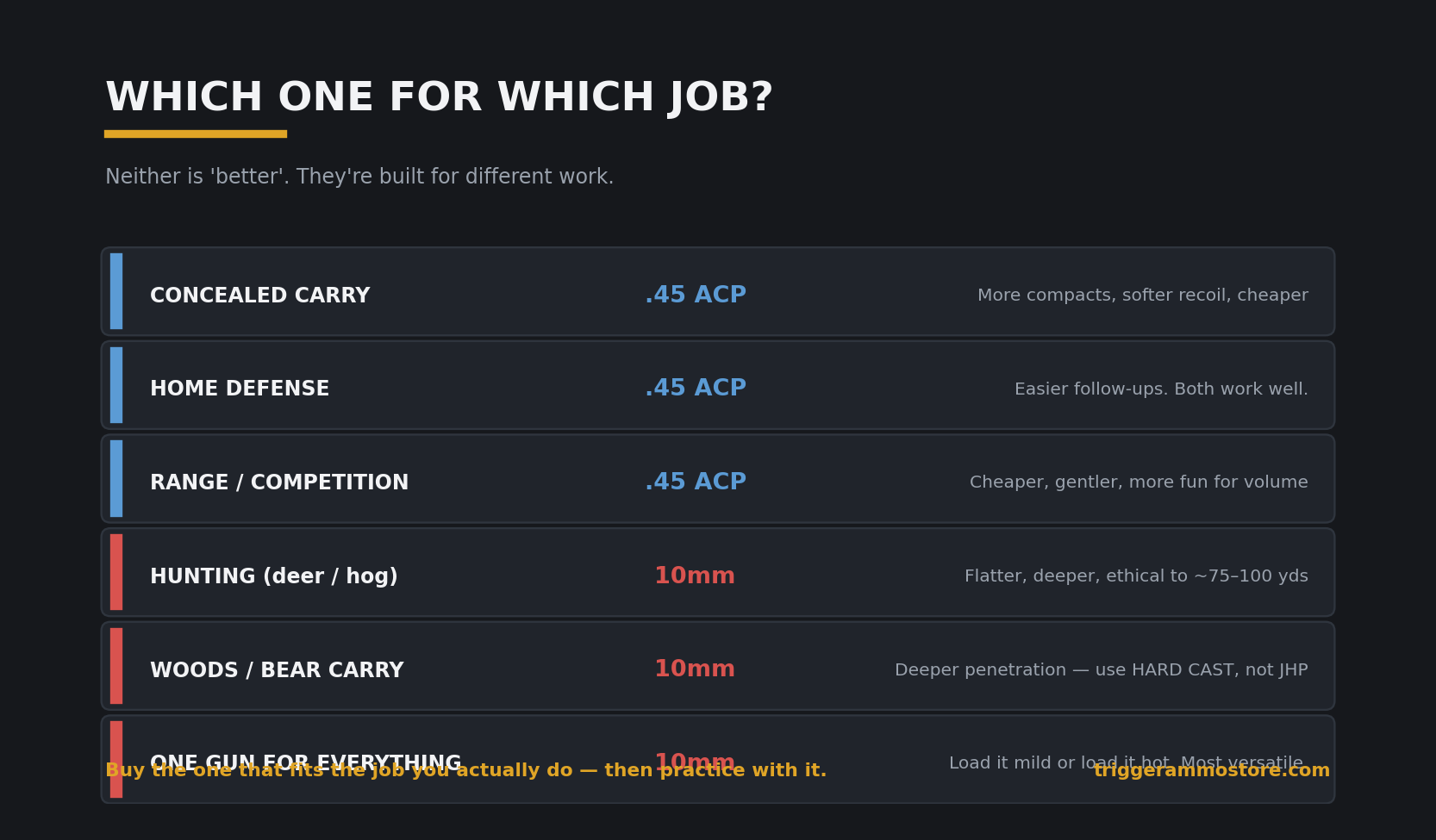
In the 10mm vs .45 ACP defensive comparison, the .45 ACP wins. More compact pistols, softer recoil, cheaper practice ammo, and 100+ years of proven defensive performance.
At typical defensive distances, the 10mm’s extra energy is past the point of diminishing returns against a human threat. Both are more than adequate. What matters is which you shoot better — and for most people, that’s the .45.
A 10mm is simply more gun than most people need for self-defense.
⚠️ 10mm for Bear Defense: The Mistake That Gets People Hurt
This is the most important section in this guide.
The 10mm has become the go-to backcountry handgun, and it deserves that reputation — its deeper penetration is a genuine edge. But the ammunition choice is everything, and most people get it backwards.
Do NOT carry hollow points for bear.
Even the best 10mm hollow points penetrate around 17 inches in gel — about 30% more than a .45. That is still not enough for a large bear. Bears have thick fur, heavy hide, dense muscle, and heavy bone. A hollow point expands, slows, and stops before it reaches anything vital.
Carry HARD CAST.
Non-expanding hard cast bullets are designed to punch straight through. Loads like the Buffalo Bore Outdoorsman (10mm, 220gr hard cast at ~1,200 fps) exist precisely for this.
The rule: hollow points for people. Hard cast for bears. Carrying JHP in bear country is a potentially fatal mistake.
And an honest word: any handgun is a compromise for bear defense. A rifle, a shotgun, or bear spray is better. You carry a handgun because it’s what you’ll actually have on you — not because it’s optimal.
(For what it’s worth: the .45 ACP has also worked. In one survey of 93 bear attacks, the .45 was used eight times, and every defensive attempt succeeded. But with heavy hard-cast loads, the 10mm has the higher ceiling.)
10mm vs .45 ACP for Hunting: The 10mm’s Real Home
This is where the 10mm vs .45 ACP question stops being close. For hunting, the 10mm wins outright.
With the right bullet — Federal Fusion 200gr SP, Hornady XTP 180gr, or similar — a 10mm ethically takes whitetail, hogs, and black bear inside 75–100 yards. The flatter trajectory and retained energy make it a genuine hunting cartridge.
The .45 ACP simply isn’t built for this. Federal doesn’t even market a .45 Auto hunting load.
The .45 Can Be Loaded Hot, Too
An honest caveat that .45 fans will (rightly) raise: .45 ACP +P loads run hotter, and a 185gr +P can approach 1,200 fps. .45 Super goes further still.
These narrow the 10mm vs .45 ACP power gap considerably — though they require a suitable pistol, and the 10mm still has the higher ceiling with hard-cast hunting loads.
The 10mm vs .45 ACP Verdict
Choose the .45 ACP if you:
- Want a concealed-carry or home-defense pistol
- Want cheaper ammo and more gun choices
- Prefer a soft push over a sharp snap
- Love the 1911 (a completely valid reason)
Choose the 10mm if you:
- Hunt deer or hogs with a handgun
- Carry in the backcountry or bear country
- Want one pistol that can be loaded mild or magnum-hot
- Accept the extra recoil, cost, and limited pistol selection
The honest answer to 10mm vs .45 ACP: the .45 is the better defensive cartridge for most people, and the 10mm is the better outdoors cartridge, full stop. Plenty of shooters own both, because they genuinely do different jobs.
Shop 10mm and .45 ACP Ammo
Browse our 10mm ammo — including hard-cast woods loads and hunting bullets — and our .45 ACP ammo for bulk FMJ practice and premium defensive hollow points.
Please buy and use ammunition responsibly and in accordance with all federal, state and local laws. For bear and dangerous-game defense, hard-cast non-expanding bullets are generally recommended over hollow points — and no handgun should be considered a substitute for a rifle, shotgun, or bear spray. Always test a defensive load for reliable feeding in your pistol before carrying it. This article is general information, not legal, tactical, or wilderness-safety advice.
Frequently Asked Questions
In the 10mm vs .45 ACP matchup, is the 10mm more powerful? Yes — roughly 33% more muzzle energy on average (500–750 ft-lbs versus 350–550), with substantially higher velocity and a flatter trajectory.
Which has more recoil in the 10mm vs .45 ACP comparison? The 10mm — about 8–11 ft-lbs versus 7–9 for the .45. The bigger difference is the character: the 10mm snaps, the .45 pushes.
Is 10mm good for bear defense in the 10mm vs .45 ACP comparison? Yes, with the right ammunition. Use hard-cast, non-expanding bullets — never hollow points. Hollow points won’t penetrate deeply enough on a large bear. And remember: any handgun is a compromise versus a long gun or bear spray.
Is 10mm too much for self-defense? For most people, yes — it’s more recoil, cost, and gun than a human threat requires. The .45 ACP (or 9mm) is the more practical defensive choice.
Can you hunt with a .45 ACP? Not really — it’s too slow and drops too fast. The 10mm is the semi-auto handgun hunting cartridge.
Is .45 ACP ammo cheaper than 10mm? Yes, noticeably — and far easier to find in bulk, with many more pistols chambered for it.
What about .45 ACP +P? It closes much of the gap and is a legitimate step up. But the 10mm still has the higher ceiling, especially with heavy hard-cast hunting loads.
For firearm safety resources, shooting sports education, and industry information, visit the
National Shooting Sports Foundation (NSSF)
.
