
9mm Ammo Explained: The Best Proven Guide
9mm ammo is the best-selling ammunition in America, and for good reason. It’s cheap, it’s everywhere, it recoils lightly, and — since the FBI’s return to it in 2015 — it’s what most American law enforcement carries. If you own one handgun, there’s a very good chance it eats 9mm.
But walk into a store and you’ll face 115 grain, 124 grain, 147 grain, FMJ, JHP, +P, bonded, subsonic. This guide explains what all of it means, and exactly which 9mm ammo to buy for what you’re doing.
What Is 9mm?
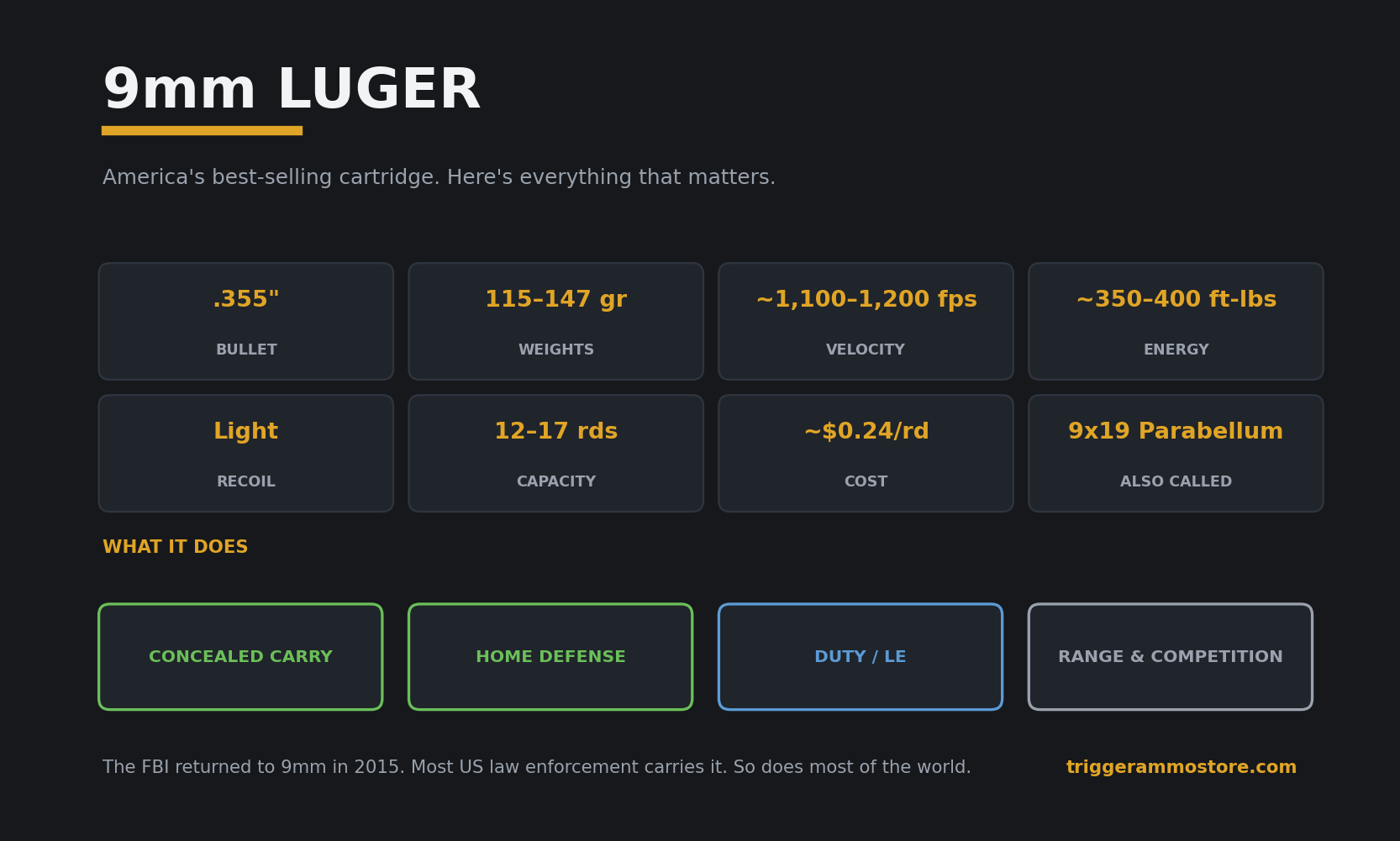
The 9mm Luger — also called 9x19mm Parabellum — was designed by Georg Luger in 1901. It fires a .355-inch bullet at roughly 1,100–1,200 fps, producing around 350–400 ft-lbs of energy.
Its whole design philosophy was small and fast: a lighter bullet meant a pistol could hold far more rounds. That decision, over a century later, is why 9mm ammo dominates the world.
| Spec | Value |
|---|---|
| Bullet diameter | .355″ |
| Common weights | 115, 124, 147 grain |
| Muzzle velocity | ~1,100–1,200 fps |
| Muzzle energy | ~350–400 ft-lbs |
| Typical capacity | 12–17 rounds |
| Recoil | Light |
| Cost (bulk FMJ) | ~$0.24 per round |
Why 9mm Ammo Won
Capacity. A 9mm pistol holds 12–17 rounds. A .45 ACP holds 7–10. In a defensive situation, that margin matters.
Recoil. It’s mild — which means faster, more accurate follow-up shots and a far gentler learning curve.
Cost. At roughly 24 cents a round, 9mm ammo is the cheapest serious centerfire round you can buy. Cheaper ammo means more practice, and practice is what actually makes you effective.
The FBI settled the argument. After decades experimenting with 10mm and .40 S&W, the Bureau returned to 9mm in 2015 — concluding that modern hollow points gave equivalent terminal performance with better shootability and higher capacity.
Grain Weight: 115 vs 124 vs 147
“Grain” is simply bullet weight. Heavier bullets travel slower; lighter bullets travel faster.
- 115 grain — fastest, snappiest recoil. The classic cheap range load.
- 124 grain — the all-rounder. Best balance of velocity and control. What most duty pistols carry.
- 147 grain — heaviest and subsonic. Softest recoil, least muzzle flash, and it performs best from short barrels.
Old thinking said faster = better expansion, so light bullets won. Modern hollow-point engineering changed that. A 147gr Federal HST expands to ~0.606″ — essentially identical to the 124gr — but at subsonic speed with less recoil.
Practical advice: buy 115gr for cheap range practice, and 124gr or 147gr premium hollow points for carry.
Types of 9mm Ammo
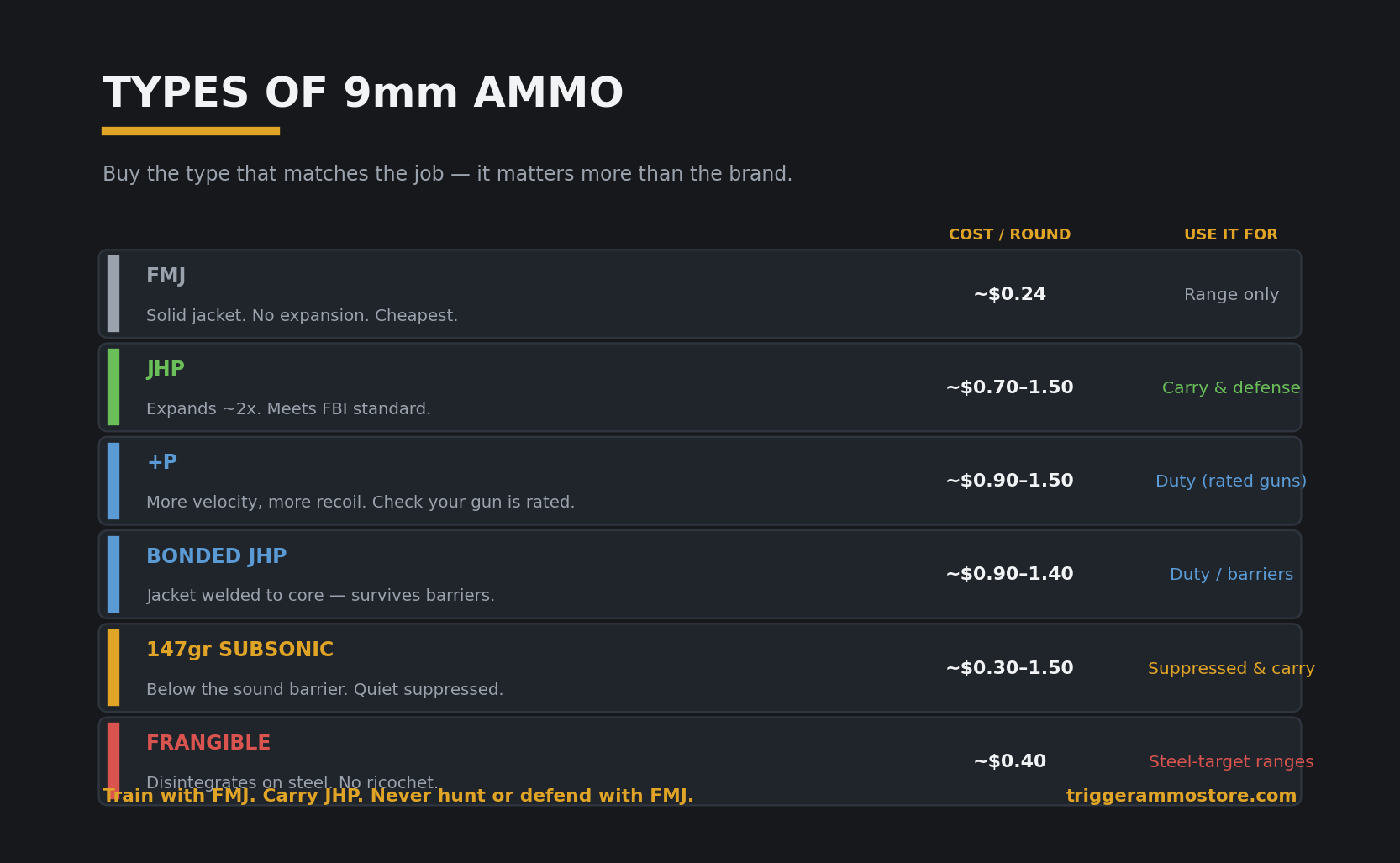
Understanding these six types covers 99% of the 9mm ammo you’ll ever encounter.
FMJ (Full Metal Jacket) — a solid jacketed bullet that does not expand. Cheap, reliable, and built purely for practice. Never use it for defense — it over-penetrates.
JHP (Jacketed Hollow Point) — expands to roughly twice its diameter on impact. This is defensive 9mm ammo. It creates an effective wound channel and reduces the chance of a round sailing through your wall.
+P — loaded to higher pressure for extra velocity, with extra recoil to match. Only use it if your pistol is rated for +P, and skip it in subcompacts where the snappiness costs you control.
Bonded JHP — the jacket is chemically welded to the lead core so it can’t separate through barriers like glass or drywall. Duty-grade.
Subsonic (147gr) — stays below the sound barrier. Quieter, especially suppressed, and less muzzle flash in low light.
Frangible — designed to disintegrate on hard surfaces. Used at steel-target ranges to eliminate ricochet.
Which 9mm Ammo Should You Buy?
| Purpose | Buy this 9mm ammo |
|---|---|
| Range / practice | 115gr FMJ — in bulk |
| Concealed carry | 124gr or 147gr premium JHP |
| Home defense | 147gr JHP (subsonic — quieter indoors) |
| Duty / barriers | Bonded JHP or Critical Duty +P |
| Suppressed | 147gr subsonic |
| Steel targets | Frangible |
⚠️ The most dangerous mistake new gun owners make is carrying cheap FMJ for self-defense. It doesn’t expand, and it over-penetrates — through the threat, through your wall, into the next room. Train with FMJ. Carry hollow points.
(We cover this fully in our hollow point vs FMJ guide, and rank the top defensive loads in our 9mm self-defense ammo guide.)
What Does 9mm Ammo Cost?
- Bulk FMJ: ~$0.20–0.28 per round
- Premium JHP: ~$0.70–1.50 per round
That’s a three-to-six-times difference — and it’s exactly why you buy both. A 200-round practice session runs about $48 in FMJ. The same in premium hollow points would exceed $200.
Buy 9mm ammo in cases, not boxes. A 1,000-round case typically saves 30% or more per round versus buying fifty-round boxes, especially once shipping is spread across the order.
Does it expire? Not practically. Stored cool and dry, modern factory 9mm ammo lasts decades. Buy in bulk when prices are good.
9mm vs Other Calibers — Quick Answers
- vs .45 ACP — 9mm holds twice as many rounds, kicks half as hard, costs half as much. Both pass the FBI standard. (Full comparison in our 9mm vs .45 ACP guide.)
- vs .380 ACP — same bullet diameter, but the .380 is a shorter, lower-pressure case. They are NOT interchangeable. The .380 is for pocket pistols; 9mm is more powerful.
- vs .40 S&W — the .40 splits the difference but has fallen out of favour. Most agencies that adopted it have gone back to 9mm.
The Bottom Line
9mm ammo is the right default for almost everyone. It’s the cheapest serious centerfire round, the easiest to shoot well, the most widely available, and it’s what the professionals carry.
Buy bulk FMJ so you can afford to practice, and premium hollow points for the rounds that count. That’s the whole strategy.
Shop 9mm Ammo
Browse our full range of 9mm ammo — bulk FMJ range loads for high-volume training, plus premium jacketed hollow points from Federal, Speer, Hornady, Winchester and Sig for carry and home defense.
Carrying a smaller pistol? See our .380 ACP ammo. Prefer a bigger bullet? Browse .45 ACP ammo.
Please buy and use ammunition responsibly and in accordance with all federal, state and local laws. Always confirm your pistol’s chambering — 9mm Luger, .380 ACP and 9mm Makarov are NOT interchangeable. Always test a defensive load for reliable feeding before carrying it. You must meet all legal requirements to purchase, and ammunition cannot be shipped to every jurisdiction.
Frequently Asked Questions
What is 9mm ammo used for? Everything — concealed carry, home defense, law enforcement duty, competition and range practice. It’s the most widely used handgun cartridge in the world.
What grain 9mm ammo should I buy? 115gr FMJ for cheap range practice. 124gr or 147gr premium hollow points for carry and home defense.
Is 9mm the same as .380? No. They share a .355″ bullet diameter, but the .380 ACP uses a shorter, lower-pressure case. They are not interchangeable — never load one in the other.
How much does 9mm ammo cost? Roughly $0.24 per round for bulk FMJ, and $0.70–1.50 for premium defensive hollow points.
Can I use FMJ 9mm ammo for self-defense? You shouldn’t. FMJ doesn’t expand and over-penetrates. Use quality hollow points for any defensive firearm.
Does 9mm ammo expire? Not practically. Stored cool and dry, modern factory ammunition lasts decades.
Is 9mm powerful enough for self-defense? Yes. With modern hollow points it meets the FBI’s ballistic standard, which is exactly why the FBI and most US law enforcement carry it.
For official ammunition safety standards and cartridge specifications, visit
SAAMI (Sporting Arms and Ammunition Manufacturers’ Institute)
.

1 Comment