
Hollow Point vs FMJ: The Best Proven Guide
The hollow point vs FMJ question is the most important thing a new gun owner can understand, and it’s the one most people get wrong. Buy the wrong one for the wrong job and you’ll either waste money — or, far worse, carry ammunition that endangers the people behind your target.
This guide settles hollow point vs FMJ in plain English: what each one does, which to buy for which job, and the mistake to never make.
The Short Answer
- 🎯 FMJ = practice. Cheap. Doesn’t expand. Buy it in bulk.
- 🛡️ Hollow point (JHP) = defense. Expands on impact. This is what you carry.
That’s the whole hollow point vs FMJ decision in two lines. Everything below explains why.
Hollow Point vs FMJ: What Is FMJ?
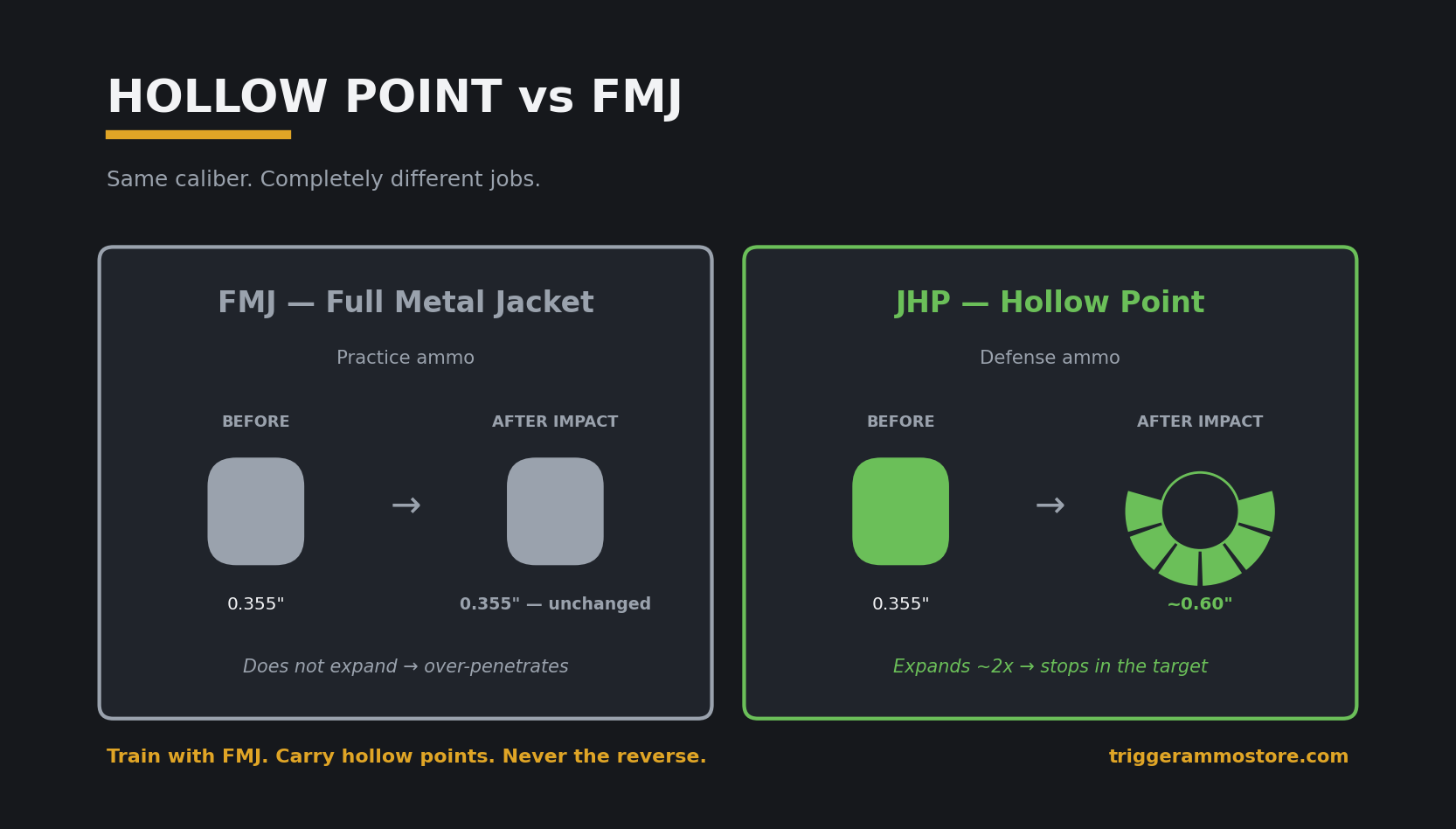
FMJ stands for Full Metal Jacket — a lead core fully wrapped in a harder metal jacket, usually copper.
It’s built for one thing: being shot a lot, cheaply. The jacket keeps the bullet from deforming, so it feeds reliably and keeps your barrel clean. It’s the cheapest centerfire ammunition you can buy.
What it does on impact: almost nothing. It punches a small, straight hole and keeps going.
Hollow Point vs FMJ: What Is a Hollow Point?
A hollow point (JHP — Jacketed Hollow Point) has a hollow cavity in its nose. On impact, that cavity fills and forces the bullet to peel open like a mushroom, expanding to roughly twice its original diameter.
A 9mm bullet starts at .355″. A quality JHP opens to around 0.60″.
Two things happen when it expands:
- A much larger wound channel — far more effective at stopping a threat
- The bullet slows dramatically — dumping its energy inside the target instead of continuing onward
That second point is the one that matters most, and it’s where the hollow point vs FMJ debate is really decided.
The Over-Penetration Problem
Here’s the part that should change how you think about this.
FMJ over-penetrates. Because it doesn’t expand, it keeps its speed and shape — punching through a threat, through drywall, and into whatever is behind it. Your neighbour’s wall. Your child’s bedroom.
A hollow point is designed to stop. It expands, slows, and stays inside the target.
That’s not a small technical difference. In the hollow point vs FMJ comparison it’s a legal, moral, and tactical one. If you fire a defensive shot in your home, you are responsible for every bullet — including the ones that don’t stop where you intended.
⚠️ The single most dangerous mistake new gun owners make is loading cheap FMJ range ammo in a home-defense or carry gun. Don’t do it.
(A caveat, because honesty matters: a hollow point can still penetrate a wall. It just does so far less often, and with far less energy remaining, than FMJ. No round is completely safe behind a miss. Know what’s beyond your target.)
The FBI Standard
Professionals don’t argue hollow point vs FMJ — they test.
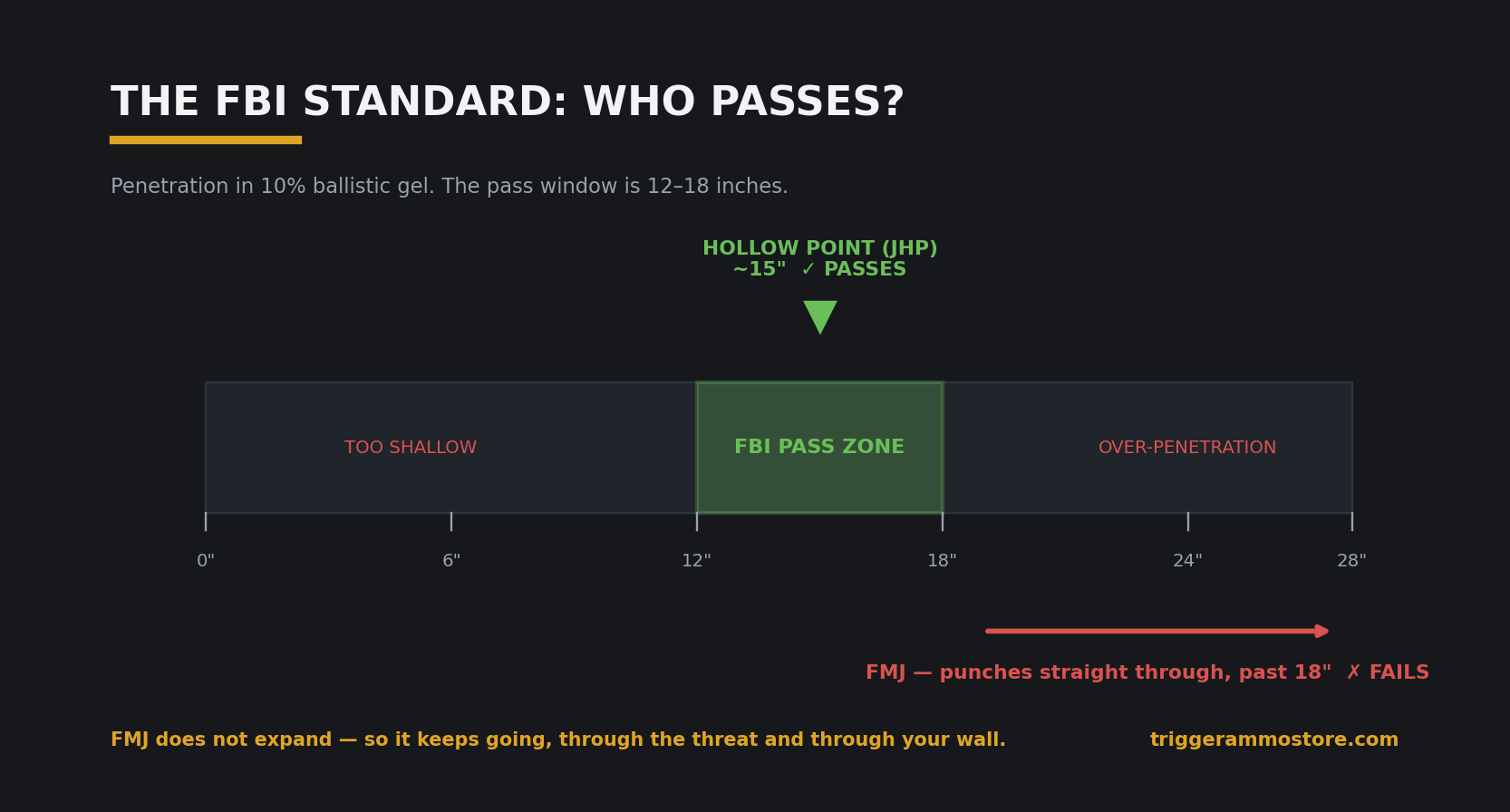
The FBI ballistic protocol fires ammunition into calibrated 10% ballistic gelatin through six barriers: bare gel, heavy clothing, sheet steel, wallboard, plywood, and auto glass.
To pass, a bullet must penetrate 12–18 inches and expand reliably.
- Under 12″ → may not reach vital organs
- Over 18″ → over-penetrates
Quality hollow points pass. FMJ does not — it blows straight through, well past 18 inches, without expanding.
Every serious defensive load is engineered to that standard. That’s what you’re paying for.
Cost: Why FMJ Still Matters
If hollow points are better, why not carry them everywhere?
Price. Roughly:
- FMJ: ~$0.24 per round (9mm, bulk)
- JHP: ~$0.70–1.50 per round
That’s three to six times more. A 200-round practice session costs about $48 in FMJ — and over $200 in premium hollow points.
That’s the real answer to hollow point vs FMJ: you need both.
- Train with FMJ — so you can afford to shoot enough to get good
- Carry JHP — so the rounds that matter actually work
Trigger time is what makes you accurate. Accuracy is what actually stops a threat. Cheap FMJ buys you that trigger time.
Hollow Point vs FMJ: Which Should You Buy?
Here is the whole decision in one table.
| Purpose | Buy |
|---|---|
| Range / practice | FMJ — in bulk |
| Self-defense / concealed carry | Premium JHP |
| Home defense | Premium JHP |
| Duty / barriers | Bonded JHP |
| Hunting | Expanding hunting bullets — never FMJ |
| Competition | FMJ (or match) |
Other bullet types you’ll see
- +P — higher pressure, more velocity. Only if your gun is rated for it.
- Bonded JHP — jacket chemically welded to core; won’t separate through barriers.
- Frangible — designed to disintegrate on hard surfaces. For steel-target ranges.
- Soft point (SP) — exposed lead tip. The rifle-hunting equivalent of a hollow point.
Two Things People Get Wrong
Two myths cloud the hollow point vs FMJ discussion.
“Hollow points are illegal.” Almost never true. They’re legal for civilians in nearly every US state (New Jersey has restrictions on transport/possession outside the home). They’re standard-issue for police nationwide. Check your own state law — but don’t assume they’re banned.
“Hollow points won’t feed in my gun.” They can be pickier than FMJ, because of the bullet profile. That’s exactly why you must test 50 rounds of your chosen defensive load through your actual gun before trusting it. Zero malfunctions, or pick a different load.
The Verdict
The hollow point vs FMJ answer isn’t “which is better” — they’re built for different jobs, and you need both.
Buy bulk FMJ so you can afford to practice. Carry premium hollow points so the shot that counts actually works. Anyone who tells you otherwise is either selling you cheap ammo or has never thought it through.
Shop Both
Stock your range bag and your carry gun. Browse our 9mm ammo, .45 ACP ammo, and .380 ACP ammo — bulk FMJ for training and premium hollow points for defense. Whatever you decide in the hollow point vs FMJ debate, we carry both.
Please buy and use ammunition responsibly and in accordance with all federal, state and local laws. Hollow point ammunition is restricted in some jurisdictions — verify your local law. Always test a defensive load for reliable feeding in your firearm before carrying it. This article is general information, not legal or tactical advice.
Frequently Asked Questions
What is the difference between hollow point vs FMJ? FMJ is a solid, jacketed bullet that doesn’t expand — cheap practice ammo. A hollow point expands to roughly twice its diameter on impact, creating a larger wound channel and reducing over-penetration. Practice with FMJ; carry hollow points.
Can I use FMJ for self-defense? You shouldn’t. FMJ over-penetrates — it can pass through a threat and continue through walls into other rooms. Use quality hollow points for any defensive firearm.
Are hollow points legal? In nearly every US state, yes — they’re standard police issue. New Jersey has restrictions. Always verify your local law.
Why is FMJ so much cheaper? It’s simpler to manufacture and produced in enormous volume. Hollow points require precision engineering and testing to expand reliably.
Do hollow points penetrate walls? Less than FMJ, but they still can. No round is completely stopped by drywall. Always know what’s beyond your target.
What grain should I choose? For 9mm defense, 124gr or 147gr premium JHP. Heavier bullets run subsonic — softer recoil, less flash, better from short barrels.
For official ammunition safety standards and cartridge specifications, visit
SAAMI (Sporting Arms and Ammunition Manufacturers’ Institute)
.

3 Comments
Bestonlineammostore
Amazing blog