
9mm Self Defense Ammo: The Best Proven Loads for 2026
Choosing your 9mm self defense ammo is not a gear decision — it’s a life-safety decision. And unlike most gun-shop debates, this one has real, measurable answers, because every serious defensive load is tested against the FBI’s ballistic protocol.
This guide ranks the loads that actually pass, explains the grain weight question in plain English, and covers the one step most people skip — the step that matters more than which box you buy.
First: Why FMJ Is Not Self-Defense Ammo
Before any brand names, understand this — it’s the most common and most dangerous mistake new gun owners make.
FMJ (Full Metal Jacket) is cheap range ammo. It does not expand. In a defensive shooting it does two bad things:
- It punches a small, straight hole — poor terminal performance
- It over-penetrates — sailing through the threat, through your wall, and into whatever is behind it
That’s a tactical problem, a moral problem, and a legal problem.
JHP (Jacketed Hollow Point) expands to roughly twice its diameter on impact. That creates an effective wound channel and dumps the bullet’s energy inside the target instead of the neighbour’s bedroom.
✅ Practice with FMJ. Carry JHP. Never the reverse.
The Standard: What “Good” Actually Means
After the 1986 Miami shootout — where agents died partly because their ammunition didn’t penetrate deep enough — the FBI built a testing protocol that the entire industry now designs to.
Rounds are fired into calibrated 10% ballistic gelatin through six barriers: bare gel, heavy clothing, sheet steel, wallboard, plywood, and auto glass.
To pass, a load must deliver 12–18 inches of penetration and expand reliably.
- Under 12″ → may not reach vital organs
- Over 18″ → over-penetrates
- Expansion target → at least 1.5× original diameter (~0.53″ for a 9mm)
Every load below clears that bar. That’s the entire point of buying premium 9mm self defense ammo — you’re paying for engineering that’s been verified, not marketing.
The Best 9mm Self Defense Ammo
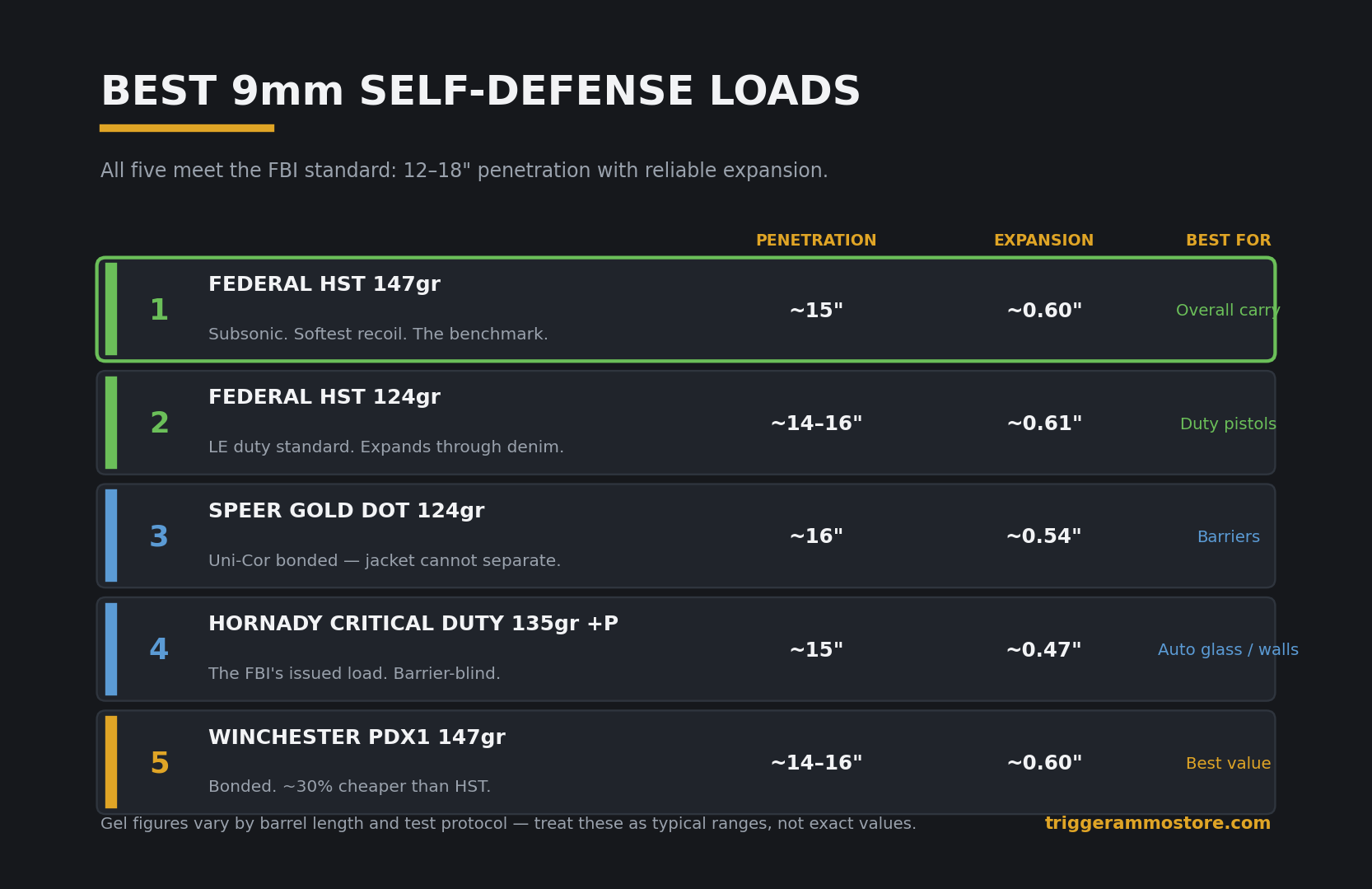
🥇 1. Federal HST 147gr — Best Overall
The benchmark, and the load carried by more American police officers than any other.
It penetrates around 15 inches — sitting almost dead-centre in the FBI window — and expands to roughly 0.60″, nearly double its original diameter. The skived jacket initiates expansion reliably even through heavy clothing, and the nickel-plated case feeds smoothly and resists corrosion when a round sits in a magazine for months.
Why 147 grain? It’s subsonic, which means softer recoil, less muzzle flash in low light, and better performance from short barrels. Same expansion as the 124gr — with less punishment.
Best for: almost everyone. If you don’t want to think about it, buy this.
🥈 2. Federal HST 124gr — The Duty Standard
Identical expansion (~0.61″) at higher velocity. This is the classic law-enforcement duty load and an outstanding all-rounder.
Best for: full-size and duty pistols with 4″+ barrels.
🥉 3. Speer Gold Dot 124gr — Best Through Barriers
Gold Dot’s Uni-Cor bonding electrochemically welds the jacket to the lead core, so they physically cannot separate. Jacket separation is a real failure mode in cheaper hollow points — when the jacket peels away, penetration becomes unpredictable. Gold Dot eliminates it.
Issued by the NYPD and dozens of agencies, with 25+ years of real-world data behind it.
Best for: barrier performance, heavy clothing, and anyone who wants a bonded core.
4. Hornady Critical Duty 135gr +P — The FBI’s Load
This is what the FBI actually issues. The FlexLock bullet has a polymer tip that stops the hollow point clogging with clothing or drywall, plus an InterLock band that mechanically locks jacket to core.
It’s barrier-blind — it behaves consistently whether it hits bare tissue, auto glass, or wallboard first. Expansion is more modest (~0.47″), because it’s built to punch through rather than open wide.
⚠️ It’s +P — higher pressure, more recoil. Verify your pistol is rated for +P, and don’t run it in a subcompact unless you shoot it well.
Best for: duty use, or homes where you might have to shoot through a door or wall.
5. Winchester PDX1 Defender 147gr — Best Value
Bonded hollow point, FBI-protocol performance, roughly 30% cheaper than HST or Gold Dot. This is genuinely defensive-grade ammunition at a budget price.
Best for: stocking a nightstand gun, or carrying premium performance without premium cost.
Also excellent
Hornady Critical Defense 115gr — the FTX polymer tip prevents clothing clog and initiates expansion at the lower velocities that short barrels produce. Purpose-built for pocket 9mms. (Note: penetration runs shallower, so it’s best for very compact guns.)
The Grain Weight Question: 115 vs 124 vs 147
This confuses more buyers than anything else. Here’s the plain version.
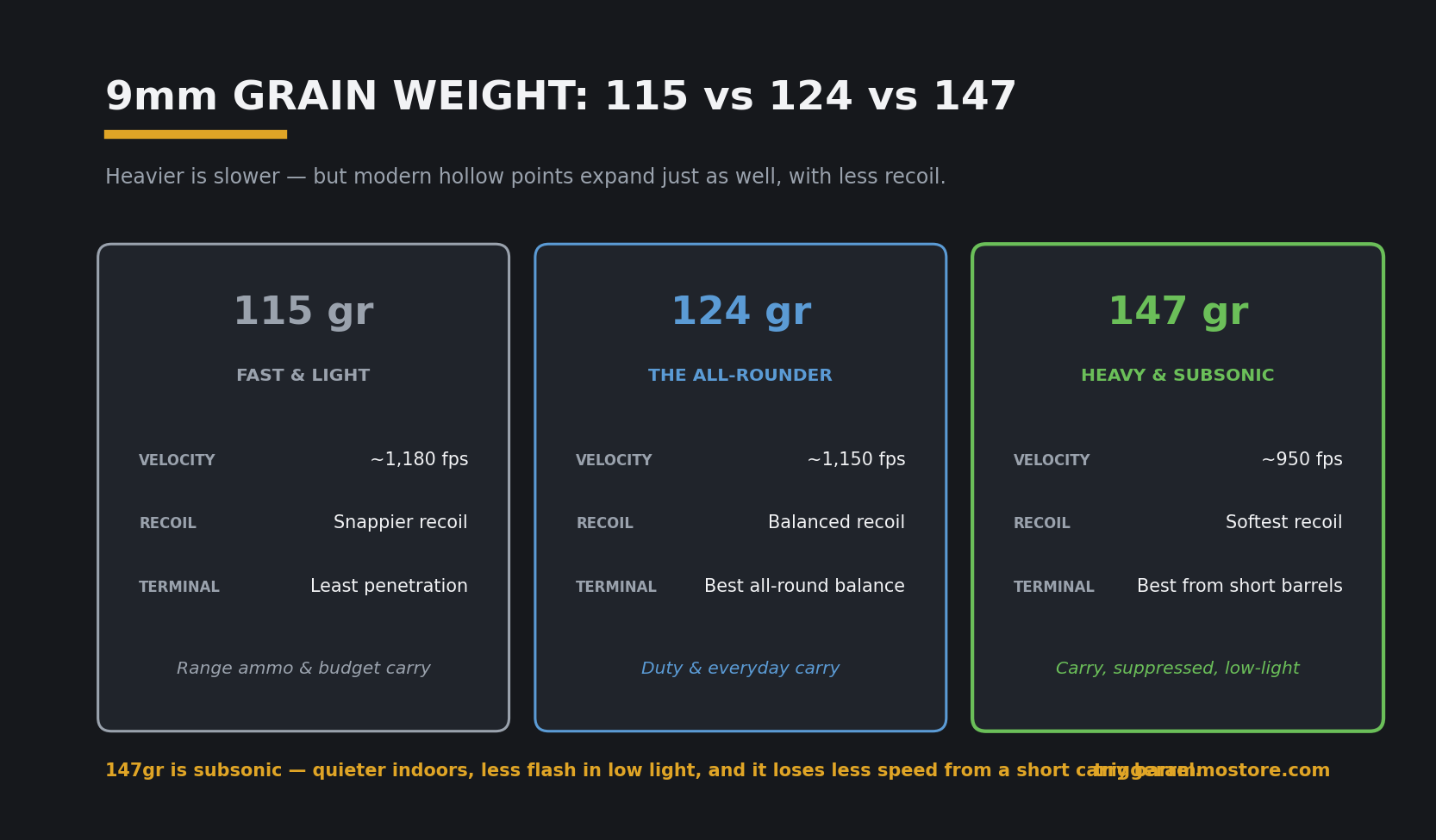
Grain = bullet weight. Heavier bullets go slower. Lighter bullets go faster. In older ammo, faster meant better expansion — so light bullets won.
Modern hollow-point technology changed that. A Federal HST 147gr expands to 0.606″ — essentially identical to the 124gr’s 0.61″ — but does it at subsonic speed.
| Weight | Velocity | Recoil | Best for |
|---|---|---|---|
| 115 gr | ~1,180 fps | Snappy | Range ammo; budget carry |
| 124 gr | ~1,150 fps | Balanced | Duty pistols, everyday carry |
| 147 gr | ~950 fps | Softest | Carry, short barrels, suppressed, low-light |
Why 147gr is the smart default
- Subsonic → quieter indoors (a real consideration for a home-defense gun)
- Less muzzle flash → you keep your night vision in a low-light encounter
- Softer recoil → faster, more accurate follow-up shots
- Loses less velocity from short barrels → it starts slow, so a 3″ barrel costs it proportionally less
Verdict: for most people carrying a modern 9mm, 147 grain premium JHP is the best choice.
⚠️ The Step Almost Everyone Skips
Buy 50 rounds of your chosen defensive load and shoot every single one through your actual carry gun.
Hollow points have a different bullet profile than FMJ. Some pistols feed them flawlessly. Some choke. You do not want to discover which at 2am.
The standard: zero malfunctions in 50 rounds. One failure to feed? Try a different load. Don’t gamble.
Three more things nobody tells you
1. Rotate your carry ammo. Chambering the same round repeatedly causes bullet setback — the bullet gets pushed deeper into the case, raising pressure dangerously. Rotate which round goes on top, and replace your carry ammo every 6–12 months.
2. Barrel length changes everything. Every gel figure you read was recorded from a specific barrel. A 147gr HST from a 3.1″ P365 performs differently than from a 5″ 1911. If you carry a subcompact, choose a load designed for short barrels — HST Micro, Gold Dot Short Barrel, or Hornady Critical Defense.
3. Be honest about the numbers. Published gel figures vary between testing sources, because barrel length and protocol vary. Treat the numbers here as typical ranges, not gospel. Anyone quoting you a penetration depth to two decimal places without stating the barrel length is selling, not informing.
What to Buy — The Simple Answer
| Your situation | Buy |
|---|---|
| Full-size or compact pistol | Federal HST 147gr |
| Subcompact / pocket carry | Federal HST 147gr or Hornady Critical Defense |
| Want a bonded core | Speer Gold Dot 124gr |
| Might shoot through barriers | Hornady Critical Duty 135gr +P |
| Best value | Winchester PDX1 Defender 147gr |
| Range practice | Any bulk FMJ — never carry it |
How much to keep: at minimum, one full magazine, one spare mag, and a sealed backup box. Most people who carry keep 100–200 rounds of defensive ammo on hand.
Shop 9mm Ammo
Stock both — practice ammo and the load you trust. Browse our full range of 9mm ammo — bulk FMJ for high-volume training, plus premium jacketed hollow points from Federal, Speer, Hornady, Winchester and Sig built to defensive standards.
Carrying a smaller pistol? See our .380 ACP ammo for pocket-carry defensive loads.
Please buy and use ammunition responsibly and in accordance with all federal, state and local laws. Always test a defensive load for reliable feeding in your specific firearm before carrying it. This article is general information — not legal, tactical, or professional training advice, and it is no substitute for qualified instruction. You must meet all legal requirements to purchase, and ammunition cannot be shipped to every jurisdiction — check your local regulations before ordering.
Frequently Asked Questions
What is the best 9mm self defense ammo? Federal HST 147gr is the most widely trusted choice — around 15″ of penetration and ~0.60″ expansion, right in the FBI window, with subsonic velocity and soft recoil. Speer Gold Dot 124gr is the top bonded-core alternative.
Can I use FMJ for self-defense? You shouldn’t. FMJ doesn’t expand and over-penetrates — it can pass through a threat and continue through walls. Use FMJ for practice only.
Is 115, 124 or 147 grain better for self-defense? 147 grain is generally best in modern hollow points — it expands as well as lighter bullets, runs subsonic, produces less flash and recoil, and performs better from short barrels. 124 grain is an excellent all-rounder.
What’s the difference between Critical Duty and Critical Defense? Critical Duty is built for full-size pistols and barrier penetration (auto glass, doors). Critical Defense is optimised for short-barrel concealed-carry pistols in direct-fire scenarios.
Should I use +P ammo? Only if your pistol is rated for it, and only if you shoot it well. +P adds velocity and recoil. In subcompacts it’s usually counterproductive — standard-pressure premium loads already perform.
How often should I replace my carry ammo? Every 6–12 months, and rotate which round gets chambered to prevent bullet setback from repeated cycling.
How many rounds should I test before carrying a load? At least 50, with zero malfunctions. A single failure to feed means try a different load.
For public land hunting information and outdoor recreation resources, visit the
Bureau of Land Management
.
For firearm safety resources, shooting sports education, and industry information, visit the
National Shooting Sports Foundation (NSSF)
.
For official ammunition safety standards and cartridge specifications, visit
SAAMI (Sporting Arms and Ammunition Manufacturers’ Institute)
.


2 Comments