
.45 ACP Explained: The Best Proven Guide
The .45 ACP has been in service since 1905, and it refuses to go quietly. Newer cartridges beat it on capacity, cost, and recoil — and yet it endures, carried by people who value one thing above all: a big bullet that makes a big hole.
This guide explains what the .45 ACP actually does, where it excels, where it doesn’t, and exactly which load to buy for your job.
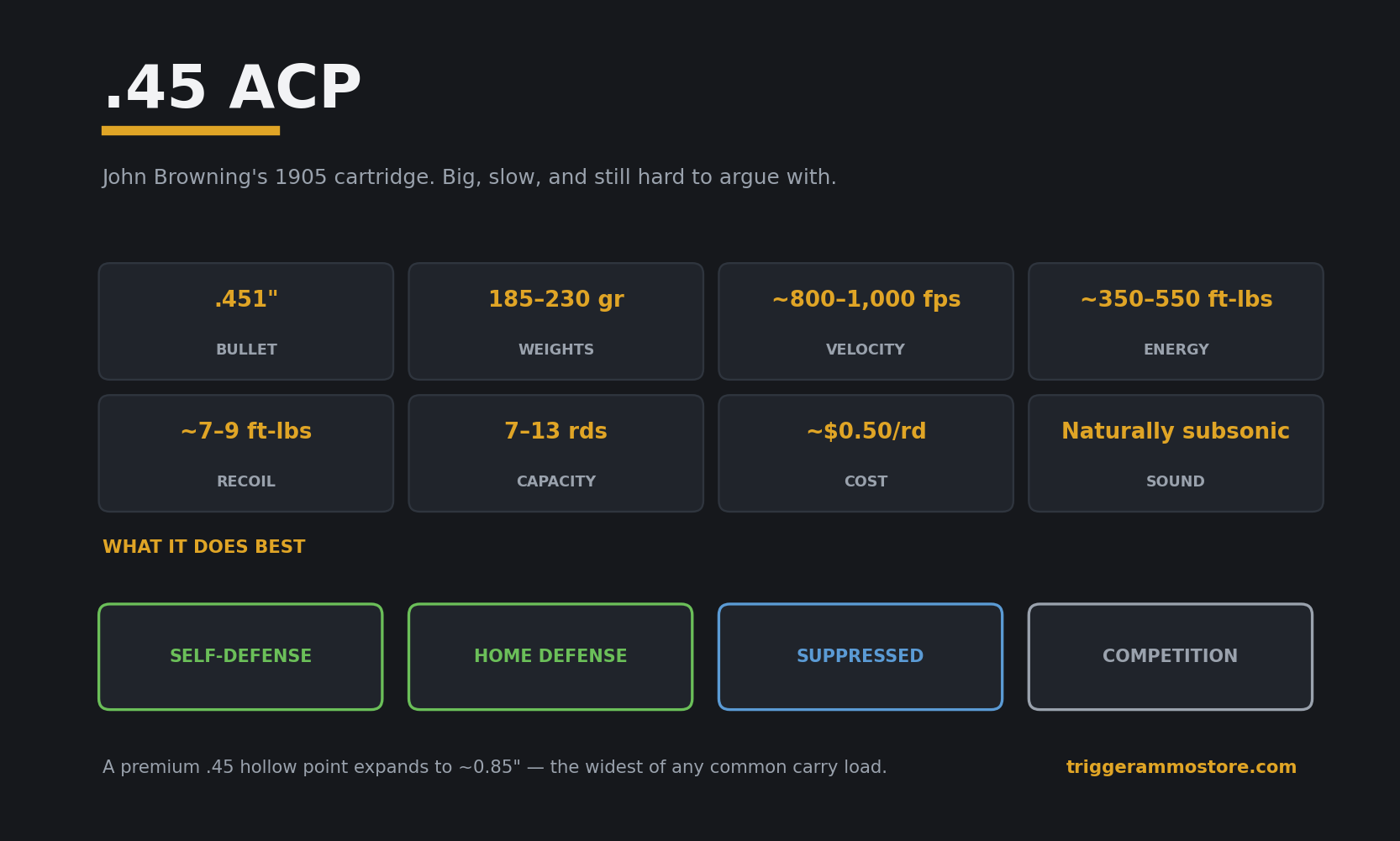
What Is the .45 ACP?
ACP stands for Automatic Colt Pistol. The cartridge was designed by John Browning in 1905 for the pistol that became the M1911 — and it served as the standard US military sidearm cartridge for 74 years, through both World Wars.
Its design philosophy is the opposite of the 9mm’s. Where the 9mm chose small and fast, the .45 ACP chose big and slow: a heavy .451-inch bullet ambling along at 800–1,000 fps.
📛 A naming note
You’ll see .45 ACP and .45 Auto used interchangeably. They are the same cartridge. Don’t overthink it.
⚠️ But .45 Colt (also called .45 Long Colt) is a completely different, non-interchangeable revolver cartridge. Don’t mix them up.
.45 ACP Ballistics
| Spec | Value |
|---|---|
| Bullet diameter | .451″ |
| Common weights | 185, 200, 230 grain |
| Muzzle velocity | ~800–1,000 fps |
| Muzzle energy | ~350–550 ft-lbs |
| Max pressure | 21,000 psi (+P: 23,000) |
| Recoil | ~7–9 ft-lbs |
| Typical capacity | 7–13 rounds |
Notice the pressure. At 21,000 psi, this is a genuinely low-pressure cartridge — roughly half a 9mm’s. That’s why its recoil feels like a slow push rather than a sharp snap, and it’s why so many experienced shooters simply prefer the way it shoots.
The Real Advantage: It Starts Big
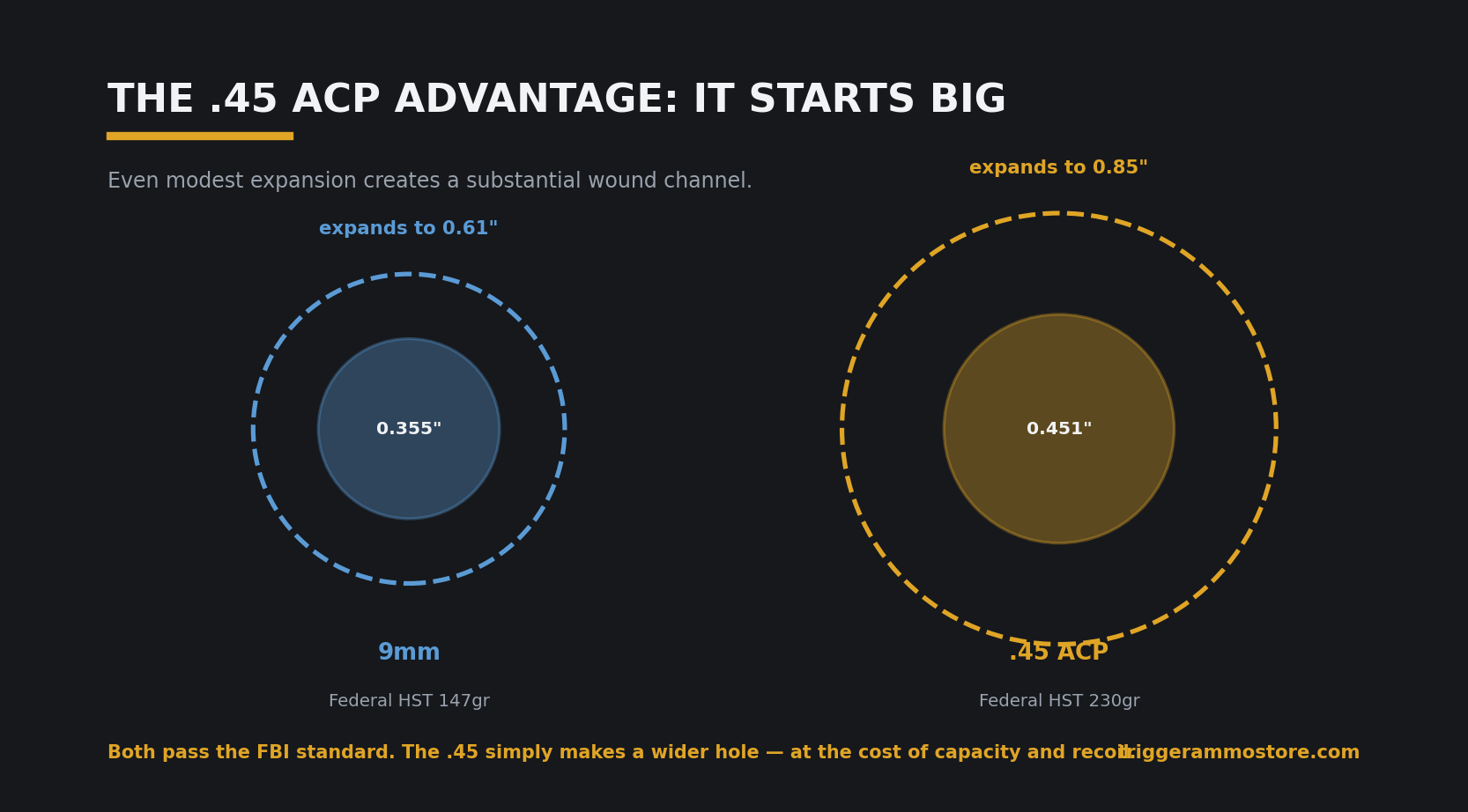
Here’s the genuine, measurable edge of the .45.
A 9mm bullet starts at .355″. A .45 starts at .451″ — already 27% wider before anything happens.
Then it expands. A premium Federal HST 230gr opens to roughly 0.85 inches — the widest expansion of any common defensive handgun load, with around 14″ of penetration, comfortably inside the FBI’s 12–18″ window.
For comparison, a top 9mm load expands to about 0.61″.
That’s not marketing. It’s a bigger hole. In the terminal-performance argument, this is the .45’s trump card — and it’s why the cartridge has never gone away.
Grain Weights: What to Buy
- 185gr — lighter, faster, snappier. Common in competition loads.
- 200gr — a middle ground, popular with competitive shooters.
- 230gr — the sweet spot. The original military weight, and the best choice for both practice and defense. If you’re unsure, buy 230gr.
Unlike 9mm — where the grain debate genuinely matters — the .45 ACP is refreshingly simple. 230 grain does almost everything well.
Naturally Subsonic: The Suppressor Advantage
Here’s an underrated feature. Because the .45 pushes a heavy bullet at modest speed, standard 230gr loads sit below the speed of sound — no supersonic crack.
That makes it one of the best suppressed handgun cartridges available, with no need for special subsonic ammunition. A suppressed .45 is genuinely quiet.
What About +P?
+P loads run at higher pressure (23,000 psi versus 21,000) for extra velocity. .45 Super goes further still.
These push the .45 toward 10mm territory — but:
- Check your pistol is rated for +P. Many older 1911s aren’t.
- You usually don’t need it. Standard-pressure 230gr HST already passes the FBI protocol with the widest expansion in the business.
Where the .45 ACP Falls Short
An honest guide has to say this.
- Capacity — 7–13 rounds versus a 9mm’s 15–17. That’s a real defensive consideration.
- Cost — roughly $0.50 per round versus a 9mm’s $0.24. Twice the price means half the practice.
- Recoil — mild in a heavy 1911, but noticeably more than 9mm, especially in a lightweight polymer compact.
- Trajectory — it’s a slow, heavy bullet. Past 50 yards it drops fast. The .45 ACP is not a hunting or distance cartridge.
And the honest verdict from the professionals: modern 9mm hollow points now match .45 terminal performance in FBI testing, which is precisely why the Bureau went back to 9mm in 2015. The .45 isn’t better — it’s different, and it’s still excellent.
What Is the .45 ACP Good For?
Self-defense and carry. Outstanding, with a century of proven performance. The widest expansion of any common carry load. Accept the capacity trade-off and you’re extremely well armed.
Home defense. Excellent — subsonic (quieter indoors), low flash, and hard-hitting.
Suppressed shooting. Among the best there is, with no special ammo required.
Competition. A mainstay of IDPA, USPSA and Bullseye. Its soft, rolling recoil is genuinely pleasant to shoot in volume.
The 1911. It’s a wonderful pistol, and wanting one is a perfectly good reason to shoot this cartridge. Nobody needs to justify that.
Not for: hunting, or anything past 50 yards.
Which .45 ACP Ammo Should You Buy?
| Purpose | Buy |
|---|---|
| Range / practice | 230gr FMJ — in bulk |
| Self-defense / carry | Federal HST 230gr (widest expansion) or Speer Gold Dot 230gr (bonded) |
| Home defense | 230gr premium JHP |
| Suppressed | Standard 230gr — it’s already subsonic |
| Competition | 185–200gr |
⚠️ Never carry FMJ for defense. It doesn’t expand and it over-penetrates. Train with FMJ; carry hollow points.
Shop .45 ACP Ammo
Browse our full range of .45 ACP ammo — bulk 230gr FMJ for high-volume practice, plus premium jacketed hollow points from Federal, Speer, Hornady and Winchester for carry and home defense.
Comparing calibers? See our 9mm ammo and 10mm ammo selections.
Please buy and use ammunition responsibly and in accordance with all federal, state and local laws. .45 ACP and .45 Colt are NOT interchangeable — confirm your pistol’s chambering. Verify your firearm is rated for +P before using it. Always test a defensive load for reliable feeding before carrying it. This article is general information, not legal or tactical advice.
Frequently Asked Questions
What does ACP stand for? Automatic Colt Pistol. The .45 ACP and .45 Auto are the same cartridge — but .45 Colt is a completely different, non-interchangeable revolver round.
What grain .45 ACP should I buy? 230 grain for almost everything — practice and defense alike. It’s the original military weight and the sweet spot.
Is the .45 good for self-defense? Yes, excellent. A premium 230gr hollow point expands to roughly 0.85 inches — the widest of any common carry load — with FBI-standard penetration.
Is .45 ACP better than 9mm? Not “better” — different. The .45 makes a wider hole; the 9mm holds nearly twice as many rounds, kicks less, and costs half as much. Both pass the FBI standard.
Is the .45 subsonic? Yes — standard 230gr loads are naturally subsonic, making it an excellent suppressed cartridge with no special ammunition needed.
Do I need +P? Usually not. Standard-pressure premium loads already deliver excellent terminal performance. Only use +P if your pistol is rated for it.
What’s the effective range? Realistically inside 50 yards. It’s a heavy, slow bullet that drops quickly — a defensive cartridge, not a distance round.
Can I hunt with a .45? Not really. It’s too slow and drops too fast. For handgun hunting, look at 10mm or a magnum revolver cartridge.
For firearm safety resources, shooting sports education, and industry information, visit the
National Shooting Sports Foundation (NSSF)
.

1 Comment