
Bullet Grain Weight: The Best Proven Guide
Walk into any ammo aisle and you’ll see the same caliber offered in three or four different bullet grain weight options. 115, 124, 147. Or 55, 62, 77. Nobody explains what it means, and most people just grab whatever’s cheapest.
This guide fixes that. Here’s what bullet grain weight actually is, the myth almost everyone believes, and exactly which grain to buy for what you’re doing.
Bullet Grain Weight: What Does “Grain” Actually Mean?
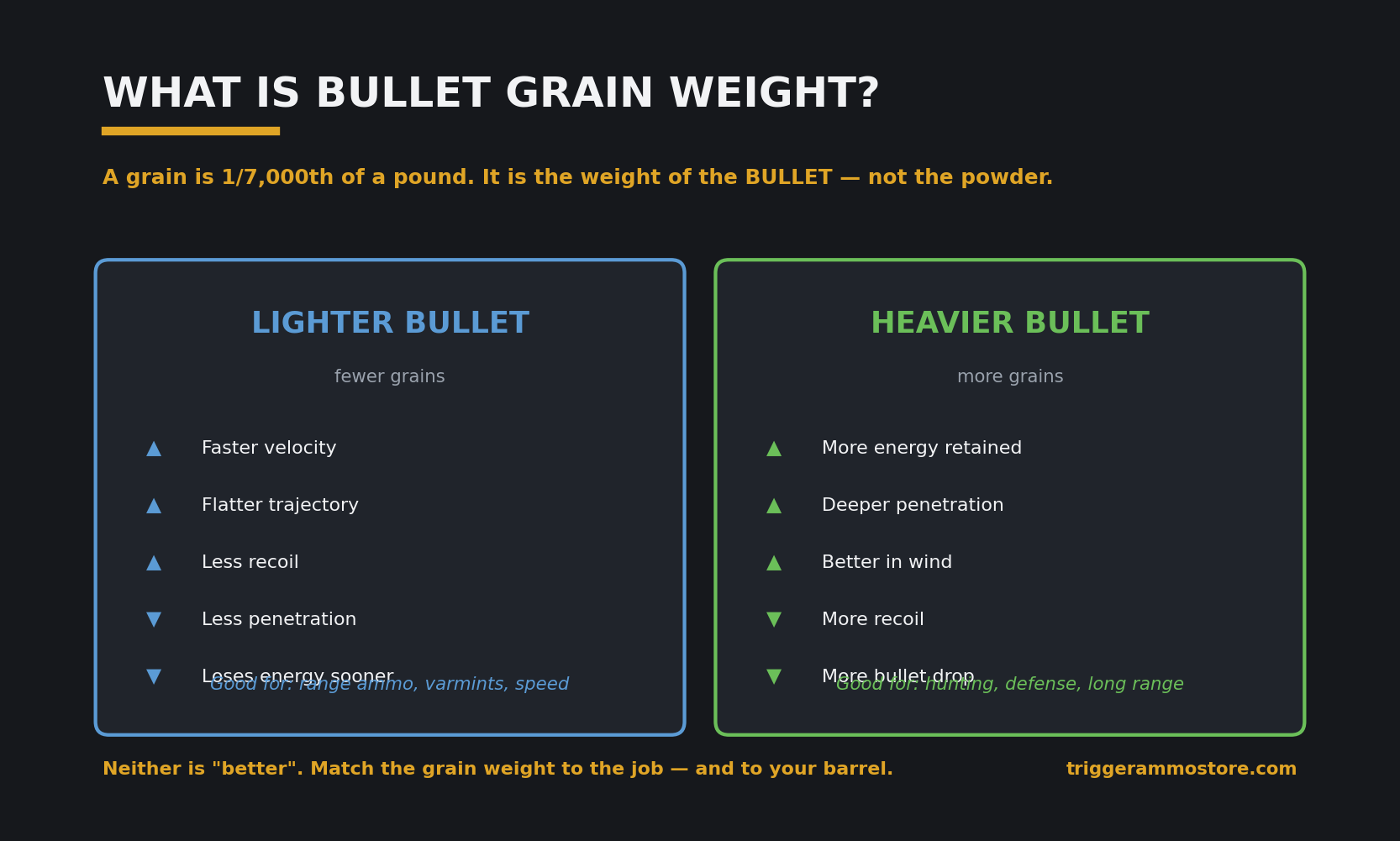
A grain is a unit of weight. Specifically: 1 grain = 1/7,000th of a pound.
It’s an old measurement — originally based on the weight of a single grain of barley — and it survived in the ammunition world because it’s precise enough for objects as small as bullets.
So a 147-grain 9mm bullet weighs 147/7,000ths of a pound. That’s it. That’s the whole concept.
⚠️ The Myth Almost Everyone Believes
Bullet grain weight is NOT the amount of gunpowder in the cartridge.
This single misunderstanding causes more confusion about bullet grain weight than anything else. This is far and away the most common misconception, and it trips up nearly every new shooter. The number on the box — 115gr, 230gr, 55gr — refers to the weight of the projectile only.
(Confusingly, powder charges are also measured in grains — but only reloaders ever see that number. It never appears on a factory box.)
When you see a grain weight on ammunition, it means the bullet. Always.
Bullet Grain Weight: Heavier vs Lighter
There’s no “better” bullet grain weight — only trade-offs. Here’s the physics in plain English.
Lighter bullets (fewer grains)
- ✅ Faster — more velocity from the same powder
- ✅ Flatter trajectory — less drop at distance
- ✅ Less recoil — less mass moving backward
- ❌ Less penetration — they shed energy sooner
- ❌ More affected by wind at long range
Heavier bullets (more grains)
- ✅ Retain energy better — they carry momentum downrange
- ✅ Penetrate deeper — critical for hunting and barriers
- ✅ Buck the wind better — higher ballistic coefficient
- ❌ More recoil
- ❌ More bullet drop — they start slower
The old rule was “faster is better.” Modern bullet engineering broke it. A 147gr 9mm hollow point now expands just as reliably as a 124gr — but at subsonic speed, with less recoil and less muzzle flash.
The Bullet Grain Weight Cheat Sheet
Handgun grain weights
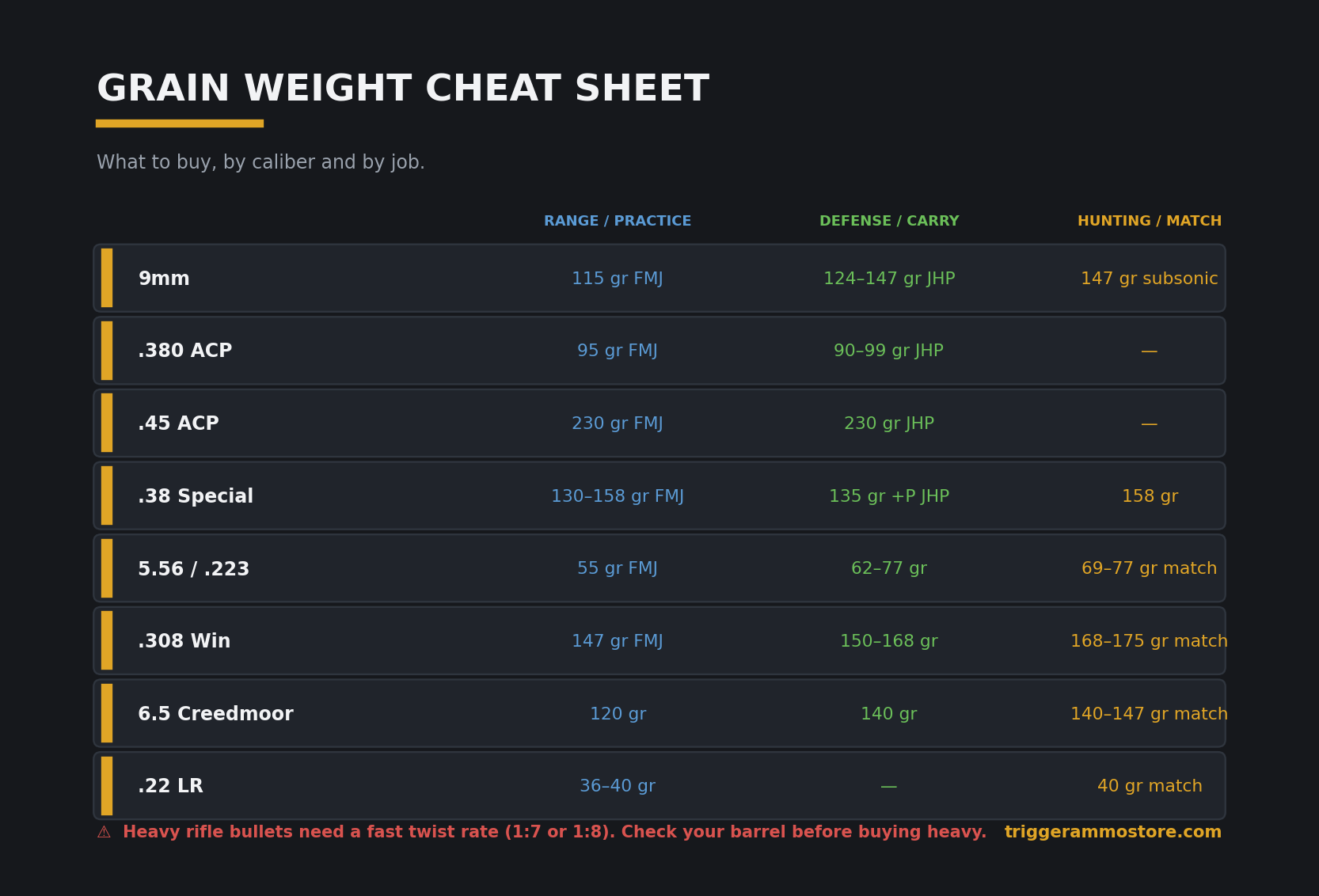
9mm — the classic three-way split:
- 115gr — cheapest, fastest, snappy. The range load.
- 124gr — the all-rounder. Best balance. Standard duty weight.
- 147gr — heaviest and subsonic. Softest recoil, least flash, best from short barrels. The modern carry choice.
.380 ACP — 90–99gr. Stick to 90–99gr defensive loads; the cartridge is velocity-limited and needs a bullet engineered to expand at low speed.
.45 ACP — 230gr is the sweet spot for both practice and defense. The bullet is already big; you don’t need to chase velocity.
.38 Special — 130–158gr for practice; 135gr +P for a snub-nose carry gun.
Rifle grain weights
5.56 / .223:
- 55gr — the cheap bulk range load (M193)
- 62gr — M855 “green tip,” steel penetrator core
- 69–77gr — heavier match and defensive bullets. ⚠️ These need a fast twist rate (see below)
.308 Winchester:
- 147–150gr — bulk FMJ practice
- 150–168gr — deer hunting
- 168–175gr — match grade and long range
6.5 Creedmoor — 140–143gr is the sweet spot for almost everything.
.22 LR — 36–40gr covers essentially the entire market.
⚠️ Twist Rate: The Thing That Ruins Heavy Bullets
Here’s the trap that catches rifle shooters, and it matters more than the bullet grain weight itself.
Your barrel’s twist rate determines which bullets it can stabilise. Twist is written as a ratio — 1:7, 1:8, 1:9 — meaning one full bullet rotation per 7, 8, or 9 inches of barrel.
Faster twist (1:7, 1:8) = stabilises heavier bullets. Slower twist (1:9, 1:12) = only stabilises lighter bullets.
Buy 77gr match ammo for a 1:9 barrel and the bullet may keyhole — tumbling instead of flying straight. Your groups will be terrible and you’ll blame the ammo.
Check your barrel stamp before buying heavy bullets. Most modern AR-15s are 1:7 or 1:8 and handle everything.
Which Bullet Grain Weight Should You Buy?
| Job | Buy |
|---|---|
| Range / high-volume practice | The lightest, cheapest load — 115gr 9mm, 55gr 5.56 |
| Self-defense / carry | Mid-to-heavy premium JHP — 124–147gr 9mm |
| Home defense | Heavy subsonic — 147gr 9mm (quieter, less flash indoors) |
| Deer hunting | Mid-weight expanding — 150–165gr .308 |
| Elk / big game | Heavy bonded — 165–180gr .308 |
| Long-range / match | Heaviest your twist allows — 168–175gr .308, 140gr 6.5 CM |
| Suppressed | Heaviest / subsonic — 147gr 9mm, 220gr .300 BLK |
The Honest Verdict on Bullet Grain Weight
Does bullet grain weight matter? Yes — but far less than two other things:
- Bullet TYPE matters more than weight. A 147gr FMJ is useless for defense; a 147gr hollow point is excellent. Never hunt or carry with FMJ, regardless of grain.
- Shot placement matters more than either. A well-placed 115gr beats a poorly-placed 147gr every single time.
Buy the grain weight your gun likes, that suits your job, and that you can afford to practice with. Then stop worrying about it and go shoot.
Shop Ammo by Grain Weight
Whatever you shoot, we stock the full range of weights. Browse 9mm ammo, .45 ACP ammo, 5.56 NATO ammo, .223 ammo, .308 Winchester ammo, 6.5 Creedmoor ammo, and .22 LR ammo — from light bulk range loads to heavy match and hunting bullets.
Please buy and use ammunition responsibly and in accordance with all federal, state and local laws. Always confirm your firearm’s chambering and twist rate before selecting a bullet weight. You must meet all legal requirements to purchase, and ammunition cannot be shipped to every jurisdiction.
Frequently Asked Questions
What does grain mean in ammo? It’s the weight of the bullet. One grain equals 1/7,000th of a pound. A 147-grain 9mm bullet weighs 147/7,000ths of a pound.
Is grain the amount of gunpowder? No. This is the most common misconception. The grain number on a box of ammunition refers to the weight of the bullet, not the powder charge.
Is a heavier bullet grain weight better? Not automatically. Heavier bullets penetrate deeper and retain energy better, but recoil more and drop faster. Lighter bullets are faster and flatter. Match the weight to the job.
What grain 9mm should I buy? 115gr FMJ for cheap range practice. 124gr or 147gr premium hollow points for carry and home defense.
What grain 5.56 should I buy? 55gr FMJ for bulk range use. 62–77gr for defense and match work — but check your twist rate first.
Does bullet grain weight affect recoil? Yes. Heavier bullets generally produce more felt recoil, all else being equal.
What twist rate do I need for heavy bullets? Faster twist stabilises heavier bullets. For 5.56, use 1:7 or 1:8 for 62–77gr. A 1:9 barrel is best kept to lighter 55gr loads.
For firearm safety resources, shooting sports education, and industry information, visit the
National Shooting Sports Foundation (NSSF)
.

1 Comment