
Best Hog Hunting Calibers for the AR Platform
Choosing among the many hog hunting calibers is different from choosing a deer round, and that trips up a lot of hunters. Hogs are built to absorb punishment — thick hide, dense muscle, and on mature boars, a gristle “shield” over the shoulder that can stop a bullet meant for a whitetail. You need penetration and energy, not just speed. This guide covers the top AR hog hunting calibers, the shot placement most hunters get wrong, and why 2026 changed the game for night hunting.
Why the AR Platform Rules Hog Hunting
Hogs come in groups, they run, and they’re often hunted at night. That’s a recipe the AR is built for: fast follow-up shots, high capacity, easy optics and light mounting, and mild recoil. When a sounder scatters, a bolt gun gives you one pig. An AR can give you several.
What Hogs Actually Demand
Before the picks, understand what separates good hog hunting calibers from the rest:
- Penetration — a mature boar’s shoulder shield is gristle and scar tissue. A bullet that fragments on impact may never reach the vitals.
- Energy — you want authority, not just velocity. Bigger, heavier bullets earn their keep here.
- Bullet construction — this matters more than caliber. Bonded, hard-cast, or controlled-expansion bullets hold together. Varmint bullets come apart.
- Range honesty — most hog shots happen inside 150 yards, often at night. Long-range performance is largely irrelevant.
The Top Hog Hunting Calibers
.300 Blackout — Best for Night Hunting
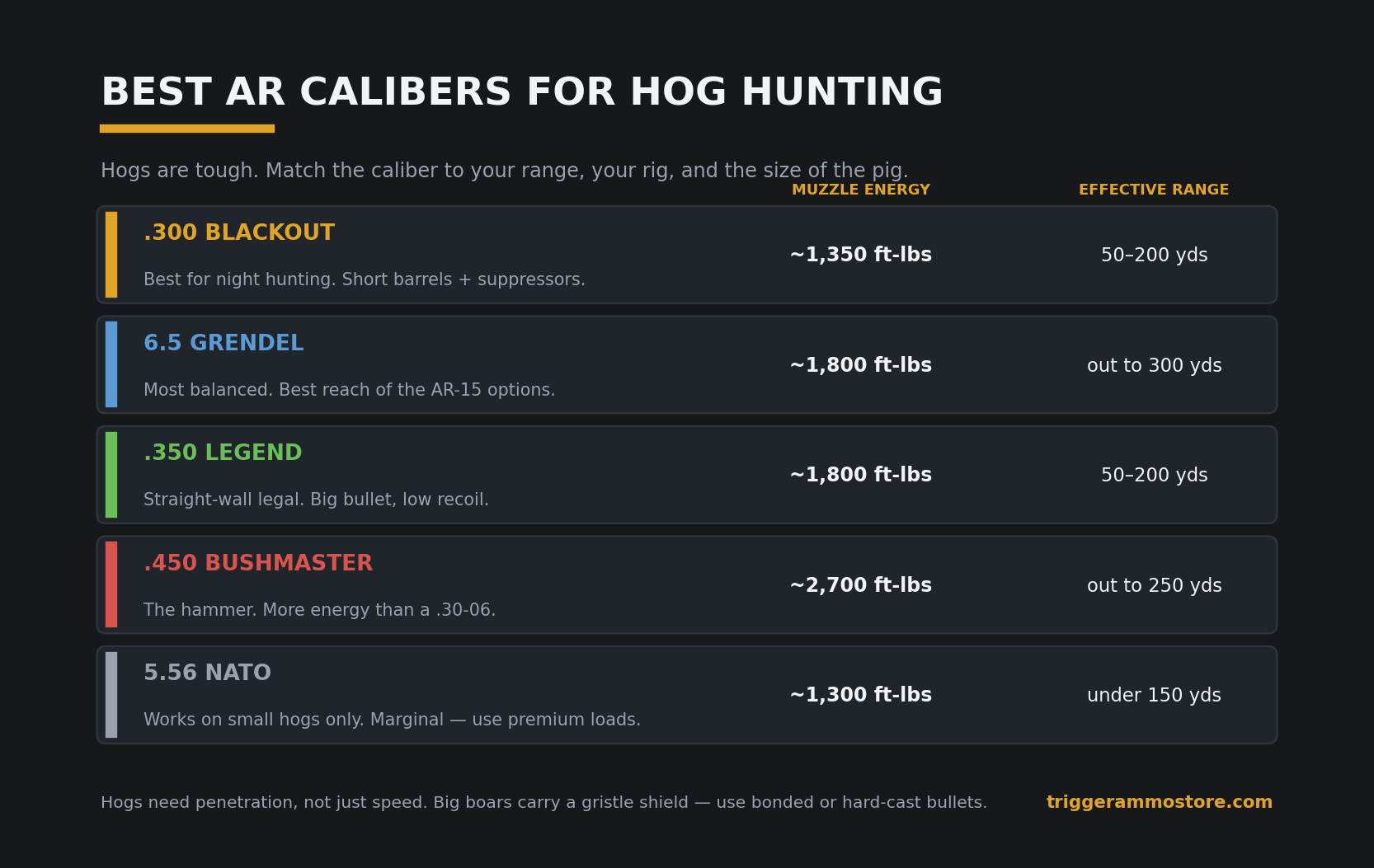
The king of the modern hog rig. The .300 Blackout was designed to deliver .30-caliber energy from a short barrel, and it pairs beautifully with a suppressor and a thermal optic — which is how most serious hog hunting is done now. Supersonic loads (110–125 gr at ~2,200 fps) hit hard inside 200 yards.
Why it wins at night: compact, quiet, and low-flash. A suppressed .300 BLK lets you take a second and third pig before the sounder figures out what happened.
⚠️ Critical safety note: .300 Blackout uses the same magazines and lower as 5.56. A .300 BLK round can chamber and fire in a 5.56 barrel, destroying the rifle. Label your magazines. Never mix them in the same bag.
6.5 Grendel — Most Balanced
If your hog hunting includes longer shots across a field, the 6.5 Grendel is the most well-rounded of the AR-15 hog hunting calibers. It carries meaningfully more energy than 5.56, shoots flat enough to stretch to 300 yards, and its high-BC bullets penetrate deeply. The 123-grain loads are a proven hog performer.
Trade-off: requires a dedicated bolt and magazines.
.350 Legend — Straight-Wall States
Built for hunters restricted to straight-wall cartridges, the .350 Legend puts a big .357-inch bullet downrange with surprisingly light recoil. A 180-grain load at ~2,100 fps delivers excellent energy transfer and penetration inside 200 yards — ideal in thick cover where most hogs are actually shot.
Trade-off: limited range, and it needs dedicated magazines.
.450 Bushmaster — Maximum Stopping Power
The hammer. The .450 Bushmaster pushes a ~250-grain bullet at roughly 2,200 fps for more than 2,500 ft-lbs of muzzle energy — more than a .30-06 — all from a standard AR-15 lower. On a big boar inside 200 yards, nothing on this list hits harder.
Trade-offs: heavy recoil, expensive ammo, dedicated bolt and magazines, and steep bullet drop past 150 yards.
5.56 NATO — Marginal (Be Honest)
Can you kill hogs with 5.56? Yes — plenty of people have. Should you? Only with a premium bonded or monolithic bullet, on smaller hogs, at close range, with excellent shot placement. Standard FMJ or varmint loads are a genuinely bad idea on a big boar; they lack the penetration to reach vitals through a shield.
If 5.56 is your only option, buy the best hunting-specific load you can and keep shots close.
Shot Placement: The Mistake Most Hunters Make
This is the most important section in the article, and it’s the one most guides skip.
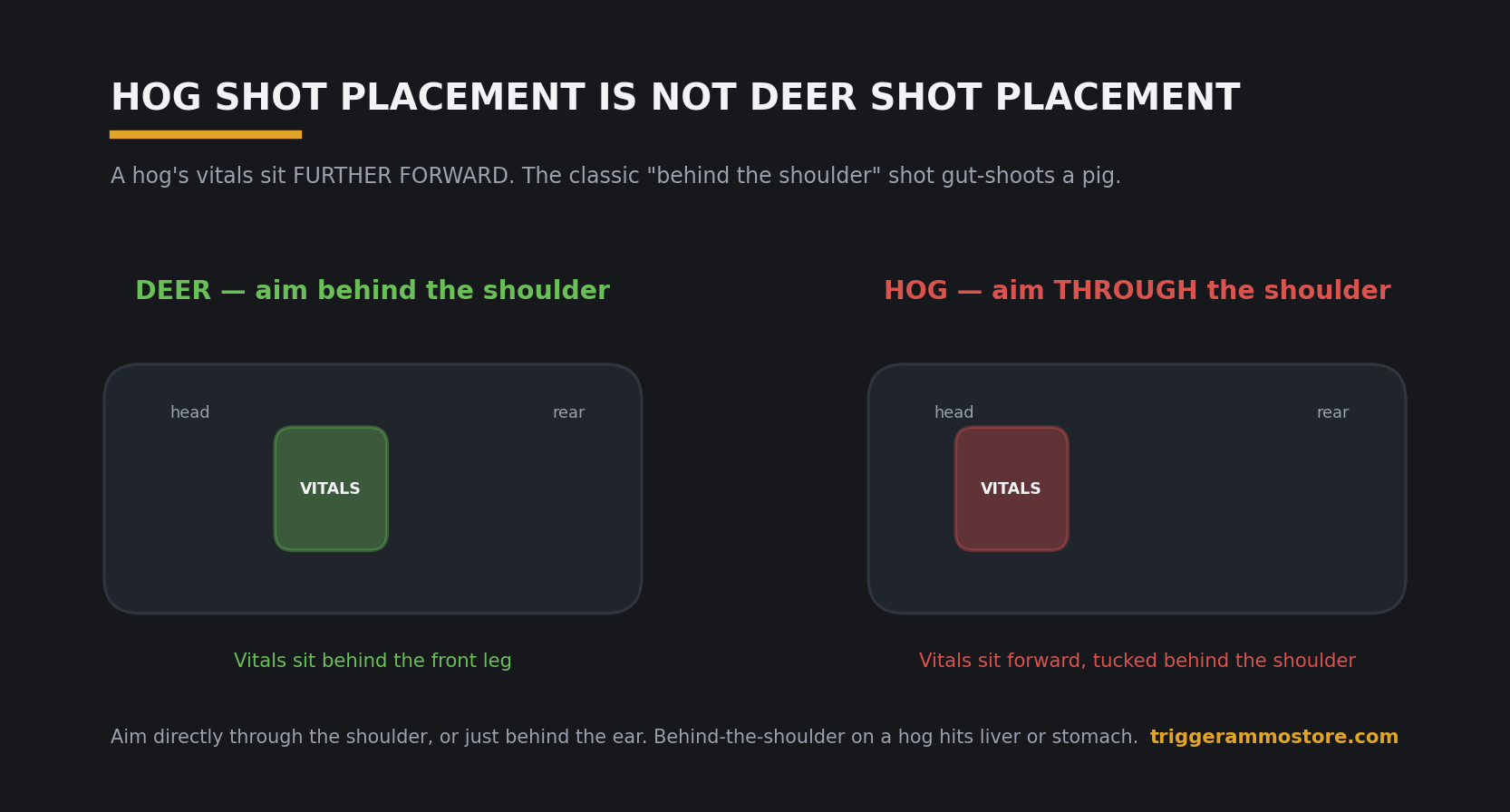
A hog’s lungs and heart sit further forward than a deer’s. The classic whitetail shot — behind the shoulder — will put your bullet through a hog’s liver or stomach. That means a wounded animal, a long track, and often a lost pig.
Aim directly through the shoulder, or take a head/neck shot just behind the ear if you’re confident. Driving through the shoulder means punching bone and shield, which is exactly why penetration matters so much in your caliber and bullet choice.
What Changed in 2026: Suppressors Got Cheap
The $200 NFA tax stamp was eliminated effective January 1, 2026, and it has transformed hog hunting. Suppressors are now far more accessible, and manufacturers have responded — threaded, suppressor-ready barrels are the default on new rifles.
Why this matters for hogs specifically: a suppressed rifle doesn’t spook the rest of the sounder. Combined with a thermal optic, a suppressed .300 Blackout or 6.5 Grendel lets you work through a group of pigs instead of getting one shot at them. If you hunt hogs seriously and haven’t looked at a suppressor since the tax change, look again.
For official ammunition safety standards and cartridge specifications, visit
SAAMI (Sporting Arms and Ammunition Manufacturers’ Institute)
.
For hunting regulations, wildlife conservation, and federal hunting information, see the
U.S. Fish & Wildlife Service
.
Which Should You Choose?
| Your situation | Caliber |
|---|---|
| Night hunting with thermal + suppressor | .300 Blackout |
| Longer shots, most versatile | 6.5 Grendel |
| Straight-wall state | .350 Legend |
| Big boars, maximum power | .450 Bushmaster |
| It’s the AR you already own | 5.56 — with premium bonded loads only |
For most hog hunters, the .300 Blackout is the answer — it fits how hogs are actually hunted. If your shots stretch out, go 6.5 Grendel. If you’re facing 300-pound boars in thick brush, the .450 Bushmaster ends arguments.
Ammo Matters More Than Caliber
Whatever you choose, the bullet is what does the work. For hogs:
- ✅ Bonded, monolithic, or hard-cast bullets — they hold together and drive deep through shield and bone.
- ❌ FMJ and varmint bullets — no expansion or too much fragmentation. Wrong tool.
Shop Hog Hunting Ammo
Gear up for the season. Browse our selection of .300 Blackout ammo, 6.5 Grendel ammo, .350 Legend ammo, .450 Bushmaster ammo, and 5.56 NATO ammo — including bonded and controlled-expansion hunting loads built to penetrate.
Please buy and use ammunition responsibly and in accordance with all federal, state and local laws, including hunting regulations, night-hunting rules, and caliber restrictions in your area — these vary significantly by state. Never mix .300 Blackout and 5.56 ammunition. You must meet all legal requirements to purchase, and ammunition cannot be shipped to every jurisdiction.
FAQ
What is the best caliber for hog hunting? For most AR hunters, the .300 Blackout — it excels at the short ranges and night conditions where hogs are actually hunted, especially suppressed. The 6.5 Grendel is more versatile at distance, and the .450 Bushmaster hits hardest.
Can you hunt hogs with 5.56? Yes, but it’s marginal. Use a premium bonded or monolithic bullet, keep shots close, and stick to smaller hogs. Never use FMJ.
Where do you shoot a hog? Directly through the shoulder, or just behind the ear. A hog’s vitals sit further forward than a deer’s — the classic behind-the-shoulder shot will gut-shoot it.
Is a suppressor worth it for hog hunting? Yes, and more than ever. With the NFA tax stamp eliminated in 2026, suppressors are far cheaper. A suppressed rifle doesn’t scatter the sounder, so you get multiple shots.
What’s the most powerful AR-15 hog caliber? The .450 Bushmaster — over 2,500 ft-lbs of muzzle energy, more than a .30-06, from a standard AR-15 lower.
Do I need a special bolt or magazine? Yes for 6.5 Grendel, .350 Legend, and .450 Bushmaster. .300 Blackout runs on standard 5.56 magazines — which is exactly why you must label them to avoid a dangerous mix-up.
