
.243 vs 6.5 Creedmoor: Which Is Better for Hunting?
The .243 vs 6.5 Creedmoor debate comes up every deer season, and for good reason: both are short-action, mild-recoiling cartridges that kill deer cleanly without beating up the shooter. But they were designed 50 years apart to solve different problems — and the right choice depends entirely on what you hunt and how far.
The Quick Answer
- Choose the .243 Winchester if you want the lightest recoil, hunt deer inside 300 yards, and want a rifle that doubles as a varmint and predator gun.
- Choose the 6.5 Creedmoor if you want more energy on target, plan to shoot past 300 yards, or might hunt larger game.
Where They Came From
The .243 Winchester arrived in 1955 — essentially a .308 case necked down to hold a .243-inch bullet. Winchester built it as a dual-purpose varmint and deer cartridge, and that dual identity is still its greatest strength.
The 6.5 Creedmoor came in 2007 from Hornady, designed for long-range competition. It fires a heavier, sleeker .264-inch bullet with a high ballistic coefficient — a bullet that slices through wind and holds velocity far downrange. It only later became a hunting favorite.
Ballistics: The Real Differences
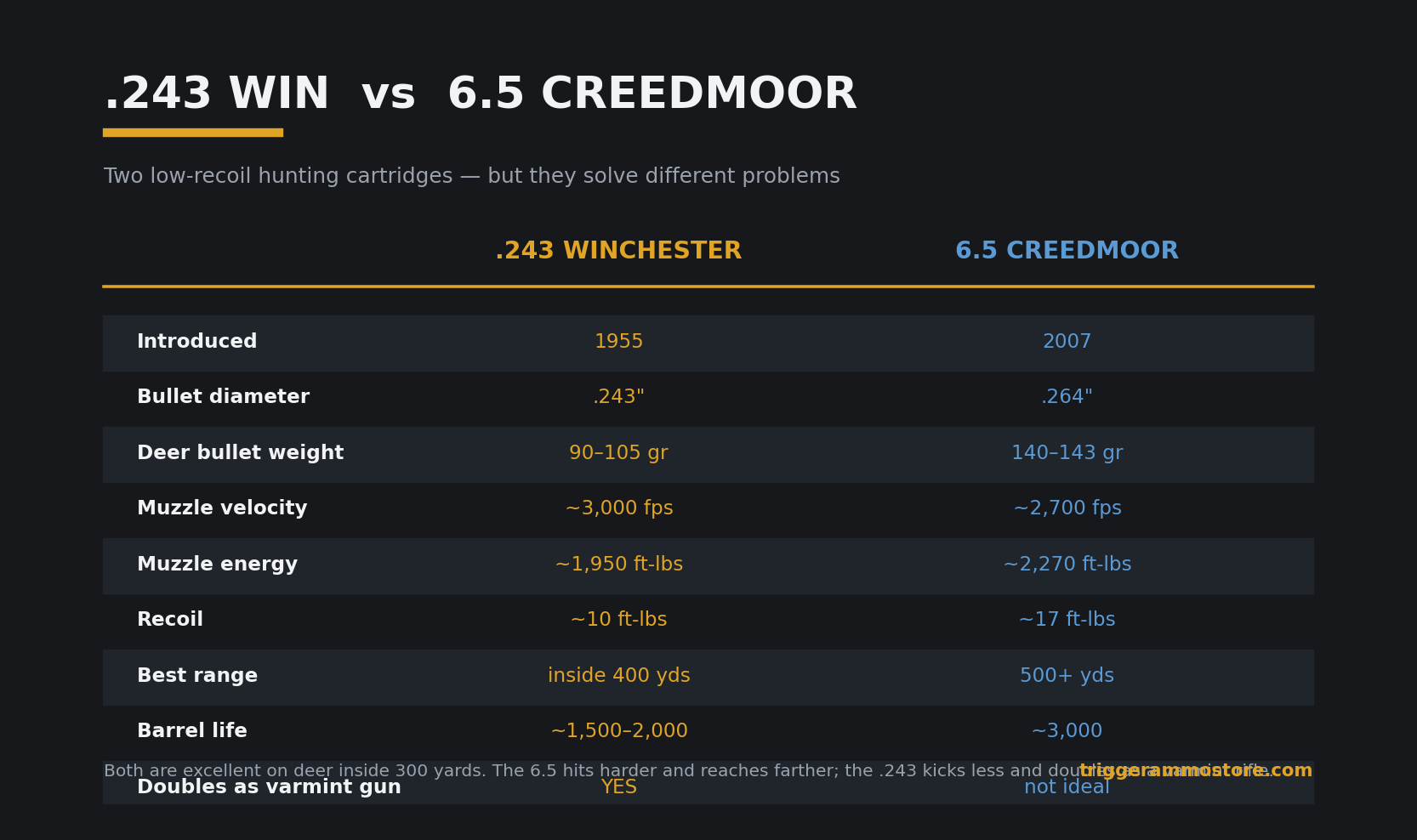
Velocity and trajectory. The .243 is the faster of the two, pushing a 100-grain deer bullet around 3,000 fps versus roughly 2,700 fps for a 140-grain 6.5 Creedmoor. That speed buys it a slightly flatter path early — about 2 inches less drop at 200 yards. But here’s the surprise in the .243 vs 6.5 Creedmoor trajectory comparison: because the Creedmoor’s heavier bullet resists drag so well, the two end up with nearly identical trajectories out to 500 yards. Speed alone doesn’t win at distance.
Energy. This is where the 6.5 pulls away. It leaves the muzzle with roughly 2,270 ft-lbs against the .243’s ~1,950 — and the gap widens fast. By 300 yards the Creedmoor carries several hundred foot-pounds more, and by 500 yards it’s nearly 500 ft-lbs ahead. More retained energy means more reliable bullet expansion and more margin for error.
Wind. The 6.5 Creedmoor’s high-BC bullets drift noticeably less. If you hunt open country, that matters more than most hunters realize.
Recoil: The .243’s Trump Card
The .243 Winchester produces around 10 ft-lbs of recoil versus roughly 17 ft-lbs for the 6.5 Creedmoor. Both are mild by centerfire standards, but the .243 is genuinely gentle — which is exactly why it’s been the go-to first deer rifle for young and recoil-sensitive hunters for 70 years.
That said, don’t overstate it. The 6.5 Creedmoor is still a soft-shooting cartridge, and many experienced hunters find the difference small in a properly fitted rifle.
Terminal Performance on Deer
Both cartridges kill deer cleanly with good shot placement. But there’s a nuance in the .243 vs 6.5 Creedmoor question worth being honest about: the Creedmoor’s heavier bullet and larger frontal diameter make it more forgiving of an imperfect shot. The .243 is fully capable, but it rewards patience and precise shot placement.
Ironically, that’s an argument for putting a 6.5 Creedmoor in the hands of a nervous first-time hunter — the recoil is still manageable, and the extra margin helps.
The Barrel Life Surprise
Most buyers get this backwards. Despite being the smaller cartridge, the .243 Winchester burns barrels faster — roughly 1,500–2,000 rounds of accurate life versus about 3,000 for the 6.5 Creedmoor. The .243 drives a light bullet very fast, which is hard on the throat.
For a pure hunter, this is irrelevant (you’ll never shoot that much). For a high-volume shooter or varmint hunter, it’s a real cost.
Versatility: The .243 Strikes Back
Here’s the .243’s genuine advantage. With light 70–85 grain bullets, it’s an explosive, flat-shooting varmint and predator round — deadly on coyotes, groundhogs, and prairie dogs. Swap to 90–105 grain bullets and it’s a proven deer cartridge.
The 6.5 Creedmoor can take predators, but it isn’t the ideal varmint gun. If you want one rifle that genuinely does both jobs, the .243 has no equal.
SAAMI cartridge specifications → https://saami.org
Ammo Cost and Availability
Both are widely stocked. The .243 is generally a bit cheaper per round; 6.5 Creedmoor ammo costs slightly more but comes in a broader selection of premium long-range and big-game loads.
Which Should You Buy?
Get the .243 Winchester if you:
- Want the mildest recoil available in a deer cartridge
- Hunt deer primarily inside 300 yards
- Also hunt varmints and predators
- Are buying a first rifle for a youth or smaller-framed hunter
Get the 6.5 Creedmoor if you:
- Might shoot past 300 yards or in open, windy country
- Want more energy and a more forgiving hit on game
- May hunt larger game (mule deer, black bear, elk with the right bullet)
- Want a rifle that doubles as a long-range target gun
The verdict: inside 300 yards on deer, the .243 vs 6.5 Creedmoor difference is smaller than the internet suggests — both work, and shot placement matters far more than the cartridge. Past 300 yards, or on anything bigger than a whitetail, the 6.5 Creedmoor is the better tool.
Shop .243 and 6.5 Creedmoor Ammo
Whichever you choose, feed it right — expanding bullets for game, never FMJ. Browse our selection of .243 Winchester ammo and 6.5 Creedmoor ammo, including bonded and polymer-tip hunting loads built for clean, ethical harvests.
Please buy and use ammunition responsibly and in accordance with all federal, state and local laws, including hunting and minimum-caliber regulations in your area. You must meet all legal requirements to purchase, and ammunition cannot be shipped to every jurisdiction — check your local regulations before ordering.
Frequently Asked Questions
Is 6.5 Creedmoor better than .243 for deer? Both work well. The 6.5 Creedmoor carries more energy and is more forgiving of imperfect shots; the .243 recoils less and shoots slightly flatter up close. Past 300 yards, the 6.5 has the edge.
Which has less recoil, .243 or 6.5 Creedmoor? The .243 Winchester — about 10 ft-lbs versus roughly 17 for the 6.5 Creedmoor. Both are mild, but the .243 is notably gentler.
Can you hunt elk with a .243? It’s legal in some places but on the light side. The 6.5 Creedmoor with a premium bonded bullet is a better choice, and a .308 or larger is better still.
Which is the better youth deer rifle? Traditionally the .243, for its light recoil. But many hunters now favor the 6.5 Creedmoor for a first rifle because its heavier bullet is more forgiving, and recoil is still very manageable.
