.22 LR ammo is the most popular ammunition on the planet — billions of rounds a year — and almost every shooter alive fired their first shot with it. It’s cheap, it barely recoils, it’s quiet, and it’s endlessly fun.
But there’s more going on than “the little plinking round.” This guide explains what .22 LR ammo actually is, the four types you’ll see on the shelf, why it’s so cheap, and exactly which box to buy for what you’re doing.
.22 LR ammo specifications and uses explained
What Is .22 LR?
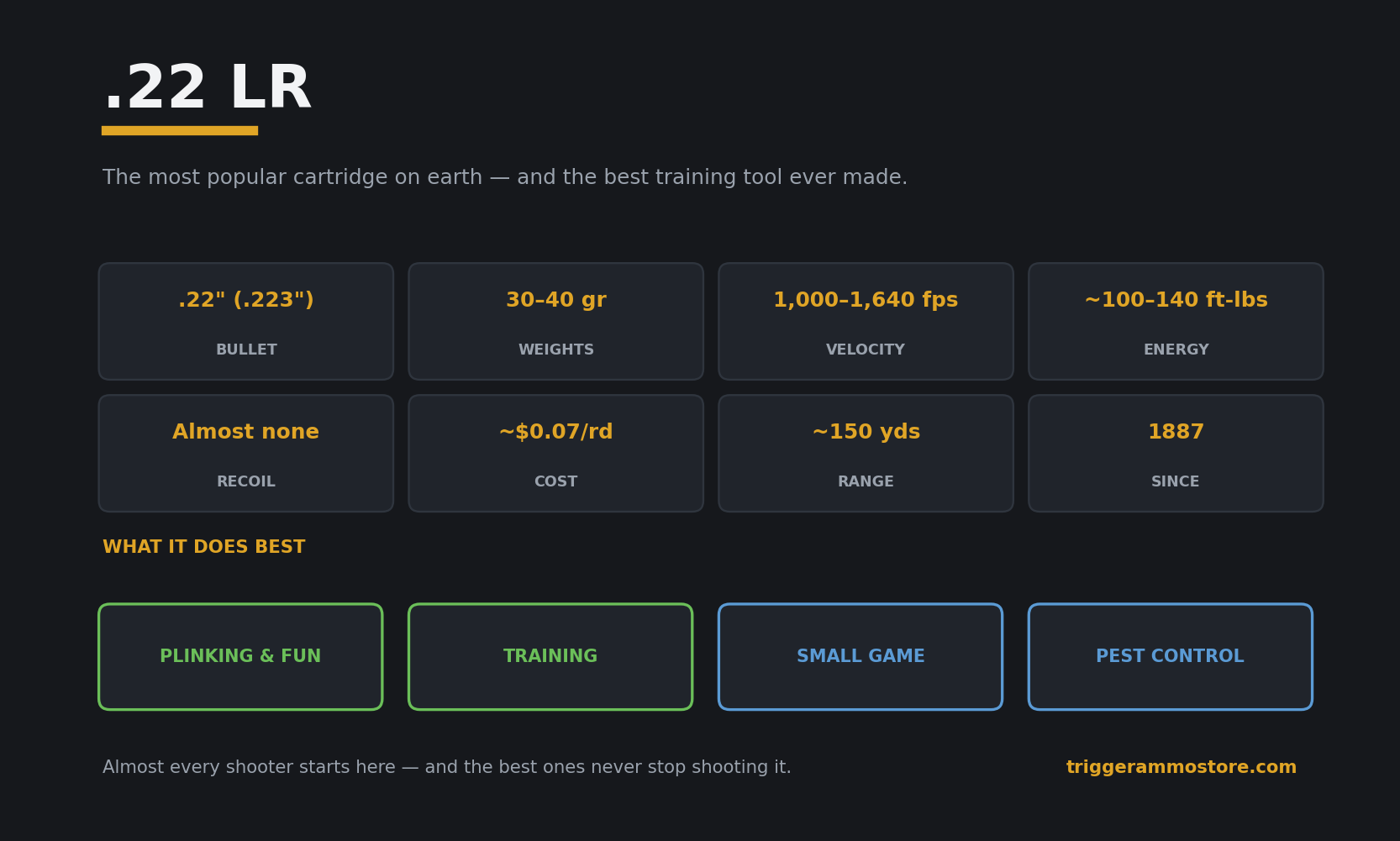
.22 LR stands for .22 Long Rifle — a rimfire cartridge introduced in 1887. It fires a small .22-caliber bullet (typically 30–40 grains) at anywhere from 1,000 to 1,640 fps.
The word “rimfire” is the key to understanding it. Unlike centerfire ammunition — where a separate primer sits in the middle of the case head — .22 LR ammo has its priming compound spun into the rim of the case. The firing pin crushes the rim to fire it. That design is cheap to manufacture, which is a big part of the story.
Spec
Value
Bullet diameter
.22″ (.223″)
Common weights
30–40 grain
Muzzle velocity
1,000–1,640 fps
Muzzle energy
~100–140 ft-lbs
Effective range
~150 yards
Recoil
Almost none
Cost
~$0.07 per round
The .22 Rimfire Family
You’ll see several “.22” cartridges on the shelf. They are NOT interchangeable in the way people assume, so know the family:
.22 Short — the oldest (1857), shortest, mildest
.22 Long — largely obsolete now
.22 Long Rifle (.22 LR) — the standard, and what this guide is about
.22 WMR (.22 Magnum) — a longer, far more powerful case. Does NOT fit a .22 LR chamber.
⚠️ A .22 LR rifle chambers .22 Short, .22 Long and .22 LR. It will NOT safely fire .22 WMR. Match your ammo to your barrel stamp.
The 4 Types of .22 LR Ammo
Types of .22 LR ammo by velocity: subsonic, standard, high and hyper
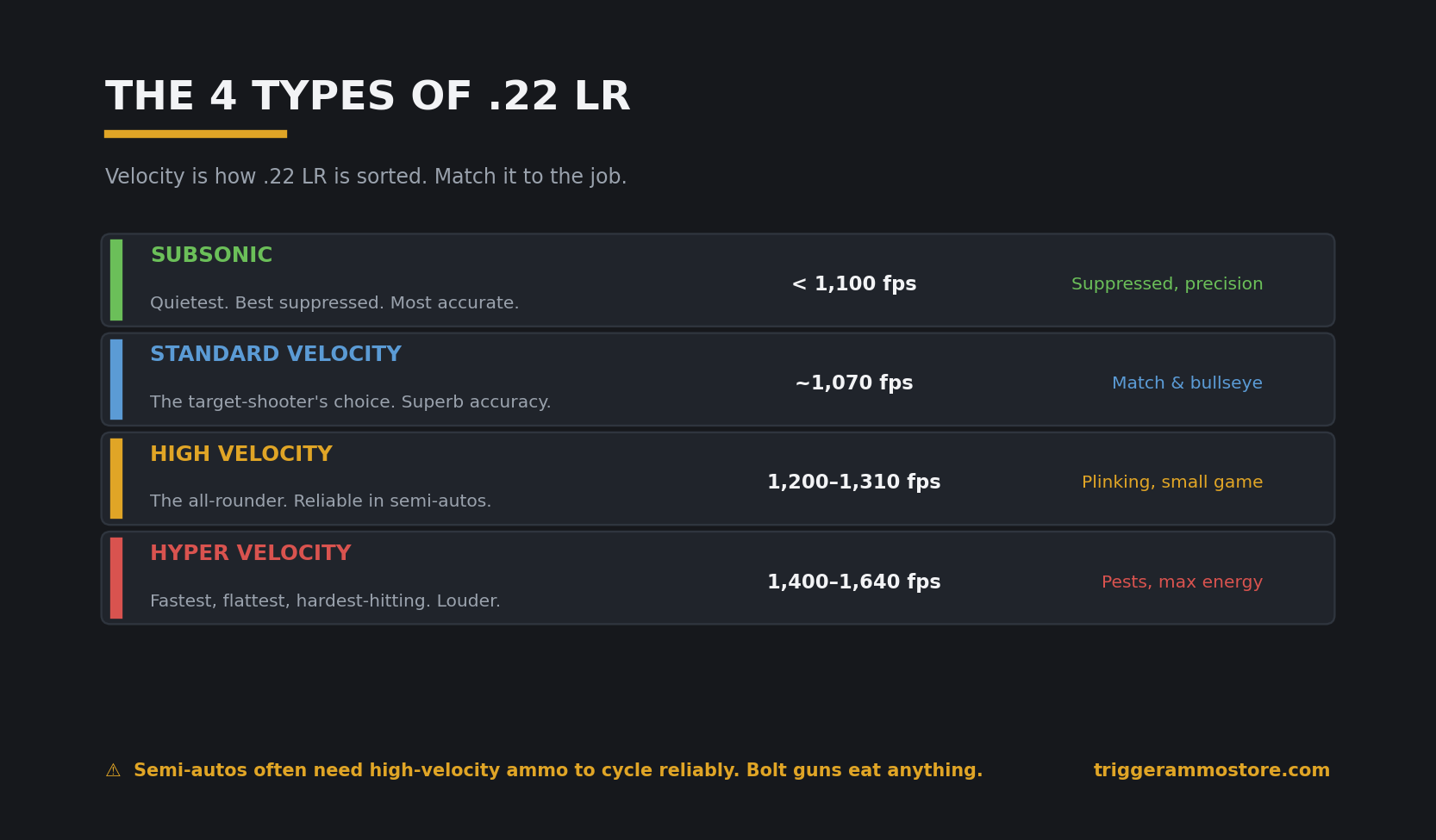
Nearly all .22 LR ammo is sorted by velocity — and that single number tells you what it’s for.
Subsonic (under ~1,100 fps). Stays below the sound barrier, so there’s no supersonic “crack.” Combined with a suppressor it’s remarkably quiet, and it’s often the most accurate. Best for suppressed shooting and precision.
Standard velocity (~1,070 fps). The target shooter’s choice. Consistent and superbly accurate — this is what wins bullseye matches. (Technically it hovers right at the sound barrier.)
High velocity (1,200–1,310 fps). The all-rounder and the most common. Reliable in semi-autos, good for plinking and small game. If you’re unsure, buy this.
Hyper velocity (1,400–1,640 fps). The fastest, flattest-shooting, hardest-hitting .22 LR ammo — loads like CCI Stinger. Best for pest control and maximum energy, at the cost of more noise and sometimes less accuracy.
⚠️ Semi-auto note: many semi-auto .22 pistols and rifles need high-velocity ammo to cycle reliably. Subsonic and standard loads may not have the energy to work the action. Bolt-actions and revolvers eat anything.
Why Is .22 LR Ammo So Cheap?
Three reasons: the rimfire design is cheap to make, it uses a tiny amount of material (small bullet, small case, little powder), and it’s produced in astronomical volume — which crushes the per-round cost.
At roughly 7 cents a round, a 500-round brick of .22 LR ammo costs less than a single 20-round box of premium rifle ammo. Nothing else even comes close.
What Is .22 LR Ammo Actually Good For?
Plinking and fun. The reason most people own a .22. Cheap, low-recoil, quiet enough to be pleasant, and endlessly entertaining.
Training — the underrated superpower. This is where .22 LR ammo earns its keep. Every fundamental — grip, sight picture, trigger control, breathing, follow-through — transfers directly to centerfire. With almost no recoil, you physically cannot develop a flinch. Serious shooters use a .22 (or a .22 conversion kit) to shoot 3–4× more for the same money. It will make you a better shooter than any gear upgrade.
Small game and pest control. A proven squirrel, rabbit, and vermin round for over a century. Precise, low-noise, and it doesn’t destroy meat. Match the load to the job — standard for accuracy, hyper-velocity for a bit more reach and energy.
New shooters and kids. This is where .22 LR ammo shines as a teaching tool. Its gentle recoil and low noise make it the ideal first cartridge. Nothing teaches fundamentals better without building bad habits.
Is .22 LR Good for Self-Defense?
An honest answer, because people ask.
.22 LR is not an ideal self-defense round. It’s low-powered, and rimfire ammo has a higher failure-to-fire rate than centerfire — which is a serious concern when it counts.
But — a .22 you can shoot accurately beats a magnum you can’t control, and for someone who physically cannot handle a larger caliber (arthritis, hand strength, severe recoil sensitivity), a .22 with reliable ammo is far better than nothing. If it’s genuinely your only option, choose a proven high-quality load and test it exhaustively.
For most people, though, a 9mm or .38 Special is the better defensive choice. The .22’s home is plinking, training, and small game.
Which .22 LR Ammo Should You Buy?
Purpose
Buy
Plinking / general use
High-velocity — bulk bricks or buckets
Semi-auto reliability
High-velocity (it cycles actions)
Target / precision
Standard-velocity match
Suppressed shooting
Subsonic
Small game / pests
High or hyper-velocity hollow points
Cheap high-volume practice
Bulk high-velocity
When buying .22 LR ammo, stick to trusted names: CCI, Federal, Winchester, Aguila, SK, Eley (match). Buy in bulk — bricks of 500 or buckets of 1,400+ — because the per-round savings are real and, stored properly, it lasts for decades.
⚠️ Storage note: rimfire is the most fragile ammo you own. Because the priming compound sits in the rim rather than a sealed primer, .22 LR ammo is more vulnerable to moisture than centerfire. Store it cool, dry, and sealed — and give your rimfire the best conditions you have.
Shop .22 LR Ammo
Stock up and go shoot. Browse our full range of .22 LR ammo — high-velocity bulk bricks for plinking and practice, match-grade standard-velocity for precision, and subsonic loads for suppressed shooting.
Want more reach? Compare it with .17 HMR ammo in our rimfire guides.
Please buy and use ammunition responsibly and in accordance with all federal, state and local laws. .22 LR and .22 WMR (.22 Magnum) are NOT interchangeable — confirm your firearm’s chambering before buying. You must meet all legal requirements to purchase, and ammunition cannot be shipped to every jurisdiction.
Frequently Asked Questions
What is .22 LR ammo used for? Plinking, training, small-game hunting, pest control, and teaching new shooters. It’s the most popular cartridge in the world thanks to its low cost, low recoil, and versatility.
What’s the difference between .22 LR velocity types? Subsonic (quietest, best suppressed), standard (most accurate, for targets), high-velocity (the reliable all-rounder), and hyper-velocity (fastest and hardest-hitting, for pests).
Why is .22 LR ammo so cheap? The rimfire design is inexpensive to manufacture, it uses very little material, and it’s produced in enormous volume — around 7 cents per round in bulk.
Is .22 LR ammo good for self-defense? It’s not ideal — low power and a higher misfire rate than centerfire. A 9mm or .38 Special is a better choice for most people, though a reliable .22 beats nothing for someone who can’t handle recoil.
Can I shoot .22 Short in a .22 LR rifle? Yes — .22 Short and .22 Long both chamber in a .22 LR firearm. But .22 WMR (.22 Magnum) does not — it’s a different, larger cartridge.
What’s the effective range of .22 LR? Realistically about 150 yards, though it’s most accurate and effective well inside that. It’s a close-range cartridge.
Does .22 LR need special storage? Yes — it’s more moisture-sensitive than centerfire because the primer sits in the rim. Store it cool, dry, and sealed.