
.308 vs 6.5 Creedmoor: The Best Proven Choice for Your Rifle
The .308 vs 6.5 Creedmoor debate is the most argued matchup in modern precision shooting — and for good reason. Both are short-action cartridges, both are deadly accurate, and both will happily reach past 1,000 yards in the right rifle. But they get there in very different ways. This guide breaks down trajectory, wind, energy, recoil, cost and barrel life so you can pick the round that actually fits how you shoot.
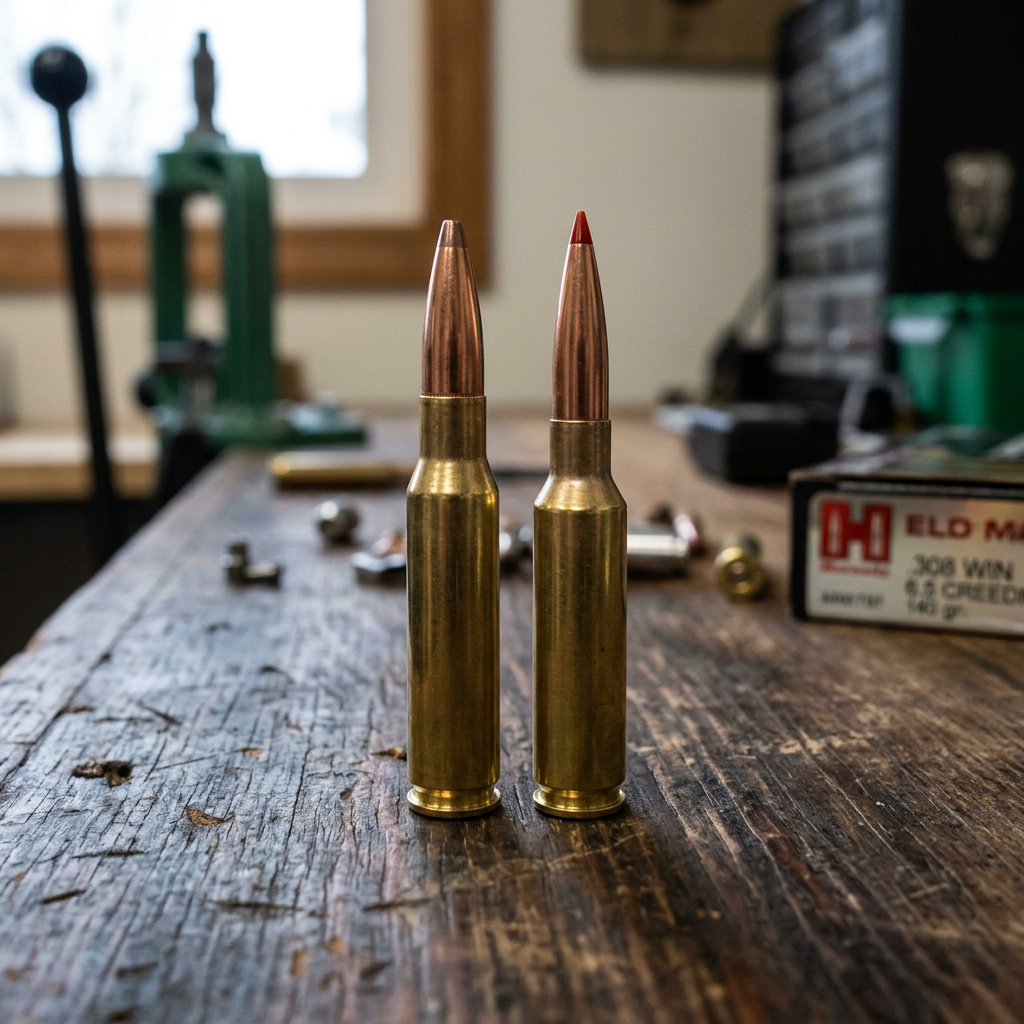
.308 vs 6.5 Creedmoor at a Glance
| .308 Winchester | 6.5 Creedmoor | |
|---|---|---|
| Introduced | 1952 | 2007 |
| Bullet diameter | .308″ | .264″ |
| Typical bullet weight | 150–178 gr | 120–147 gr |
| Muzzle energy | ~2,600 ft-lbs | ~2,300 ft-lbs |
| Trajectory | More drop | Flatter |
| Wind drift | More | ~30% less |
| Recoil | ~19 ft-lbs | ~13 ft-lbs |
| Barrel life | 4,000–5,000 | 2,500–3,000 |
| Cost | Cheaper | Slightly higher |
| Best at | Inside 500 yds, big game | Long range, wind, precision |
A Quick History
.308 Winchester. Launched in 1952 as the commercial sibling of the 7.62x51mm NATO round. Seventy years later it’s one of the most popular short-action cartridges on earth — and that head start is why it still has the widest selection of bullets, rifles, and budget loads of any precision cartridge.
6.5 Creedmoor. Arrived in 2007 from Hornady, designed as a long-range target round that would fit a short action. It pairs a narrow, aerodynamic .264″ bullet with an efficient case. The result is a high ballistic coefficient — a bullet that slices through air and resists wind far better than its size suggests.
Ballistics
Trajectory and Bullet Drop
Out to about 300 yards, the two are close enough that most shooters won’t notice. Past that, the 6.5 Creedmoor’s higher-BC bullets pull ahead. It drops roughly 10 inches less at 500 yards, and that gap widens to well over five feet by 1,000 yards. Less drop means simpler holdovers and more forgiving range estimation.
Wind Drift
This is the hardest .308 vs 6.5 Creedmoor advantage to argue with. In a 10 mph crosswind at 500 yards, the 6.5 Creedmoor drifts around 6 inches less — roughly a 30% improvement. Since misreading wind is the number-one cause of missed long-range shots, that edge translates directly into hits.
Energy
The .308 flips the script up close. Its heavier bullets leave the muzzle with more energy, and inside roughly 400 yards it hits harder — which matters for big game. But the 6.5 Creedmoor sheds velocity so slowly that it eventually catches and passes the .308 downrange. By 1,000 yards, the 6.5 carries more energy on target.
In short: .308 hits harder near, 6.5 Creedmoor hits harder far.
Recoil and Shootability
The 6.5 Creedmoor generates around 13 ft-lbs of recoil versus roughly 19 for a comparable .308 — close to 30% less. That isn’t just comfort. Less recoil means less flinch, faster follow-ups, and the ability to spot your own impacts through the scope. For newer shooters and long sessions, it’s a real performance advantage.
Barrel Life and Cost
Here the .308 wins clearly. Its modest pressure is gentle on barrels — many shooters see excellent accuracy for 4,000–5,000 rounds. The 6.5 Creedmoor’s efficiency costs it: throat erosion sets in sooner, often around 2,500–3,000 rounds.
Cost follows the same pattern. As the older, NATO-derived cartridge, .308 is generally cheaper per round with a wider range of loads. The 6.5 has closed the gap, but the .308 is still friendlier for high-volume practice.
Ballistics figures here are consistent with published SAAMI cartridge specifications and manufacturer data — run your own numbers with a ballistic calculator for your exact load.
Which Should You Choose?
Choose the 6.5 Creedmoor if you:
- Regularly shoot past 500 yards
- Shoot in open, windy country
- Want the lightest recoil for precision work
- Prioritize flat trajectory and easy holdovers
Choose the .308 Winchester if you:
- Mostly shoot and hunt inside 500 yards
- Want maximum bullet and rifle selection
- Shoot high volume and care about barrel life and cost
- Want a proven all-rounder for big game
The honest verdict: neither is “best” in a vacuum. The 6.5 Creedmoor wins long range and shootability; the .308 wins close-range power, cost, barrel life, and versatility. Define your purpose first and the answer becomes obvious.
Stock Up
Whichever way you lean, we carry both. Browse our full range of .308 Winchester ammo and 6.5 Creedmoor ammo — from budget range loads to match-grade precision rounds.
Please buy and use ammunition responsibly and in accordance with all federal, state and local laws. You must meet all legal requirements to purchase, and ammunition cannot be shipped to every jurisdiction — check your local regulations before ordering.
FAQ
Is the 6.5 Creedmoor more accurate than the .308? Both are capable of exceptional accuracy. The 6.5’s higher-BC bullets make it more forgiving at long range and in wind — but a quality .308 rifle and load shoots extremely well too.
Which hits harder, .308 or 6.5 Creedmoor? The .308 carries more energy close-to-mid range. The 6.5 Creedmoor retains energy better and surpasses it at long distance.
Is the 6.5 Creedmoor good for hunting? Yes — excellent for deer-sized game and widely used on larger game at sensible ranges. The .308 offers a small edge in close-range power and more heavy hunting bullets.
Can I shoot both in the same rifle? No — different chamberings. Many short-action and AR-10 rifles are offered in either, but each barrel is dedicated to one.
