
6mm Creedmoor vs 6.5 Creedmoor: The Best Proven Pick for Competition
The 6mm Creedmoor vs 6.5 Creedmoor debate dominates precision rifle forums, and top PRS shooters have mostly picked a side. But the reason they chose the 6mm isn’t the one most people repeat — and there’s a practical catch that decides this for the majority of shooters before ballistics ever enter the conversation.
They’re the Same Cartridge (Almost)
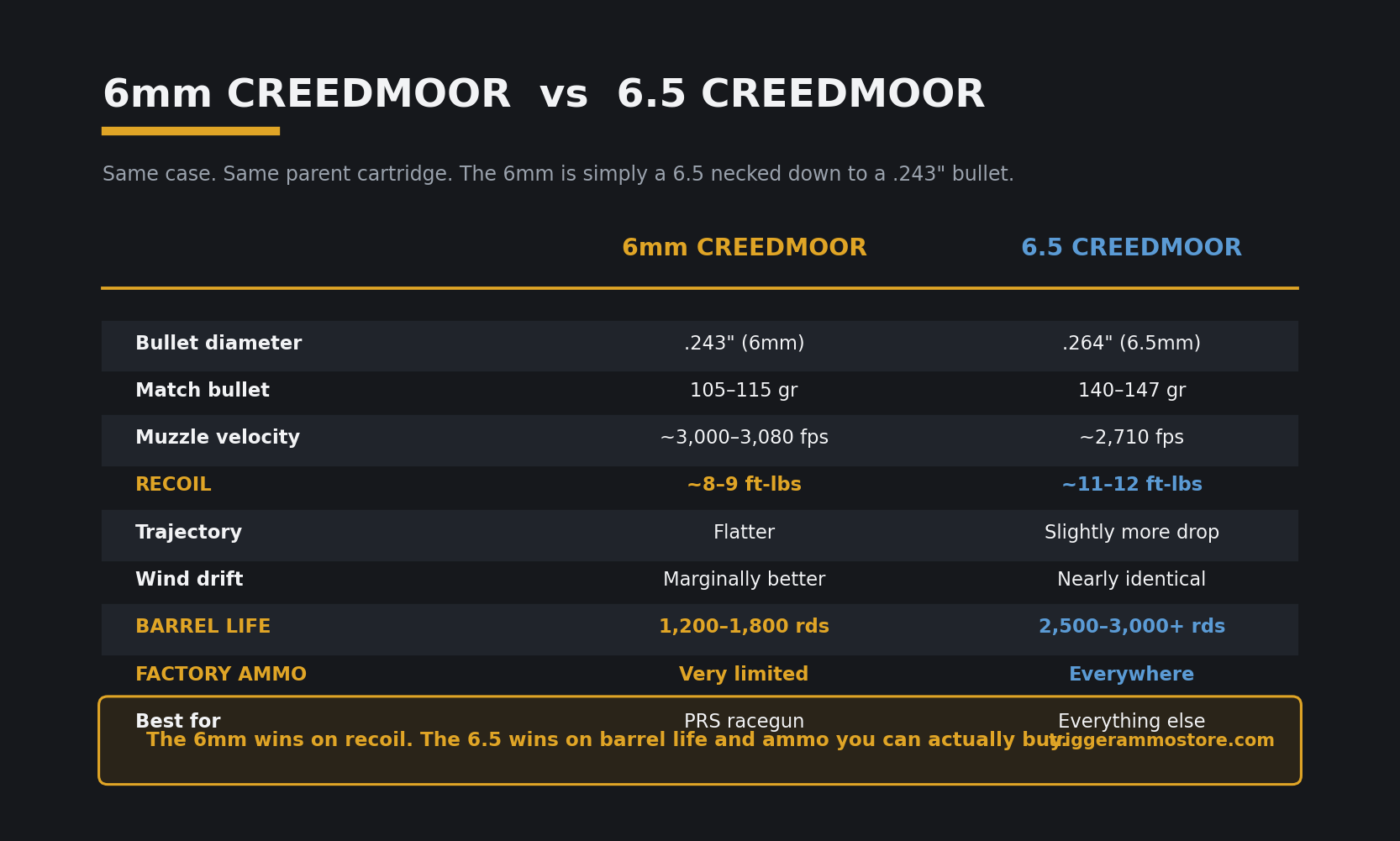
Start here, because it clears up most of the confusion. The 6mm Creedmoor is literally a 6.5 Creedmoor case necked down to accept a smaller .243-inch (6mm) bullet instead of a .264-inch (6.5mm) one. Same case body, same 1.920″ length, same short action, same magazines.
Push a lighter bullet with a similar powder charge and you get: more velocity, flatter trajectory, less recoil. That’s the whole 6mm proposition.
But that “overbore” design — a large powder charge forced through a small bore — acts like a blowtorch on your barrel throat.
Ballistics: Less Impressive Than the Hype
Velocity and trajectory. The 6mm Creedmoor pushes a 105–115 grain match bullet around 3,000–3,080 fps versus roughly 2,710 fps for a 140-grain 6.5. It shoots flatter — noticeably so at distance.
Wind drift — read this carefully. This is where the internet oversells the 6mm. When you compare equivalent high-BC bullets, the wind drift difference between the two is small — competitive shooters who run both report it’s often nearly identical. You still have to call the wind either way.
So why do top PRS shooters run 6mm? Not for wind. For recoil.
Recoil: The Real Reason
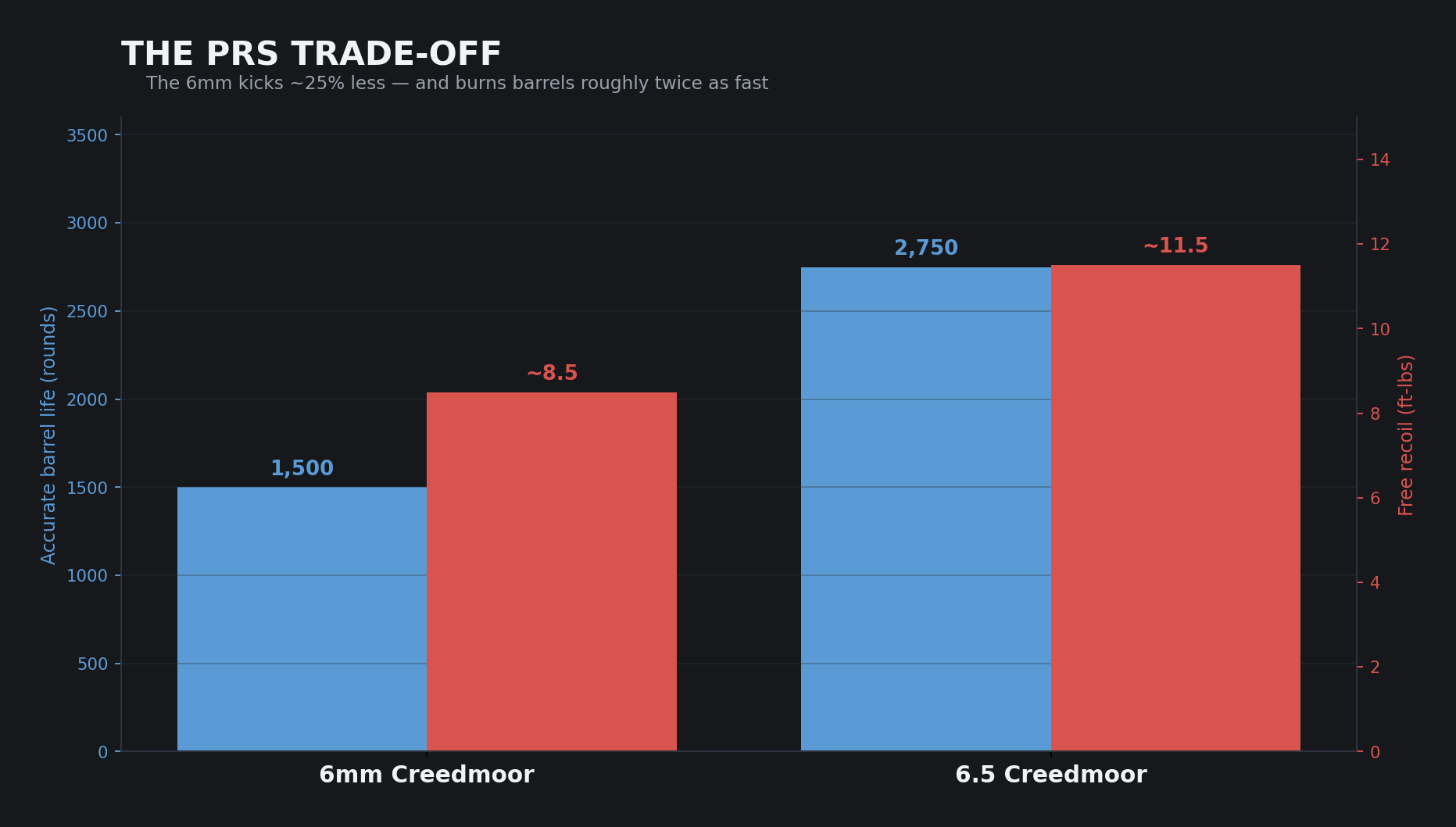
In a 14-pound PRS rifle, the 6.5 Creedmoor generates around 11–12 ft-lbs of free recoil. The 6mm sits at roughly 8–9 ft-lbs.
In a heavy competition rifle with a muzzle brake, a 6mm Creedmoor barely moves. That lets the shooter stay in the scope and watch their own bullet trace and impact — hit or miss. Miss, and you make an immediate wind correction and send the next round without a spotter.
Across a 14-stage match day, that’s the entire game. It’s why the 6mm took over the top of the sport.
The Cost: Barrel Life
Here’s the bill. That overbore design torches throats:
- 6mm Creedmoor: roughly 1,200–1,800 rounds of match-grade accuracy.
- 6.5 Creedmoor: roughly 2,500–3,000+ rounds.
If you shoot PRS seriously, you can burn out a 6mm Creedmoor barrel in a single season. Budget for a re-barrel as a running cost, not a surprise.
⚠️ The Factory Ammo Problem (This Decides It for Most People)
Here’s the practical catch, and it settles the 6mm Creedmoor vs 6.5 Creedmoor question for the majority of shooters.
Factory 6mm Creedmoor ammo is scarce. Hornady makes a 108 ELD-M match load and a few boutique makers offer competition ammo — but consistently finding it on a shelf is another matter. Running a full competition season on factory 6mm ammo isn’t practical.
Almost every serious 6mm Creedmoor shooter reloads.
So the honest rule:
- If you don’t reload (and don’t plan to start immediately) → buy the 6.5 Creedmoor. You can compete regionally on factory match ammo and develop your skills first.
- If you reload → the 6mm becomes a real option.
What About Hunting?
Stick with the 6.5 Creedmoor. There are only a handful of hunting-specific factory loads for 6mm Creedmoor — nearly all 6mm CM ammo is built for competition. If you want a mild-recoiling 6mm hunting rifle, the .243 Winchester is the safer bet: similar performance at hunting ranges, with far more factory loads and rifles available.
The Alternatives Top Shooters Moved To
Worth knowing: because the 6mm Creedmoor burns barrels so fast, many elite PRS competitors have shifted to the 6mm Dasher and 6mm GT. These deliver nearly identical wind-cheating ballistics while burning less powder — pushing barrel life past 2,500 rounds.
If you’re building a dedicated racegun and reloading anyway, they’re worth a look.
Which Should You Choose?
Choose the 6.5 Creedmoor if you:
- Don’t reload (this alone decides it)
- Want factory match ammo that’s actually available and affordable
- Value barrel life — roughly double the 6mm’s
- Also hunt
- Are still developing your skills (recoil isn’t your limiting factor yet)
Choose the 6mm Creedmoor if you:
- Compete in PRS seriously and want every recoil advantage
- Reload — this is close to mandatory
- Accept re-barreling as a routine cost
- Want to spot your own impacts unassisted
The Honest Verdict
For 90% of shooters, the 6.5 Creedmoor is the right call in the 6mm Creedmoor vs 6.5 Creedmoor matchup. The 6mm’s advantage is real but narrow — it matters most to shooters already good enough that recoil management is their limiting factor. If that isn’t you yet, the 6mm buys you a shorter barrel life and an ammo supply problem in exchange for an edge you can’t yet use.
Get good with the 6.5 first. The cartridge is not what’s holding you back.
Shop Creedmoor Ammo
Browse our full range of 6.5 Creedmoor ammo — abundant match-grade and hunting loads — and 6mm Creedmoor ammo for competition shooters.
Please buy and use ammunition responsibly and in accordance with all federal, state and local laws. 6mm Creedmoor and 6.5 Creedmoor are NOT interchangeable — confirm your rifle’s chambering before ordering. You must meet all legal requirements to purchase, and ammunition cannot be shipped to every jurisdiction.
FAQ
Is 6mm Creedmoor better than 6.5 Creedmoor? For serious PRS competition, the 6mm’s lower recoil helps you spot your own impacts. For everyone else, the 6.5 Creedmoor is better — longer barrel life, far more factory ammo, and it hunts.
What’s the barrel life of a 6mm Creedmoor? Roughly 1,200–1,800 rounds of match accuracy, versus 2,500–3,000+ for the 6.5 Creedmoor. Competitive shooters may burn one out in a single season.
Can you buy factory 6mm Creedmoor ammo? Some — Hornady’s 108 ELD-M and a few boutique loads — but availability is limited. Most serious 6mm Creedmoor shooters reload.
Does the 6mm really buck wind better? Less than you’d think. With comparable high-BC bullets the difference is small. Its genuine advantage is lower recoil, not wind.
Are they interchangeable? No. The 6mm Creedmoor is a necked-down 6.5 Creedmoor and fires a different bullet diameter. Different chambers, different ammo.
Is 6mm Creedmoor good for hunting? It can work on deer-sized game, but hunting loads are scarce. The .243 Winchester or 6.5 Creedmoor are better hunting choices.
For public land hunting information and outdoor recreation resources, visit the
Bureau of Land Management
.
For firearm safety resources, shooting sports education, and industry information, visit the
National Shooting Sports Foundation (NSSF)
.
For hunting regulations, wildlife conservation, and federal hunting information, see the
U.S. Fish & Wildlife Service
.

1 Comment
Bestonlineammostore
best content so far. keep it up