
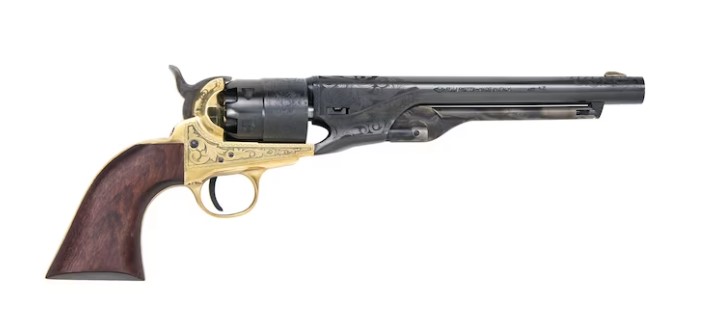
Description
Traditions 1860 Army Black Powder Revolver — .44 Caliber, 8″ Barrel
The Traditions 1860 Army is a percussion revolver based on the Colt 1860 Army.
The 1860 replaced the 1851 Navy as the standard Union sidearm and remained in service through the Indian Wars and early frontier period.
It ships to your door. No FFL required — see the ordering section.
What Made the 1860 Army the Standard
Colt introduced the 1860 to address two complaints about the 1851: the octagonal barrel was slow to produce, and the .36 calibre was considered marginal for cavalry use.
The 1860 answered both. A round barrel was faster to make under wartime demand. And .44 calibre — with 0.454″ balls — put down horses and men with more authority at the ranges cavalry actually fought.
By 1865, Union quartermasters had issued well over 100,000 of them. The design then followed the frontier west, worn by soldiers, marshals and civilians until cartridge revolvers made it obsolete.
Traditions 1860 Army Specifications
- Calibre: .44 (black powder)
- Suggested ball diameter: 0.454 inches
- Capacity: 6 shots
- Barrel: 8 inches, round, blued
- Frame: Brass, engraved
- Frame finish: Brass
- Overall length: 13.75 inches
- Weight: 2.65 lbs
- Sights: Hammer/blade
- Grip: Walnut
- Trigger: Single action
- Ignition: Percussion
The Brass Frame and Engraving — What It Means for Use
The Traditions 1860 Army uses a brass frame rather than steel. This is historically accurate — Colt did produce some brass-framed variants — but it carries a practical note that every buyer should understand.
Brass is softer than steel. Repeated heavy charges will stretch the frame over time and open the barrel-to-cylinder gap, affecting accuracy and potentially causing safety issues.
Shoot moderate, period-appropriate charges and this revolver will give years of service. Push it hard and you shorten its life considerably.
The engraving on the frame is decorative. It does not affect function but does make this a more attractive display piece than a plain frame version.
What You Need to Shoot It
The Traditions 1860 Army does not arrive ready to fire.
You need loose black powder or an approved substitute, 0.454″ round balls, percussion caps sized to the nipples, and lubricant or pre-lubricated wads.
A capper, a nipple wrench and a nipple pick are worth buying before range day.
Browse our black powder supplies for consumables. Never use smokeless powder in a black powder arm. Observe the charge range Traditions specifies for this revolver.
Cleaning After Every Session
Black powder fouling is corrosive. It attacks steel the same day it is deposited.
Clean with hot soapy water the day you shoot — remove the cylinder, clean every chamber and nipple, dry all parts completely, then oil before storage.
Do not leave it overnight uncleaned. This is non-negotiable on any cap-and-ball arm, and the Traditions 1860 Army is no exception.
Where It Sits in the Cap-and-Ball Range
The Traditions 1860 Army is one of two .44 calibre revolvers in the range. The other is the Pietta 1851 Navy .44 — slightly shorter barrel, case-hardened steel frame, cream grips, $10 less.
The three .36 calibre options are the Pietta Spiller and Burr, the Pietta 1858 Remington Navy (which accepts Howell conversion cylinders), and the Traditions US Marshall.
Browse the full black powder revolvers range.
Ordering
Percussion muzzleloading revolvers are generally not classified as firearms under the Gun Control Act. Federal law typically permits direct shipment to the buyer.
State and local rules vary. Confirm legality at your delivery address before ordering. Buyers must be of legal age in their jurisdiction.
Antique and reproduction black powder classifications are administered by the ATF. Competition calendars are published by the NMLRA and the N-SSA.
Review our terms and conditions before ordering, or contact us with questions about your state. Black powder and percussion caps ship separately under applicable hazmat rules.
SHORT DESCRIPTION (above Add to Cart)
Traditions reproduction of the Colt 1860 Army, the primary Union cavalry revolver of the Civil War. .44 calibre percussion, 8″ blued round barrel, engraved brass frame, walnut grips, 6-shot cylinder, hammer/blade sights. 13.75″ overall, 2.65 lbs. Brass frame: moderate charges only. Takes 0.454″ balls. Ships direct, no FFL required. Powder, balls and caps sold separately.
💬 Before You Go — Running It at Events or on the Range?
Own a 1860 Army? Leave a review — tell us whether you’re using it for reenacting, range work, or display, because that’s the question the next buyer is quietly asking when they compare this to a plain-frame version. And if you came looking for a revolver we don’t stock, tell us which one. ⚔️
Please purchase and use black powder arms responsibly and in accordance with all federal, state and local laws. Percussion muzzleloading revolvers are generally not classified as firearms under the Gun Control Act, and federal law typically permits direct shipment to the buyer — however state and local restrictions on black powder arms vary, and it is the buyer’s responsibility to verify legality at the delivery address prior to purchase. Buyers must meet the minimum legal age in their jurisdiction. Never use smokeless powder in a black powder arm. Observe the manufacturer’s specified charge range. Black powder and percussion caps ship separately under applicable hazmat regulations. Not for sale to persons prohibited from possessing firearms.
Frequently Asked Questions
Do I need an FFL to buy this? Generally no. Percussion muzzleloading revolvers aren’t classified as firearms under the Gun Control Act, so federal law usually permits shipment directly to you. State rules vary — check yours.
What does “engraved brass frame” mean in practice? Decorative scroll engraving on the brass frame — purely visual, no effect on function. It makes the revolver more attractive as a display piece and gives it a period-correct ornate look.
Are the grips really walnut? Yes — two-piece walnut, confirmed in the spec table. This is a genuine wood grip, not polymer.
What ball diameter does it take? 0.454 inches — the standard .44 cap-and-ball diameter, same as the Pietta 1851 Navy .44 in the range.
Does the brass frame limit what I can shoot? Yes. Brass is softer than steel; repeated heavy charges will stretch the frame over time. Moderate, period-appropriate loads only.
Why did the Union Army move from the 1851 to the 1860? Primarily calibre and production speed. The 1860’s round barrel was faster to produce under wartime demand, and .44 was considered a more effective cavalry cartridge than .36.
How do I clean it after shooting? Hot soapy water the same day — remove the cylinder and clean every chamber and nipple. Dry everything completely, then oil before storage. Black powder fouling is corrosive.
Is it a good reenacting revolver? Yes — the 1860 Army is the most historically documented Union cavalry sidearm of the Civil War and one of the most requested impressions.


Reviews
There are no reviews yet.